The Arizona workers’ compensation system is technically designed to allow you to make benefits claims without needing an attorney. But just like representing yourself in court against a criminal charge is possible but not necessarily advisable, there are times when having an experienced workers’ compensation attorney can improve your chances of a favorable outcome when filing a claim, negotiating with an insurance company, or appealing a claim denial.
The Matt Fendon Law Group has experienced Arizona workers’ compensation attorneys who can help you in all aspects of the workers’ comp process. If you need help with a workers’ compensation benefits claim, our expert Phoenix workers’ comp attorneys can answer your questions and help you file a claim.
Call us at (800) 229-3880 to arrange a free consultation with an experienced Phoenix workers’ compensation lawyer.
Do You Always Need a Lawyer in a Workers’ Comp Claim?
The short answer is “No.” Arizona workers’ compensation law is a no-fault system, which means that employees do not legally need the help of an Arizona workers’ compensation claims attorney to file a claim or appeal a denied claim.
Claimants have the right to represent themselves in a workers’ comp case. However, just because you can go it alone does not always mean you should.
When to Hire a Workers’ Compensation Lawyer
Generally, there are five categories of workers’ compensation cases where having a workers’ compensation lawyer can be a good idea for you. Review each case category to learn when to hire a workers’ compensation lawyer.
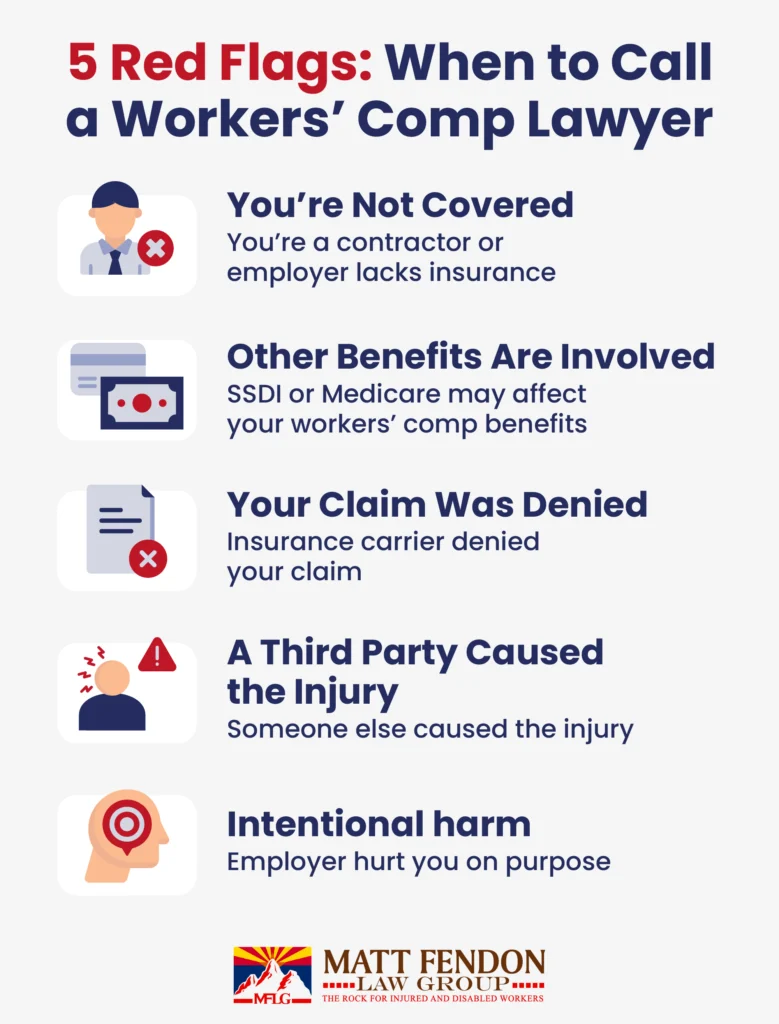
Category One: When You Do Not Have Access to Workers’ Compensation Benefits
This category includes situations in which Arizona workers’ compensation benefits are not available to you, and you need to find another way to recover for your work-related medical bills and other expenses.
This can happen if you are an independent contractor. Independent contractors are not covered as employees under Arizona workers’ compensation law.
This might also occur if your employer either does not carry workers’ compensation insurance or fails to maintain a policy with sufficient insurance coverage. If this is the case, you may be able to make a claim for workers’ compensation benefits with the claims division of the Industrial Commission of Arizona.
Category Two: When You Are Already Receiving Other Disability Benefits
Sometimes you can receive workers’ compensation benefits in combination with other benefits, like Social Security Disability Insurance (SSDI) or Medicare.
Workers’ compensation benefits differ when combined with other benefit sources.
For example, if you are already receiving SSDI benefits, receiving workers’ compensation benefits may reduce the amount of SSDI compensation you get. If you are on Medicare, you might need to make sure that a part of your workers’ comp benefits is set aside to pay for your future medical treatments.
A Phoenix workers’ compensation lawyer can help you understand how receiving multiple benefits from different sources may affect the benefits you can also receive from Arizona workers’ compensation.
Category Three: When the Insurance Carrier Denies Your Claim
An insurance company might deny your workers’ compensation benefits claim for several reasons. If it does, then having a legal team of Phoenix workers’ compensation attorneys to help you know your options or to help you with an appeal could be a sound choice.
Here are three of the most common areas where our Phoenix workers’ comp lawyers at Matt Fendon Law Group help clients resolve claim disputes with insurers.
Problems With Your Claim Application
Sometimes, an insurer’s reason for claim denial may be administrative or “technical” in nature. For example, the insurer could argue that you missed an important deadline in making your claim or that you did not complete your claim correctly.
Problems Evaluating the Strength and Nature of Your Claim
Another reason for a claim denial is if the insurer has doubts about whether your injury or medical condition is truly a work-related injury or as serious as you claim it to be.
For example, if you have a pre-existing medical condition that has worsened over the years, the insurance carrier could argue that it and not your employment was the real source of your current disability.
In a worst-case situation, the insurer might even conclude that your claim is fraudulent.
Problems Agreeing on the Permanency of Your Benefits
Depending on your circumstances, you can apply for different levels of workers’ compensation benefits in your work-related injury claim. These can include:
- Temporary partial disability benefits
- Permanent partial disability benefits
- Permanent total disability benefits
Your doctor or other treating healthcare professional will assess your level of disability. If the workers’ comp insurer disagrees with this assessment, it might challenge it and seek to establish a lower level of disability benefits.
This kind of disagreement can become a serious matter. For example, your treating physician might believe that you need a significant procedure like surgery, but the insurance provider counters that a less intrusive treatment is all that is needed.
Overcoming insurer objections to your application will require you to gather evidence to bolster your claim or rebut insurer objections to it. Sometimes, this can be as simple as knowing what questions to ask in an informal letter to the insurance carrier.
Other occasions can mean preparing for a confrontation with the insurer. This can require more complex methods of gathering evidence, including medical records, depositions, and expert witness opinions. It could also require follow-up procedures, such as an independent medical examination, culminating in a formal appeal hearing before an administrative law judge.
Category Four: When Someone Other Than Your Employer is Involved
Sometimes, third parties can play a role in causing your work-related accident or injury. Claims against such parties are not covered under workers’ compensation insurance, but that does not mean that you have no recourse against such people.
Who Can Be a Third Party in Workers’ Compensation Claims?
Anyone who contributed to the cause of your work injury in a way that is reasonably foreseeable is a potential third-party defendant in a civil court lawsuit. Frequent sources of potential third-party defendant claims are motor vehicle accidents involving another driver when you are driving on company business.
In other situations, identifying third parties who are possibly liable to you for an accident that happens to you on the job can require more investigation.
- This is true with claims based on product liability, in which everyone involved in the design, manufacture, or sale of a dangerously defective product, like work equipment, can be subject to strict liability if it harms you.
- If you are injured while acting as an employee due to unsafe conditions on a property, the property owners may also become third-party defendants.
- Independent contractors and subcontractors who are involved with the work you do and contribute to your work injury can also be held responsible as third-party defendants. Tracing contractual relationships is key to identifying potential third-party defendants against whom you have a claim.
- General contractors also have a duty to keep a safe work environment.
If you want to pursue a third-party workplace injury claim, then you must do so within one year of the injury’s occurrence. After that, you would need to ask the workers’ compensation insurer for a claim reassessment and file a lawsuit against the third party before the two-year statute of limitations runs out.
If you reach a negotiated settlement with the third-party defendant, then you will still need the written consent of the workers’ compensation insurance company. Otherwise, the benefits you receive from an original workers’ compensation claim may be lost.
Category Five: When Your Employer Harms You on Purpose
For Arizona employers, a major incentive to support workers’ compensation is that it takes the worry off their shoulders that they will face lawsuits every time an employee gets hurt on the job. The “rule of exclusivity” in workers’ compensation means that unless the employer acts intentionally to cause harm, workers’ compensation is the employee’s only remedy.
The rule of exclusivity usually works in an employee’s favor when they make a workers’ compensation claim. This rule holds that employees need not prove their employers’ fault, only that the injury or condition is related to their employment.
Still, in some cases, for whatever reason, your employer might intentionally do something on purpose to harm you at work. Even if your boss steps on your foot as he walks by and breaks some bones in it, if he did so carelessly, the rule of exclusivity still applies, even though he harmed you directly.
Arizona law also allows for a personal injury lawsuit against any employer for intentionally harmful acts if you have enough evidence for a legal case. The compensation you would seek in a personal injury action in court would be similar in some ways to what injured employees seek through workers’ compensation after a workplace accident.
For example, reimbursement for medical costs, ongoing physical therapy, lost wages, and property damage or loss.
Additional Claims Are Available in a Personal Injury Action Against the Employer
One difference between a civil lawsuit and a workers’ comp claim is that lawsuits can include claims against the defendant that you cannot receive through workers’ compensation. These include money damages for pain and suffering, emotional distress, and, in particularly serious cases, even exemplary or punitive damages.
Another aspect to consider in a personal injury lawsuit against an employer who intentionally caused harm is that, if the employee dies as a result, surviving family members or the deceased worker’s estate may still have legal claims. This is also true for legal claims against third parties for fatal workplace injuries.
When Should I Not Hire an Arizona Workers’ Compensation Attorney?
A simple rule for workers’ compensation claims is that the simpler they are, the less likely it is that your employer’s workers’ comp insurance carrier will challenge your claim. Factors the insurance provider will consider when it evaluates your claim include:
- How apparent it is that the injury is work-related. In clear-cut cases where there is no dispute about whether your claim is connected to your employment, an insurer is less likely to challenge the claim.
- How serious the claimed injury or medical condition is. Medical benefit claims that include significant, potentially costly medical expenses and disability benefits are more likely to receive close scrutiny from insurance carriers.
- How much time you will miss. The longer you are sidelined from employment, and the longer the duration of medical treatment and physical therapy your workplace injuries will require, the more likely the insurer will look for things to challenge your claim.
Arizona workers’ compensation claim insurers are like any other kind of insurance carrier. As soon as you file a claim, you become a potential liability on their balance sheet.
The more of a potential payout cost you become to the workers’ comp insurer, the more likely it is to look for ways to reduce its financial loss.
Talk to an Arizona Workers’ Compensation Lawyer Today
Although not all Arizona workers’ compensation claims require you to engage an attorney to help you, an experienced workers’ comp law firm can be exactly what you need during the trickier parts of the process.
At Matt Fendon Law Group, our highly skilled and compassionate workers’ compensation lawyers are ready to help you with all aspects of your workers’ compensation claim or help you take legal action against third parties who caused you harm at work.
We can help you:
- Understand what is happening. The process of obtaining workers’ compensation benefits can be stressful and complicated. It’s critical that you have an experienced Arizona workers’ comp lawyer on your side.
- Deal with your employer. Employers often try to intimidate or take advantage of injured workers. The attorneys at Matt Fendon Law Group will stand up for your rights.
- Negotiate with the insurance carrier. Insurance carriers are less likely to give you the run-around when you have a skilled and aggressive attorney in your corner.
- Receive the compensation you deserve. While you recover from your work injury, workers’ compensation benefits pay a portion of your lost wages, as well as your medical bills. Our attorneys will fight to get you the benefits you need and deserve.
- Represent you at the hearing. A hearing before an administrative law judge could be required. When that is the case, our attorneys will represent you and argue on your behalf.
- Handle your appeal. If your workers’ compensation claim is denied, our experienced workers’ compensation lawyers can help you put together the strongest argument on your behalf within the tight 90-day appeal deadline.
Call us today at (800) 229-3880 or contact us online to schedule a confidential, free consultation with an experienced workers’ compensation lawyer in Phoenix.