Workers’ compensation injuries in Arizona can be temporary or permanent. For injured workers, permanent impairments can be scheduled or unscheduled in nature. Both of these are eligible for workers’ compensation monthly payments.
In this blog post, we explain what permanent impairment ratings are, how they are determined, and what you might be able to expect in compensation if you are permanently disabled because of a work-related injury in Arizona.
The Matt Fendon Law Group provides legal assistance to Arizona workers who have temporary and permanent injury claims under the workers’ compensation system for temporary or permanent disabilities. To speak with one of our experienced workers’ comp lawyers, call us at (800) 229-3880 or use our online form to contact us for a free initial consultation and claim evaluation.
How Are Permanent Impairments Different from Disability Ratings?
For Arizona workers’ compensation, your permanent impairment evaluation is distinct from your disability rating. Impairment concerns the health issues affecting you, such as the loss of function of a body part or permanent disfigurement. Your disability rating concerns limitations or restrictions on your ability to perform your job and whether you can return to your pre-injury work.
Basically, your impairment rating focuses on your whole-body impairment for an unscheduled injury and impairment ratings to parts of the body enumerated in the schedule listed in ARS23-1044(B). These do not consider your job duties, while your disability rating assesses how your impairments affect your ability to work.
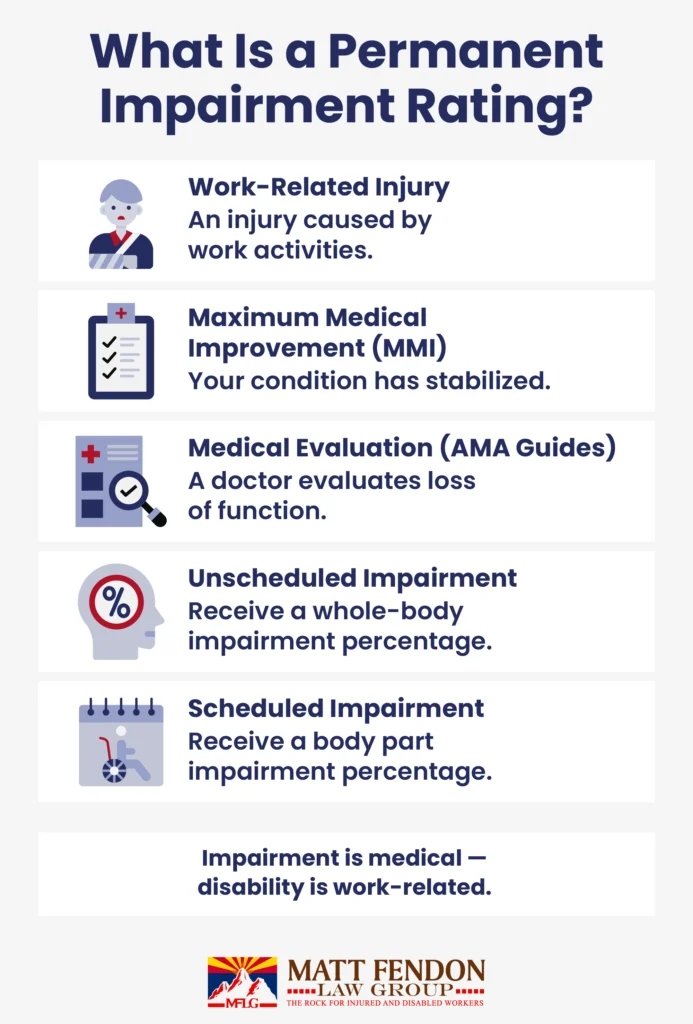
How is Your Impairment Rating Determined?
You can receive temporary partial disability compensation while you are undergoing medical treatment for a work-related injury.
Under Arizona workers’ compensation practice, once a treating doctor determines you are at Maximum Medical Improvement, a permanent impairment evaluation must be performed consistent with Industrial Commission rules and practice.
Impairment ratings can be scheduled or unscheduled, depending on the injured body part and whether it is included in Arizona’s statutory schedule under Arizona Revised Statutes (ARS) ARS 23-1044(B).
Your treating doctor can rate the percentage of your impairment using the standards for the evaluation of permanent impairment as published by the most recent edition of the American Medical Association (AMA) Guides to the Evaluation of Permanent Impairment. AMA Guides are widely accepted in impaired evaluation, although Arizona law bases scheduled awards on statutory months and percentage of loss of use where specified.
The AMA Guides provide a medical evaluation methodology to convert a small body part impairment rating into a larger body part rating, and then into a “whole body” rating.
For example, an 8% impairment of your thumb converts into a 3% impairment of the hand; this, in turn, converts into a 3% impairment of your upper extremity; and this finally converts into a 2% impairment of your whole body.
The Guides also provide a consistent way to combine impairments for injuries that have affected multiple body parts.
For example, if you injured a finger, wrist, and elbow on the same arm, the numerical ratings for each body part can be combined into a numerical rating for the upper extremity and your whole body.
Your treating physician must provide a final, signed report providing details of your impairment rating to the workers’ compensation insurance carrier, self-insured employer, or Special Fund Division of the ICA.
Scheduled Impairment Ratings
What you can receive in workers’ compensation for a scheduled impairment is based on ARS 23-1044(B). It sets the payment at 55% of your average monthly wage and the number of months you can receive the compensation. This is in addition to the compensation for temporary total disability.
Scheduled impairment-based compensation is subject to adjustments based on circumstances. These include:
- If a body part has been partially impaired and you can return to your pre-injury job, then the injury is compensated at the rate of 50% of your average monthly wage. This is permanent partial disability.
- If the scheduled body part has been 100% impaired because of amputation or total functional loss, then the injury is compensated at 55% of your average monthly wage.
Scheduled awards are paid on a monthly basis. Here is the Arizona schedule for specific body parts:
| Body Part | How Many Months You Can Receive Average Monthly Wage Benefits |
| Loss of thumb | 15 |
| Loss of first finger (index finger) | 9 |
| Loss of second finger | 7 |
| Loss of third finger | 5 |
| Loss of fourth finger (little finger) | 4 |
| Loss of distal or second phalange of the thumb; orLoss of distal or third phalange of the first, second, third or fourth finger | Half the number of months set for the loss of the entire thumb or affected finger |
| Loss of more than one phalange of a thumb or finger | Same as for loss of the entire thumb or finger; Loss of more than one finger shall not exceed the compensation amount provided for loss of a hand. |
| Loss of a great toe | 7 |
| Loss of any other toe | 2.5 |
| Loss of first phalange of any toe | Half the number of months for one toe. Compensation for half of the amount as for loss of one toe. |
| Loss of more than one phalange | Same as for loss of the entire toe |
| Loss of dominant hand | 50 |
| Loss of minor hand | 40 |
| Loss of major arm | 60 |
| Loss of minor arm | 50 |
| Loss of a foot | 40 |
| Loss of a leg | 50 |
| Loss of eye by enucleation | 30 |
| Permanent and complete loss of sight in one eye, without enucleation | 25 |
| Permanent and complete loss of hearing in one ear | 20 |
| Permanent and complete loss of hearing in both ears | 60 |
| Permanent and complete loss of use of a finger, toe, arm, hand, foot, or leg | Same as loss of the same member by separation |
Disability that is Deemed Total and Permanent
Under ARS 23-1045(C), the following injuries will be deemed to cause total and permanent disability, absent proof to the contrary:
- The total and permanent loss of sight of both eyes
- The loss by separation of both feet
- The loss by separation of both hands
- An injury to the spine resulting in permanent and complete paralysis of both legs or both arms, or one leg and one arm
- An injury to the skull resulting in incurable insanity
- The loss by separation of one hand and one foot
Unscheduled Impairment Ratings
Compensation for unscheduled impairments, like back, shoulder, or hip injuries, is not based on your average monthly wage but on your diminished earning capacity.
Unlike scheduled injuries, unscheduled impairments do not depend on numerical values assigned by the AMA Guides. Instead, all that is necessary is to show that your impairment is anything more than 0%.
If you have an impairment of more than 0%, and it is not covered by the statutory schedule, then the question to answer is whether your injury has led to work restrictions that impact your earning capacity.
Unscheduled impairments take into account factors including your age, education, work experience, and current earning potential. The Industrial Commission of Arizona (ICA) will use this information to calculate your benefits on a case-by-case basis. Unscheduled impairments are compensated at 55% of the difference between your pre-injury and post-injury earning capacity for partial disability. If you are found permanently and totally disabled from all work, permanent total disability benefits are paid at 66⅔% of your average monthly wage.
These payments may continue for the remainder of your life but are subject to annual review.
The ICA may also award compensation for permanent disfigurement of the head or face, including loss of teeth, up to 18 months based on submitted evidence. Lump-sum payments may be approved for workers with financial or rehabilitation needs, subject to ICA approval.
Specific Unscheduled Considerations for Multiple Impairments
Sometimes you can have an impairment that can be a scheduled one, but depending on circumstances, it can convert into an unscheduled impairment:
- If an impairment rating is assigned to two or more body parts not on the same extremity, the claim converts to an unscheduled injury.
- If you have a prior scheduled impairment rating and then sustain a subsequent impairment to a scheduled body part, the second impairment will automatically be unscheduled under ARS 23-1065(B).
- A prior non-industrial impairment that results in an earning capacity disability, no matter how slight, may unschedule the subsequent scheduled industrial injury if it can be shown that there is an impairment that is ratable under Arizona law. The same is true for an out-of-state industrial injury that is scheduled in nature.
Do You Have Questions About Understanding Permanent Impairment Ratings?
Arizona’s workers’ compensation impairment ratings and their relationship to functional limitations are important for understanding how much you might receive in compensation after a work-related injury. It can be hard to fully comprehend this impairment rating evaluation system, and to know whether your impairment is scheduled or unscheduled, total or partial, or permanent, and what impairment percentage of your average monthly wage or your diminished earning capacity applies to you.
At the Matt Fendon Law Group, our experienced workers’ compensation attorneys can help you determine your impairment rating, gather necessary medical evidence, negotiate with workers’ compensation insurance companies, and file a workers’ compensation claim in Arizona or even appeal a claim denial.
Call us at (800) 229-3880 or contact us online to talk with an experienced attorney in a free consultation about receiving fair compensation for your workers’ comp claim.