
Work-related nerve damage claims often come from traumatic injuries. When this happens, you can experience symptoms like muscle weakness, difficulty holding objects properly, and sharp pains in your hands, arms, legs, or feet that can keep you from work.
When this happens, if your employer is covered by workers’ compensation insurance, you may be eligible to receive benefits through Arizona workers’ comp.
If you are suffering from serious nerve injuries, your employer’s insurance company may be willing to enter into a settlement agreement with you.
The amount you might receive in settlement depends on many factors, although many estimates are around $20,000. In this blog post, we go over the factors that go into negotiating a nerve damage settlement to show how they can affect your settlement value.
If you have experienced a work injury that has resulted in nerve damage, Matt Fendon Law Group can help you file a workers’ compensation claim and negotiate with an insurance company to pursue fair compensation available under Arizona law.
Call us at (800) 229-3880, or use our online contact form to speak with an experienced Arizona workers’ compensation attorney.
Is There an Average Workers’ Compensation Settlement for Nerve Damage?
Arizona law does not provide or publish average settlement amounts for workers’ compensation claims, and reported figures are typically based on national estimates rather than Arizona-specific statutory benefits. With that caveat, some national sources provide “average” settlement amounts for nerve damage.
Depending on the source, the part of the body affected, and the severity of the injury, a nerve damage claim might be as low as $10,000, with most estimates ranging around $20,000 and a few as high as $60,000, and in rare cases involving permanent nerve injuries and related disabilities, more than a million dollars.
In Arizona, workers’ compensation benefits are primarily governed by statute—scheduled and unscheduled benefits under A.R.S. § 23-1044, and negotiated full-and-final settlements under A.R.S. § 23-941.01—and can vary widely based on the facts of your case.
As with most settlements, the more serious your injuries, the larger your settlement is likely to be. This is why it is important for you to contact an experienced work injury lawyer who can help you evaluate what your settlement may be worth.
Do All Workers’ Compensation Nerve Damage Injury Cases Settle?
Arizona law does not compel an insurance company to settle your workers’ compensation claim with you. From a workers’ compensation insurer’s point of view, not all nerve injury claims are good settlement candidates. Sometimes the facts of your situation can influence the insurer’s willingness to settle with you. Examples include:
- The insurance company believes that your claim is weak. This can be the case when the insurer believes that your injury is not work-related, or you have not complied with Arizona workers’ compensation requirements to preserve your claim, or you do not have much medical evidence to support your claim.
- You have not yet reached maximum medical improvement. If you are still recovering from your nerve injuries, the insurer may want to wait on settlement because of uncertainty about what your future medical expenses may be and questions about how to set the total value of your potential claim.
- It is cheaper for the insurer to make ongoing weekly payments over time.
- The insurance company wants to maintain influence over your medical care. Arizona law allows the self-insured employer to direct your medical care. If your employer is insured by an insurance carrier for workers’ compensation, the doctor you choose to see initially for the injury usually becomes the treating doctor for the injury. The insurance carrier may also send you to see a doctor of their choosing for one visit. In other aspects, the insurance carrier is allowed to administer your claim. Injured workers have the right to request a change of treating physician, subject to ICA rules, so the insurer’s control over your ongoing treatment is limited. If the employer is self-insured, it is more difficult for a change of doctors to be approved without the employer’s approval.
- The insurance company is disputing your claim. This can happen if the insurer is challenging the extent of your permanent impairment, whether you cannot return to work, or what kind of ongoing medical treatment you will need.
- The insurance company wants to play hardball with you. Sometimes an insurance company will at least initially refuse to settle as a pressure tactic, trying to get you to accept a lowball settlement offer later, put financial pressure on you, or see if you go back to work.
What Factors Go Into a Negotiated Nerve Damage Settlement?
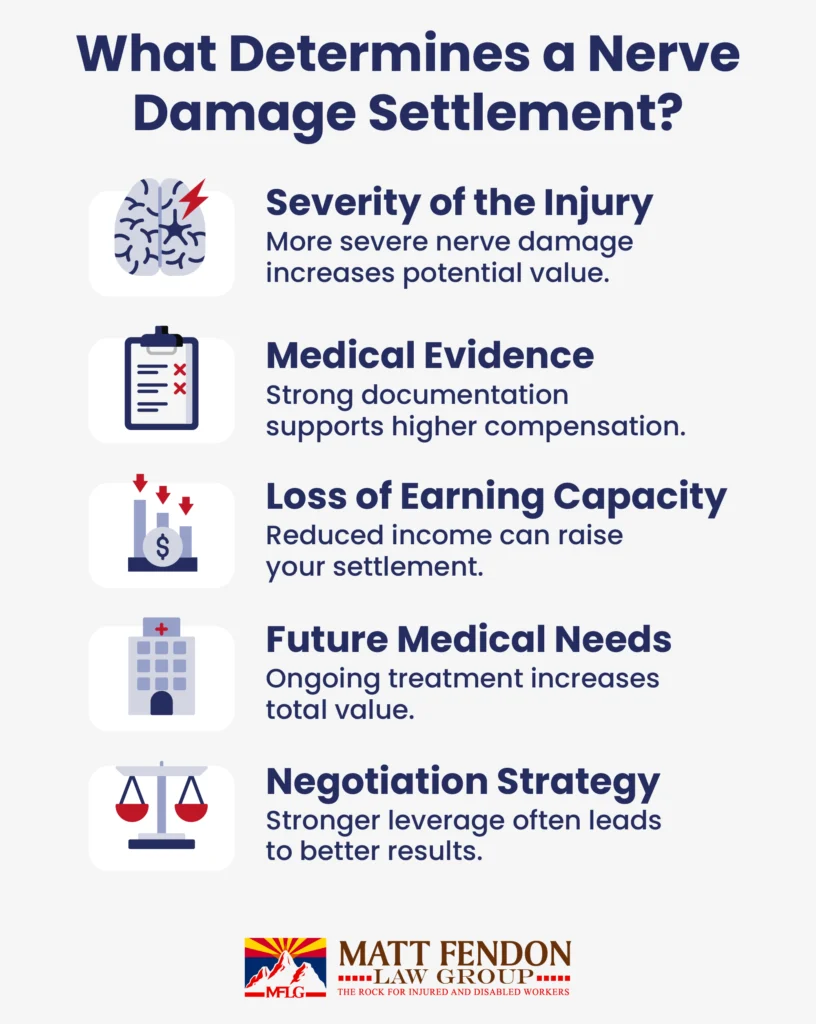
If you do enter into settlement negotiations for your nerve injury workers’ compensation claim, the outcome will depend on multiple factors. Some of these you have little or no control over, like the nature and severity of the injury. Others you can influence, sometimes well before negotiations begin.
Here are some of the important considerations that you and your attorney should take into account when preparing for and engaging in negotiations with a workers’ compensation insurance company.
Preserve Your Workers’ Compensation Claim
The stronger your underlying claim for workers’ compensation benefits is, the stronger your negotiating position will be. Here are some steps you can take to make sure you have a strong workers’ compensation claim:
- Seek medical attention immediately. You should seek medical care as soon as any nerve injury symptoms appear. If you delay treatment, this can make it harder to link the injury to your employment and lead the insurance company to doubt the severity of your condition.
- Get evaluated by a specialist: You might see your primary care provider initially, but if nerve damage has occurred due to a work accident, this often requires confirmation from a neurologist or another specialist.
- Report the injury to your employer promptly: Arizona workers’ compensation requires you to report “forthwith” to your employer that you have been injured at work. In a way similar to seeking medical attention, the longer you wait to report, the more you might cast doubt on your claim in the eyes of the insurance company.
- Gather and keep copies of all related documentation. The more documentary evidence you have to support your injury claim, the more leverage you can gain in insurance settlement negotiations. This means medical records or diagnosis and treatment, specialist referrals, communications with your employer and the insurance company, and any witness statements.
How Severe are the Effects of Your Nerve Injuries?
This is a factor that you may have little control over, but it will play an important role in establishing what your possible settlement for nerve damage is worth. Insurance companies will consider the following specifics:
- The severity and permanence of your injury. The more serious or permanent your nerve damage is, the more likely it is to result in a higher settlement. This is particularly true if the nerve injury affects your mobility or your ability to return to work. A settlement for nerve damage based on carpal tunnel syndrome, for example, will be valued less than one for a spinal cord injury.
- The impact on your ability to go back to work. If your work injury keeps you from returning to your job or limits your work capacity, you may be entitled to additional compensation for lost income and earning potential.
- The cost of your current and future medical care. Your settlement amount will need to include your anticipated future medical needs in addition to what you have already spent on required medical treatment.
- Your occupation and your wages at the time of the injury. Higher-paying jobs or careers that rely heavily on your ability to perform physical labor can lead to a larger settlement because of the greater financial impact on you of being unable to work.
What Workers’ Compensation Benefits are you Able to Receive?
The more your nerve injuries enable you to receive in workers’ compensation benefits, the more your settlement will need to cover you for foregoing those benefits in lieu of settlement. For a nerve damage claim, workers’ compensation will cover you in the following ways:
Paying for Your Medical Bills
Workers’ compensation will pay for all your reasonably necessary medical costs. For a nerve damage injury, these include outpatient specialist treatments (neurologist visits), costs of surgery, inpatient hospital costs, pain management, prescription medications, and physical therapy.
Temporary Disability Benefits
During your injury recovery and before you reach your point of maximum medical improvement, you can receive temporary partial or total disability benefits through workers’ comp.
Permanent Impairment Benefits
Arizona workers’ compensation can pay long-term benefits for nerve damage, whether scheduled or unscheduled. Whether an injury is classified as scheduled or unscheduled depends on whether the impairment falls within the statutory schedule or involves a more general disability affecting your earning capacity — not on the medical diagnosis alone.
Scheduled compensation under A.R.S. § 23-1044(B) may be used if the nerve damage affects a body part covered under the statute. Examples include hands, fingers and thumbs, arms, feet, vision, and hearing.
Scheduled compensation pays 50% of your pre-injury average monthly wage for a partial loss of use, 55% for a total loss or amputation, or 75% if the injury prevents you from returning to your pre-injury job. The number of months you receive benefits depends on the specific body part affected.
Unscheduled compensation under A.R.S. § 23-1044(C)–(D) may apply when the impairment is not limited to a single scheduled body part or results in a general impairment affecting earning capacity. Common examples in nerve damage cases include:
- Spinal nerve injuries
- Injury to the nerve roots of your neck or shoulders
- Injury to multiple body parts
- Complex regional chronic pain
- Generalized neurological impairments
Unscheduled compensation is based on your loss of earning capacity, which in turn factors in your age, education, work history, work restrictions your nerve damage imposes on you, and the availability of jobs in your labor market.
In some cases, if you experience permanent nerve damage as a catastrophic injury, you may qualify for permanent total disability benefits that are payable for life under A.R.S. § 23-1045.
What Form of Settlement Will You Pursue?
Settlements with insurance companies can take different forms, including structured settlements and lump sums, which are often part of a full-and-final settlement.
Structured Settlements
A structured settlement is payable to you in installments. The insurance company will ordinarily buy an annuity from which these payments are made to you. The main purpose of this kind of settlement is to provide you with long-term financial security. This makes a structured settlement a good choice if you are suffering from a permanent disability, long-term wage loss, or ongoing medical support needs. A structured settlement may be included as part of the full and final settlement.
Full-and-Final Settlements
A full-and-final settlement is usually paid in a lump sum that is meant to pay you for all your present and future medical expenses, along with a future indemnity to cover lost wages.
A full-and-final settlement requires approval by the Industrial Commission of Arizona (the ICA) under A.R.S. § 23-941.01. Once this approval is in hand, this form of settlement will permanently close your workers’ compensation claim.
- The main advantages of a full-and-final settlement are that you receive all of your money up front and are not restricted in how you spend that money.
- The main disadvantage is that if you miscalculate your future medical costs, you waive your right to reopen the claim under A.R.S. § 23-1061(H) to cover additional medical treatment costs, or to rearrange any permanent disability benefits you receive under § 23-1044(F).
Your workers’ compensation attorney can help you decide which of these options is best for you in your nerve damage injury settlement strategy.
What Approach Will the Workers’ Compensation Insurer Use in Negotiations?
As we have seen above, an insurance company is not obligated to settle with you if you suffer a workplace injury. If it does negotiate with you, it may use a variety of tactics that can be meant to reduce the potential value of your settlement by putting pressure on you to accept less.
For example, insurance claims adjusters know that for many people, the combination of being unable to return to work and the high medical bills associated with treating nerve injuries can lead to intense financial pressure.
By engaging in delaying tactics, the insurer can increase this pressure, hoping you will agree to a lower settlement sooner rather than hold out for a larger one through prolonged negotiations.
Other times, the insurance company can take more aggressive measures to put you at a negotiating disadvantage. Examples include claiming your injury is a pre-existing condition, blaming third parties for your injury, blaming you for your injury at least in part, and using private investigators to observe you in your daily life activities and to monitor your social media accounts, hoping to catch you behaving inconsistently with your claimed symptoms or disabilities.
The Strength of Your Legal Representation
In workers’ compensation settlements, it is often true that the settlement payout you receive will not necessarily be what you deserve, but rather what you negotiate. When you are negotiating with an experienced insurance claims adjuster, you will be up against a skilled negotiator whose main mission is to keep the insurance company’s settlement payout as low as possible.
Most injured workers are not trained negotiators who haggle workers’ compensation claims for a living. If you try negotiating alone against an insurance adjuster, you will be at a serious disadvantage.
You can offset this disadvantage by hiring an experienced Arizona workers’ compensation benefits law firm to negotiate on your behalf. This is what a Matt Fendon Law Group attorney can do for you.
How Much Resistance Can You Expect From The Insurance Company?
Another potentially significant factor in insurance company settlement negotiations is that the more likely it is that your nerve damage injury will be permanent and costly to compensate you for, the stronger the incentive will be for the insurance company to fight your claim.
Insurance companies are profit-oriented, and insurance claim adjusters can be tough and wily negotiators on behalf of their employers. These adjusters can use a variety of tactics to get you to settle for less than the maximum compensation you need.
Sometimes these tactics can be subtle, like offering you a quick settlement amount that is usually much less than you could negotiate. Other tactics can be meant to wear you down into accepting a low-ball settlement offer, like constantly demanding more documentation to support your claim or being slow to respond to your communications.
Still, other claim adjuster methods can be more aggressive. For example, the insurer may hire a private investigator to follow you, or to monitor your social media accounts, hoping to catch you doing something that can be used to challenge your claims about the effect of your nerve damage injury on your ability to engage in work or daily life activities. Or, the adjuster may argue that your injury was pre-existing in nature, or that you contributed to the accident at work that caused it.
What Happens if Settlement Negotiations Fail?
Just like insurance companies do not need to agree to negotiate with you, even when they do, sometimes negotiations may reach an impasse.
If negotiations cannot be resumed, your recourse is often to continue receiving workers’ compensation benefits while you are eligible to receive them.
What Should I Do When I Receive a Settlement Offer?
When negotiations reach the point where the workers’ compensation insurance company makes you a settlement offer, you will have three options:
- You can accept the settlement offer.
- You can reject the offer and continue receiving benefits through Arizona workers’ compensation.
- You can try to negotiate for a better settlement offer (this is often the case with initial low-ball offers).
Like helping you to decide which kind of settlement type is best for your specific situation, your workers’ compensation attorney can give you guidance on whether you should accept the settlement offer or choose an alternative response to the insurer.
Have You Suffered Nerve Damage at Work?
Our purpose in this blog post is to familiarize you with some of the basic factors and considerations that go into negotiating a fair settlement amount for a disabling nerve damage-related workplace injury, and to give you a basic idea of how an average settlement for nerve injury works.
It is important to understand that Arizona workers’ compensation does not cover pain and suffering. However, if a third party’s negligence contributed to your workplace nerve injury, you may have the option to file a separate personal injury lawsuit, which can seek compensation for non-economic damages — including pain and suffering — in addition to your workers’ compensation benefits.
At Matt Fendon Law Group, our law firm’s attorneys have decades of combined experience representing injured Arizona workers in seeking compensation through settlement negotiations. We understand the key issues you need to address and how to counter insurance company tactics, whether subtle or hardball.
To speak with an experienced Arizona workers’ compensation settlement lawyer, call our office at any time at (800) 229-3880 or reach us online to schedule a free consultation with our legal team to evaluate your nerve injury compensation claim.