Arizona applies Arizona Revised Statutes (ARS) Section 23‑1043.01(B) to mental‑only and stress‑related claims. In this blog post, we focus on mental health claims under Arizona workers’ comp.
If you have a claim for a mental health condition because of your work, or you want to know more about how Arizona’s state workers’ compensation law governs these claims, then Matt Fendon Law Group can help.
To speak with an experienced workers’ compensation attorney and to schedule a free consultation, call us at (800) 229-3880. You can also communicate with us through our online contact form.
What is Arizona’s Law For Mental Health Workers’ Compensation?
ARS 23-1043.01(B) is brief, so we provide it here in full:
“23-1043.01. Heart-related and mental cases
B. A mental injury, illness or condition shall not be considered a personal injury by accident arising out of and in the course of employment and is not compensable pursuant to this chapter unless some unexpected, unusual or extraordinary stress related to the employment or some physical injury related to the employment was a substantial contributing cause of the mental injury, illness or condition.”
This law authorizes workers’ compensation claims for “mental injuries, illnesses, or conditions.” This statute governs mental‑only claims. Mental health conditions caused by physical injuries are compensable under the general workers’ compensation causation rules.
What Types of Mental Health Conditions Does Workers’ Compensation Cover?
Common mental health conditions that may be covered by workers’ compensation include:
- Post-traumatic stress disorder (PTSD)
- Depression and major depressive disorder
- Anxiety disorders and panic attacks
- Substance abuse disorders related to work stress (compensable only if resulting from unexpected, unusual, or extraordinary work-related stress or from a compensable physical injury)
- Sleep disorders caused by workplace trauma
- Phobias related to workplace incidents
- Adjustment disorders
Mental Health Claims Caused by Physical Injury
This path, which is also known as the physical-mental claim path, is the easier of the two options to use. What you need to do is to show a substantial contributing cause between a work-related physical injury and the subsequent onset of your mental health condition.
For example, let’s say that you suffer a back injury at work that results in physical symptoms like chronic pain, which, over time, causes you to experience depression. Or, you are involved in a severe automobile accident while driving in connection with your employment and, as a result, experience symptoms of PTSD. Both of these can be valid grounds for physical-injury-based mental health claims under Arizona workers’ compensation.
Often, mental health symptoms do not manifest themselves until the passage of time. So, for example, you might file a workers’ compensation claim for a physical work injury to cover medical bills, then later, the mental health problems it causes you may be added as they manifest while the claim is open for benefits or later through the reopening process.
If your subsequent mental health condition becomes related to the industrial injury, then you may be able to receive workers’ compensation benefits like mental health therapy, psychiatric care, medication, and lost wage compensation if your mental health issues keep you from work.
It is important to understand that Arizona workers’ compensation does not cover pain and suffering damages. Workers’ compensation is a defined-benefits system: it covers medical treatment costs and a portion of lost wages, but it does not compensate you for the emotional distress, reduced quality of life, or other non-economic harms that your condition causes you.
If your mental health condition was caused by the negligence of a third party — someone other than your employer or a coworker — you may be able to pursue pain and suffering damages through a separate personal injury claim. An experienced attorney can help you determine whether a third-party claim applies to your situation.
Stress-Related Mental Health Claims
The more difficult path to make a workers’ compensation claim for a mental health condition is one that is based on purely psychological injuries that result from stress at work. This is also known as the “mental only” path. The key here is that what might be called “ordinary” stress will not do: it must be unexpected, unusual, or extraordinary.
Examples of claims that can arise based on this kind of stress are PTSD without an underlying physical injury, or anxiety or depression that results solely from workplace stress. On the other hand, it is safe to say that general job-related stress, such as heavy workloads, tight deadlines, and disagreements or personality clashes with coworkers, is neither unexpected, unusual, nor extraordinary in most work environments.
What Are Examples of Unexpected, Unusual, or Extraordinary Stress?
Some cases that have resulted in successful Arizona workers’ compensation mental health claims unconnected with a personal, work-related injury have been:
- Witnessing a violent death or a catastrophic accident at work
- Being the victim of an armed robbery or assault
- Catastrophic, rare workplace traumatic events like an explosion or mass-casualty incident
“Unexpected” work stress lacks a uniform definition. It must be determined on a case-by-case basis, and the kind of work you do has a major bearing on this issue.
This is particularly true of people who work in high-stress occupations, such as police officers, firefighters, or emergency medical first responders. Seeing a person covered in blood or being exposed to violent behavior may be unexpected in an office environment, but these can be “all in a day’s work” for law enforcement officers or emergency medical technicians.
Here are some examples of what Arizona courts have held to be unexpected, unusual, or extraordinary stressors that were major contributing causes of workers’ compensation mental health claims.
- A convenience store clerk was the victim of an armed robbery, in which a gun was held to that person’s head. The employee claimed severe PTSD after the incident.
- A sheriff’s deputy responded to a mass casualty airplane crash that involved dozens of fatalities, “extreme carnage,” and exposure to traumatic conditions. The deputy claimed disabling psychological trauma.
- A worker witnessed a coworker’s violent death in a machinery accident and developed acute psychological trauma as a result.
The table below provides examples of what can be considered expected versus extraordinary or unexpected stress in Arizona mental health claims.
| Job | What Courts Consider “Expected” | What Might Be “Extraordinary” |
|---|---|---|
| Police officer | Violent scenes, suicides, domestic violence | Terrorist attack, mass‑casualty event |
| Nurse/EMT | Trauma, death, and medical emergencies | Hospital shooting, catastrophic system failure |
| Office worker | Deadlines, interpersonal conflict | Witnessing a violent death, physical trauma |
How Do You Prove a Mental Health Workers’ Compensation Claim?
Sufficient supporting documentation is critical in establishing a mental health-related claim. Relevant evidence includes:
- A medical diagnosis from a licensed mental health provider
- Clear documentation linking the condition to a specific work event
- Evidence that the event was unexpected, unusual, or extraordinary (for mental‑only claims)
- Consistent treatment records
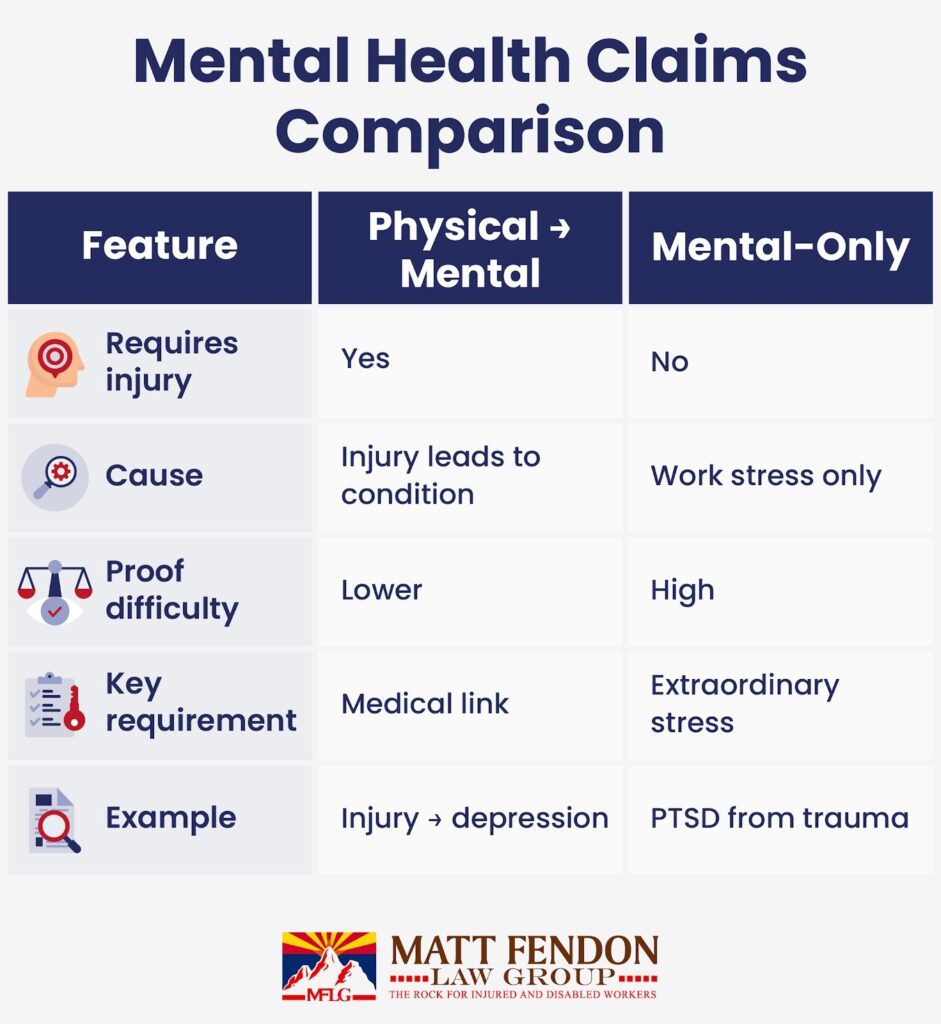
The table below summarizes the differences between physical-mental and mental-only workers’ compensation claims for mental health:
| Type of Claim | Physical-Mental | Mental‑Only |
|---|---|---|
| Requires physical injury? | Yes | No |
| Legal standard of proof | The physical injury is a substantial contributing cause of the subsequent mental health condition | Must prove “unexpected, unusual, or extraordinary stress” is a substantial contributing cause of the mental health condition |
| Difficulty in proving | Moderate to low if physical injury exists | High |
| Examples | Depression from chronic pain; PTSD after injury | PTSD from workplace trauma without physical injury |
What Are Average Settlement Amounts for Mental Health Workers’ Compensation Claims?
Settlement amounts for mental health workers’ compensation claims vary widely depending on the severity of the condition, the cost of treatment, and the impact on your ability to work. Based on national estimates, general stress-related claims tend to settle in the range of $5,000 to $50,000, while more severe PTSD claims can range from $50,000 to $100,000 or more.
These figures are national estimates and are not specific to Arizona. Every case is different, and past settlement amounts do not predict the outcome of any future claim. To get a better sense of what your mental health workers’ compensation claim may be worth, speak with an attorney who can evaluate the details of your case.
Do You Have a Claim For a Work-Related Mental Health Condition in Arizona?
Making a successful disability benefits claim for a mental health consequence of a work-related injury or stressor event can be challenging.
It often requires careful examination of the work environment you were in, getting supporting evidence of the workplace injury if that was the underlying cause, and obtaining diagnoses and other records from mental health professionals, then presenting this evidence in a way that will convince a workers’ compensation insurance company to accept your compensable mental injury claim.
Negotiating with insurance carriers can be challenging in mental health injury cases.
Employers and insurance companies often treat mental health claims with heightened scrutiny, especially when they are not connected to a prior work injury.
They may question whether your psychological conditions are genuine or work-related and are more likely to investigate your mental health claims thoroughly, looking for alternative explanations or evidence of pre-existing conditions that contributed to your psychological symptoms.
This is why having an experienced lawyer on your side is important from the beginning of your claims process. An experienced workers’ compensation lawyer is what you will have when you hire a Matt Fendon Law Group attorney.
Together, our team of Arizona workers’ compensation legal professionals has many years of experience negotiating on behalf of injured workers who have related mental health conditions, and workers who have experienced severe levels of mental stress that lead to such conditions, even without physical injuries.
To evaluate your potential mental health condition workers’ compensation benefits claim, call us at (800) 229-3880 at any time, or reach us online.