A crush injury at work occurs when all or part of your body is compressed, pinched, or trapped between two or more objects for an extended period, or between an object and a surface, with enough force or pressure to cause tissue, bone, nerve, or organ damage.
In a worst-case situation, a crush injury can be fatal.
Here, we explain what a workplace crush injury is, how it is different from being struck by an object, the kinds of harm that result from crush injuries, how to make a crush injury claim under Arizona workers’ compensation, and considerations that factor into how much fair compensation you can receive after a crush injury.
Why Choose Matt Fendon Law Group for Your Crush Injury Workers’ Compensation Claim?
Compared to other traumatic injury workers’ compensation claimants, workplace crush injury victims can suffer from severe injuries that can have long-lasting or permanent effects that can have a significant impact on the kinds of workers’ compensation benefits you can receive and on settlement claims.
This more serious nature of crush injuries makes it more likely that your employer’s workers’ compensation insurance company will fight you in its analysis of your claim and in establishing a value for any settlement payout.
That is why having a Matt Fendon Law Group workers’ compensation lawyer on your side is essential when pursuing workers’ compensation after a crush accident.
Because our firm only represents Arizona workers’ compensation claimants, we have the focused experience needed to pursue fair compensation for your workplace crush injury, and to ensure that an insurance company will not low-ball you in settlement.
If you have been hurt on the job in a crush injury incident, call our law firm at (800) 229-3880 or use our online contact form to reach out to one of our skilled Scottsdale workers’ compensation legal professionals in a confidential, free initial consultation.
What Kinds of Crush Injuries Happen at Work?
Any kind of work you do that involves using or being around heavy machinery, vehicles, or moving equipment, presses, conveyors, or falling objects is a candidate to deliver a crush injury. When this happens, common crush injuries include:
- Compartment syndrome (pressure that builds up inside a closed muscle compartment, cutting off blood flow and oxygen to muscles and nerves)
- Damaged muscle tissue, bruising, and internal bleeding
- Lacerations
- Nerve injuries or peripheral neuropathy causing long-term impairment
- Serious complications like kidney failure, spinal cord injuries, traumatic brain injury, and tissue death
- Wrist injuries, broken bones, and bone fractures, or severe leg injuries requiring months of recovery
- Complete loss of limb function or the need for amputation in extreme cases
- Increased risk of other medical conditions, such as infection, osteomyelitis, or ligament damage, after surgery
Crush injuries can occur for many reasons. In construction, some of the most common causes include being struck or run over by a vehicle or being pinned between a vehicle and another hard surface. Additionally, falling equipment or unsecured building materials can crush you.
A few common causes of on-the-job crush injuries include being pinned between a forklift and a wall, or having your hand pulled into a conveyor belt where it is crushed, or being buried in a building collapse or a trench collapse, or by shifting materials.
What is the Workers’ Compensation Process for Crush Injuries?
The process for filing a workers’ compensation claim in Arizona for crush injuries is the same as for other kinds of injuries. We outline these steps below.
Seek Medical Attention and Identify Your Crush Injury as Being Work‑Related
Seek immediate medical attention, including emergency medical care if necessary. As soon as possible, see a doctor and inform that person during your examination that your crush injury is connected with your employment.
Report the Crush Injury to Your Employer
Arizona law requires you to file your claim with the ICA within one year. Prompt employer reporting is strongly recommended because delays can lead insurers to dispute the claim. Your report should include:
- The date and time of your crush injury
- Where you were working when you experienced the injury
- The symptoms you experienced
- A statement that you believe the crush injury to be work‑related
Failure to report promptly is one of the most common grounds insurers use to dispute work injury claims, so it is essential that you report to your employer without delay.
Your Employer Reports Your Crush Injury to Its Insurance Carrier
After receiving notice, your employer must report the injury to its workers’ compensation carrier and the ICA, as required by ARS 23‑908(E).
Do not confuse your employer’s reporting obligation with your responsibility to file a workers’ compensation claim. Employers are required to report known work injuries to their insurer, but this does not replace your obligation to file your own claim with the ICA.
File Your Workers’ Compensation Claim With the ICA
You file your workers’ compensation claim with the Industrial Commission of Arizona (the ICA). You may file your claim using Form 407 yourself, or your treating doctor may file it on your behalf.
You must file your claim within one year after you know, or reasonably should know, that your crush injury is connected to your employment.
The ICA Notifies the Insurance Carrier
Once the ICA receives the claim, it will assign it a claim number and notify your employer’s insurance carrier. The carrier will then begin investigating your claim. This is the point when your crush injury claim officially becomes part of Arizona’s workers’ compensation system.
The Insurance Company Issues a Notice Accepting or Denying Your Claim
Under ARS 23‑1061(M), the carrier must issue a Notice of Claim Status within 21 days. The insurer may accept your claim, or deny it, or issue what is known as medical-only acceptance, meaning that it will cover treatment but not wage benefits.
If the insurer accepts your claim, then your authorized medical treatment continues, and you may be able to receive temporary disability benefits if your crush injury has caused you to miss work.
Request a Hearing if the Insurer Denies Your Claim
If the insurance carrier denies your claim, then you have the right to request a hearing before an ICA Administrative Law Judge (ALJ). You must file a Request for Hearing within 90 days of the denial.
What Factors Affect Crush Injury Compensation?
Almost every crush injury will be moderate to severe. The severity can vary depending on how much pressure was applied and for how long. In many cases, after experiencing a crush injury, you will need to take time off from work to recover.
It is possible, if not likely, that you will incur substantial medical expenses in treating a crush injury, which can include costs for ambulance transportation, emergency medical care, and extended inpatient hospital treatment that could include surgery and even limb amputation.
Many crush injury victims wonder, “What is the average compensation for a crush injury?” Although there is no single amount, crush injury settlements and payouts need to reflect the extent and severity of the injury, possible additional related injuries, your need for past and future medical care, possible lost wage claims, and the long-term impact on your daily life.
Key Factors in a Crush Injury Settlement
- Your medical expenses, including X-rays, surgical procedures, and ongoing physical therapy
- The impact of any lost wages and whether you will require vocational rehabilitation
- Permanent impairment rating, prosthetic needs, and other lasting consequences of the injury
- The presence of safety violations at work that contributed to the injury
- Evidence from medical records, expert testimony, or injury severity assessments
- Whether the insurance company disputes your workers’ compensation benefits claim eligibility, the sufficiency of your supporting evidence, or the value of any part of your claim
- Whether any third-party liability bears on your crush injury
Note: Arizona workers’ compensation does not pay for pain and suffering. Those damages are available only through a separate third-party personal injury claim — for example, against a negligent equipment manufacturer or a non-employer driver — pursued in addition to your workers’ compensation benefits.
With these general considerations in mind, we can say that, according to national data, crush injury cases can result in settlements ranging from low five-figure sums to high six-figure amounts in particularly serious claims.
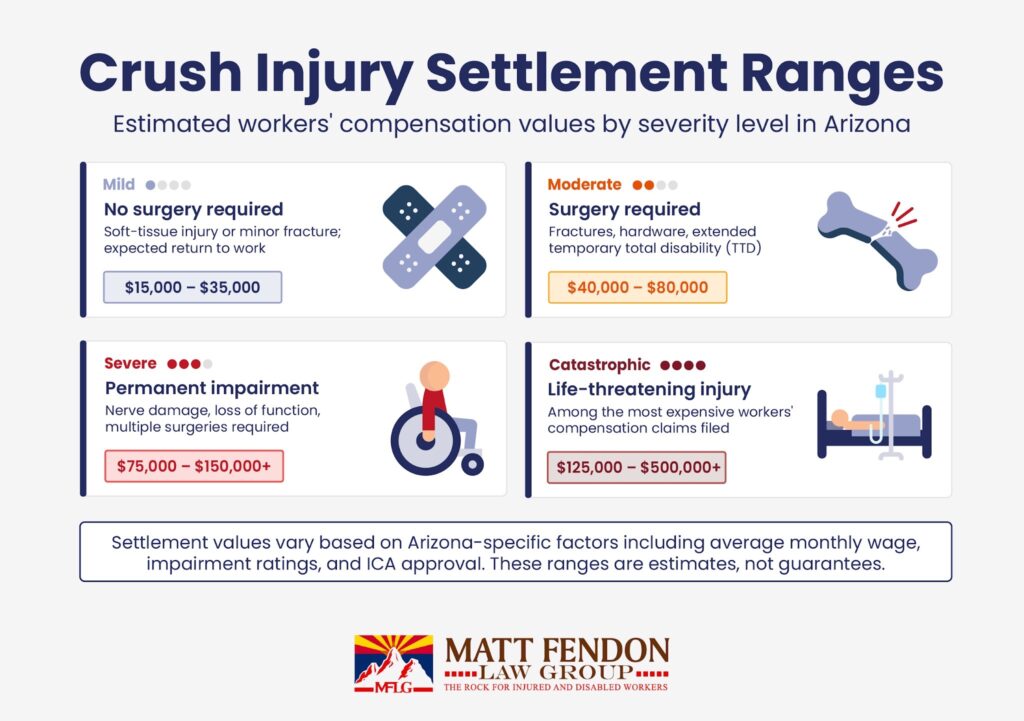
Settlement values vary widely and depend on Arizona‑specific factors such as average monthly wage, impairment ratings, and ICA approval.
The table below shows some types of crush injury cases and possible settlement ranges.
| Severity level | Typical settlement range potential value | Notes |
|---|---|---|
| Mild crush injuries (no surgery) | $15,000 – $35,000 | Soft‑tissue injury or minor fracture, return to work |
| Moderate crush injuries (surgery required) | $40,000 – $80,000 | Fractures, hardware, extended TTD |
| Severe crush injuries (permanent impairment) | $75,000 – $150,000+ | Nerve damage, loss of function, multiple surgeries |
| Crush injuries with amputation or catastrophic outcome | $125,000 – $500,000+ | Amputations are among the most expensive WC claims |
When a workplace crush injury occurs, lawyers and courts often review medical records, the circumstances of the accident, and whether safety violations or negligence contributed to it. Evidence such as OSHA reports, workplace conditions, or employer practices can play an important role.
What Are the Long-Term Effects of a Crush Injury?
A workplace crush injury can leave consequences that stay with you for months, years, or the rest of your life — and those consequences are central to how an Arizona crush injury claim is valued by the Industrial Commission of Arizona and by the insurance carrier evaluating your settlement.
Chronic Pain and Ongoing Medical Care
Many crush injury victims continue to need medical care long after leaving the hospital, such as physical therapy, follow-up surgeries, hardware removal, infection management, and pain medication. Compartment syndrome and peripheral nerve damage often produce chronic pain that limits your daily activities and your ability to work.
Permanent Impairment and Disability Ratings
Once your condition reaches maximum medical improvement, an evaluating physician will assign you a permanent impairment rating.
In Arizona, that rating drives whether you receive scheduled disability benefits — paid for a fixed number of months for specific body parts like a hand, foot, or eye — or unscheduled disability benefits, which can continue indefinitely for injuries that affect your overall earning capacity, like a back injury or traumatic brain injury.
When a crush injury leads to amputation, benefits should also cover prosthetics, replacements, and ongoing care of the residual limb.
Reduced Earning Capacity
A serious crush injury can prevent you from returning to your former job or to your former field. You may need to retrain, accept light duty at lower pay, or stop working entirely. Disputes about your loss of earning capacity are one of the most common reasons workers’ compensation claims end up before an Administrative Law Judge.
Mental Health Impact
A traumatic crush incident can leave behind anxiety, depression, and post-traumatic stress. Under Arizona law, mental health conditions can be compensable when they are connected to the underlying physical injury — so tell your treating doctor and make sure those symptoms are documented.
Impact on Family and Daily Life
The long-term effects of a crush injury rarely stop with the injured worker. Family members may take on caregiving roles, and reduced income can compound the stress of recovery, making it all the more important to pursue the full benefits Arizona law allows.
Have You Suffered a Crush Injury Accident at Work? Call a Crush Injury Lawyer Today
Even a relatively minor crush injury at work can have a tremendous negative impact on your ability to make a living; a catastrophic crush injury can leave you permanently disabled.
The Arizona workers’ compensation system exists to compensate you for medical bills and lost income when you have been hurt at work. Still, it can be an impersonal, complex, and confusing process to navigate on your own.
When you retain Matt Fendon Law Group to represent you after a crush-related workplace injury, you can be confident that you will have a highly experienced attorney on your side when you are gathering the evidence you need to support your crush injury compensation claim, filing your claim, and dealing with the workers’ compensation insurance company.
If the insurance carrier denies your claim, we will help you request an Administrative Law Judge hearing with the ICA and provide you with legal representation at that hearing.
Often, crush injury workers’ compensation claims result in a structured settlement or a lump-sum payment. In some cases, Arizona allows full‑and‑final settlements under ARS 23‑941.01, which may be paid as a lump sum or, less commonly, as a structured settlement.
Your Matt Fendon Law Group lawyer can advise you on which form of settlement is best for your situation and negotiate on your behalf for fair compensation in a settlement payout.
With so much at stake after a work accident that results in a crush injury, don’t leave your compensation to chance.
Call Matt Fendon Law Group today at (800) 229-3880 to speak with one of our Arizona workers’ compensation legal professionals, or reach out to us online to do the same and to schedule a free initial consultation with a crush injury lawyer.