
Hip injuries at work can be debilitating and can have long-term effects on your ability to get back to work, and can have lifelong impacts on your day-to-day life. Because of this, Arizona workers’ compensation settlements can be substantial.
Nationally, the typical workers’ compensation hip injury settlement falls somewhere in the range of $30,000 to $60,000, though severe cases—especially those requiring hip surgery or a hip replacement—can settle for $200,000 or more.
Claim cost data from the National Safety Council pegs the average workers’ compensation claim cost for a hip injury at about $60,000, split roughly between $36,000 in medical costs and $24,000 in indemnity for lost wages.
Your own hip injury settlement amounts will depend on Arizona-specific factors like your average monthly wage, the severity of your injury, your impairment rating, and how the Industrial Commission of Arizona values your loss of earning capacity.
In this article, we will examine how hip injury settlements work under Arizona’s workers’ compensation system. In particular, we cover the following topics:
- What kinds of hip injuries can happen at work, and how the average compensation for hip injury claims is calculated
- The kinds of workers’ compensation benefits you can receive for a job-related hip injury in Arizona
- How you can settle your hip injury workers’ compensation claim
- Factors that can affect the value of your workers’ compensation insurance settlement
How Matt Fendon Law Group Can Help With Your Hip Injury
The Arizona workers’ compensation lawyers at Matt Fendon Law Group focus on this particular area of law. We do workers’ compensation as the core of our practice.
This means that when you choose our law firm to help you with your workers’ compensation claim, including settling it with a workers’ compensation insurer, you can be confident in the knowledge and expertise of the legal representation you will receive.
Don’t trust your job-related hip injury settlement to just any law firm. Call Matt Fendon Law Group at (800) 229-3880 today to talk to one of our Arizona workers’ compensation legal specialists, or reach us online to schedule a free consultation and claim evaluation.
Arizona Workers’ Compensation Benefits for Hip Injuries
Arizona’s workers’ compensation is a no-fault system regulated by the Industrial Commission of Arizona (the ICA). The ICA must approve all settlements, including full and final settlements, to ensure they are free from fraud, coercion, or undue influence and that the worker understands the terms.
Workers’ compensation does not cover pain and suffering damages. These are only available in cases where your employer intentionally causes your injury or a third party causes your harm, in which you can then file a claim for personal injury.
To qualify for workers’ compensation benefits in Arizona, you must report your injury to your employer and be able to show that your hip injury has a connection to your work duties.
In Arizona’s workers’ compensation system, as an injured worker, you are entitled to several types of benefits, which together influence the value of a settlement. Key parts of workers’ compensation benefits include the following.
Medical Benefits
Workers’ compensation covers all reasonable and necessary medical bills for your work-related hip injury. You will not need to pay any out-of-pocket costs for this medical care. This includes emergency treatment, doctor visits, hospital stays, surgery, medications, physical therapy, and even future medical care, such as a total hip replacement or assistive devices if needed.
Arizona workers’ compensation pays your medical expenses for as long as treatment is needed to reach your maximum improvement, and past that point, if you need supportive care.
Temporary Disability Benefits
If your hip injury keeps you out of work or on restricted light duty with lower pay while you recover, you can receive temporary disability payments. In Arizona, these are typically 66⅔% of your average monthly wage, up to a statutory maximum benefit.
Most states base disability benefits on your average weekly wage (AWW), but Arizona is unusual — it uses your average monthly wage (AMW) instead. The concept is the same: your benefits are tied to your pre-injury earnings, just calculated on a monthly cadence rather than a weekly one.
If you have wage records from multiple employers or seasonal income variation, the way your AWW gets converted into an Arizona AMW can meaningfully affect the value of your claim, which is one of the first things an experienced workers’ compensation lawyer will check when they review your file.
A small adjustment to the average weekly wage that the insurance carrier uses can change your weekly check by tens of dollars and your settlement value by thousands.
Temporary Total Disability (TTD)
Workers’ compensation pays you TTD benefits when you cannot work at all during your recovery. These are usually paid bi-weekly, and replace about two-thirds of your lost wages up to the statutory cap until you return to work or reach maximum medical improvement (MMI).
Temporary Partial Disability (TPD)
If you can do some work or light duty at a lower income, then TPD benefits make up a portion of the difference in your wages.
Permanent Disability (PPD/PTD)
If your hip injury results in lasting impairment after you reach MMI, then you may qualify for permanent disability benefits. In Arizona, hip injuries are treated as “unscheduled” benefits, meaning that the compensation you receive is based on your lost earning capacity, generally 55% of the difference between your pre-injury wage and what you can earn post-injury.
Permanent Partial Disability (PPD)
If you can work again but with reduced earning capacity (for example, you cannot do heavy lifting anymore), you can qualify for PPD benefits as unscheduled benefits. These monthly benefits can continue potentially for life, subject to periodic review by the Industrial Commission of Arizona (the ICA) if your earning loss persists.
Your permanent impairment rating is the medical foundation for any PPD award. An Arizona workers’ compensation doctor assigns this rating using the AMA Guides to the Evaluation of Permanent Impairment, and it reflects how much function you have permanently lost in your hip.
A higher impairment rating typically results in a higher loss-of-earning-capacity calculation, which drives a larger permanent impairment settlement.
Permanent Total Disability (PTD)
If your hip injury completely prevents you from any gainful employment, then you can receive permanent total disability benefits. PTD pays about 66 2⁄3% of your pre-injury wage, up to the statutory maximum, for life.
Vocational Rehabilitation
Arizona workers’ compensation can provide help if you are unable to return to your old job because of your hip injury. Examples of vocational rehabilitation benefits are job retraining, education, or job placement assistance to help you find new employment within your medical restrictions.
How to Settle Your Work-Related Hip Injury Claim
Sometimes it makes sense to settle your workers’ compensation claim rather than continue collecting ongoing benefits. This can be the case, for example, if you have been out of work for a long time, have reached maximum medical improvement, and need permanent disability benefits.
Settlements are also common if your hip injury requires intensive medical care or long-term treatment. Generally speaking, your employer’s workers’ compensation insurer is more likely to consider settling your claim if it believes that doing so will save it money in the long term.
How Arizona’s Industrial Commission Approves a Settlement
Unlike most states, Arizona requires the Industrial Commission of Arizona to formally approve every full and final settlement before it becomes binding. This process is governed by A.R.S. § 23-941.01, and it works like this:
- You, the insurance carrier, and your attorney negotiate the terms. This includes the lump-sum settlement amount, whether any future medical care will remain open, and the closure of indemnity (lost wages) benefits.
- You submit a full and final settlement agreement to the ICA. The agreement must include sworn attestations that the settlement was reached free from fraud, coercion, undue influence, or any undisclosed side agreements, and that you understand the terms — including that you are giving up the right to reopen the claim later.
- An Administrative Law Judge (ALJ) reviews the agreement. If an attorney represents you, the ALJ generally approves the settlement after confirming that the statutory attestations are present. If you are not represented, the ALJ must hold a hearing and personally question you to confirm you understand what you are giving up.
- The settlement becomes final once the ALJ approves it. At that point, you typically cannot reopen the claim, change the terms, or come back later if your condition worsens — which is why this decision is one of the most consequential moments in your case.
In other states, this kind of agreement is often called a “compromise and release,” or “C&R.” Arizona uses the term “full and final settlement,” but the concept is the same — once the ICA signs off, the case is closed.
An experienced Arizona workers’ compensation attorney can help you decide if settling your claim is right for your situation and represent you both in negotiations with the insurance carrier and at the ICA approval stage.
Factors That Affect Hip Injury Settlement Amounts in Arizona
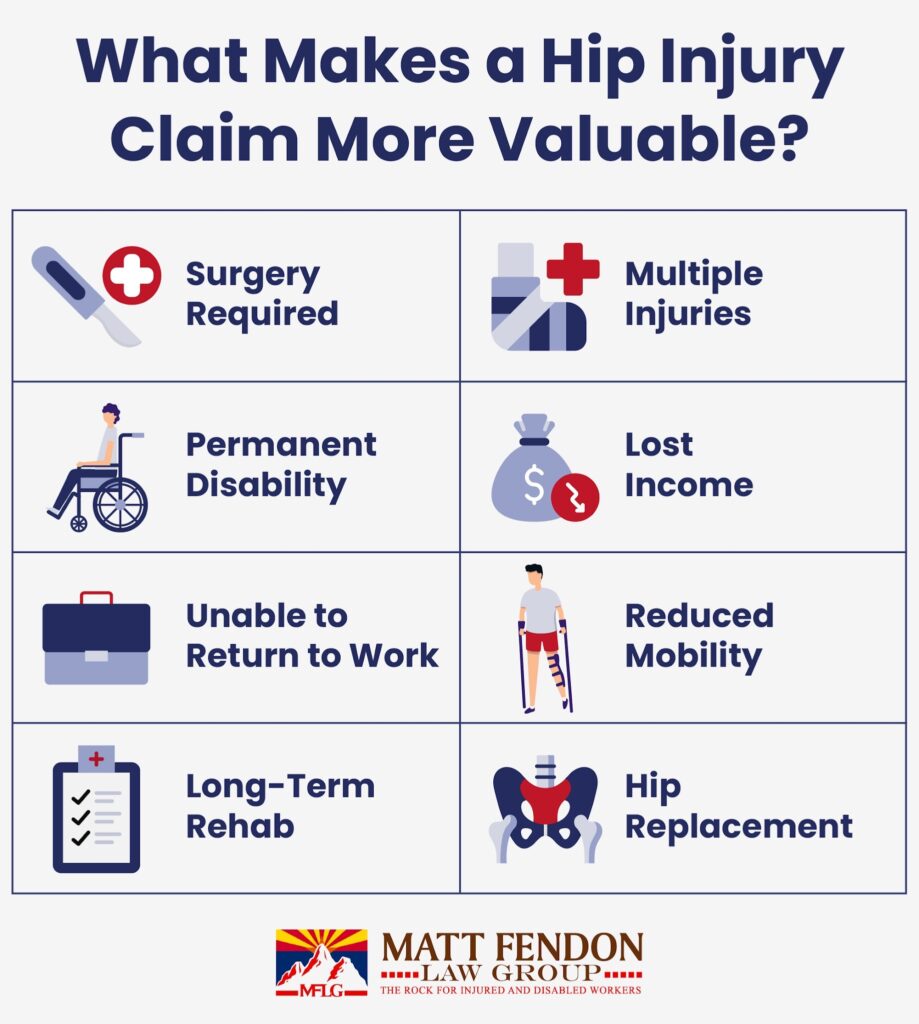
As shown above, the average settlement for a hip injury can vary considerably. Here are some of the important factors that can go into your attorney’s negotiating strategy with the insurance carrier:
- How severe is your hip injury? If it will require surgery to treat, including hardware implants or a hip replacement, or will require long-term treatment or rehabilitation, this can significantly increase your settlement.
- Can you return to work? If your hip injury prevents you from returning to the same work you did before the injury or limits your job duties, then the resulting lost earning capacity will pull your case above the average settlement value.
- What was your pre-injury income? Your workers’ compensation wage benefits are based on a percentage of your pre-injury earnings, so up to Arizona’s statutory limit, higher wages mean larger payments, and this translates into higher settlement value.
- Do you have any other injuries besides the hip injury? For example, a fall at work can affect your back, neck, knees, elbows, and wrists, and these additional injuries can increase your settlement value.
- How old are you? The greater your age, the longer it can take to recover from a hip injury, and this can increase your settlement.
- Do you have any pre-existing injuries or conditions? If a hip injury aggravates a condition like osteoarthritis, it can be a value enhancement in settlement.
- How much control do you want over the settlement payout? A structured settlement with monthly payments? Or a full-and-final lump sum settlement payment that can make more funds available right away but is harder to reopen later if your circumstances change in an unanticipated way?
In addition to these considerations, one of the most important factors that can have a concrete effect on your settlement payout is the negotiating skill of your workers’ compensation lawyer.
Insurance company claim adjusters are typically smart, savvy, experienced negotiators who know many tactics to try to persuade you to settle for less. Some of these tactics may be subtle, while others are blunt.
They can range from making a quick initial offer that is almost always for considerably less than what your claim is worth, to downplaying the severity of your hip injury, to accusing you of exaggerating your injury symptoms or even making a fraudulent claim.
Having a dedicated workers’ compensation attorney on your side, like one from Matt Fendon Law Group, means that you will have legal representation that will not fall for insurance company techniques and strategies that are not in your best interest.
A Matt Fendon Law Group attorney will also know how to gather and organize your supporting evidence to present a strong negotiation position for maximum fair compensation of your claim, and can give you legal guidance on which kind of settlement arrangement, a structured or full-and-final settlement.
Do You Need Help After a Hip Injury at Work in Arizona?
A hip injury at work can and often does mean that you will lose income in the short term, and can mean financial and daily life activity consequences from a permanent impairment that follows you for the rest of your life.
Workers’ compensation law in Arizona can be complex to understand and properly apply. It requires careful study of Arizona’s statutory laws, understanding how the ICA works with claims, and staying up to date with relevant professional legal education requirements.
Not every law firm has trained and experienced workers’ compensation professionals to represent you in any kind of work-related injury claim, not to mention a hip injury workers’ compensation settlement. But Matt Fendon Law Group does.
Our workers’ compensation attorneys have many years of combined experience representing Arizona workers in Phoenix, Scottsdale, Prescott, Tucson, and Flagstaff.
To speak with one of them or schedule a free initial consultation with a workers’ compensation lawyer, call us at (800) 229-3880 or use our online contact form.