
A workers’ compensation settlement for rotator cuff and bicep tear injuries depends on the severity of the shoulder injury, the medical treatment required, whether surgery is needed, the worker’s permanent impairment rating, and how the injury affects the worker’s ability to return to the job.
There is no single average settlement amount for every torn rotator cuff and bicep tear claim. Some settlements may be lower, while more serious cases involving surgery, permanent impairment, lost wages, and long-term work restrictions may be higher, depending on the facts.
If you suffered a rotator cuff tear, bicep tear, torn bicep, or other shoulder injury on the job in Arizona, call Matt Fendon Law Group at (800) 229-3880 now for a free consultation.
What Is the Average Workers’ Compensation Settlement for a Rotator Cuff and Bicep Tear?
The average workers’ compensation settlement for rotator cuff and bicep tear injuries varies widely. A minor rotator cuff tear with physical therapy and a full recovery may settle for far less than a severe torn rotator cuff with biceps tendon damage, surgery, permanent work restrictions, and reduced earning capacity.
A rotator cuff workers’ compensation settlement may be affected by whether the injury involves:
- A partial rotator cuff tear
- A full-thickness rotator cuff tear
- A torn bicep or biceps tendon injury
- Rotator cuff surgery
- Arthroscopic shoulder surgery
- Permanent impairment
- Lost wages or wage loss
- A dominant arm injury
- A physically demanding job
- Prior shoulder injury or pre-existing damage
It is also important to understand what Arizona workers’ compensation does not cover. Arizona workers’ compensation does not pay for pain and suffering.
Instead, a workers’ compensation claim usually focuses on medical bills, medical treatment, lost wages, permanent partial disability, and the impact of the work injury on the employee’s ability to earn a living. Pain and suffering may only be recoverable through a separate third-party personal injury claim, if one applies.
To give a general sense of scale, national estimates for these injuries are sometimes reported anywhere from around $30,000 for less severe claims to $50,000, $75,000, or more when surgery, permanent impairment, and lasting work restrictions are involved.
These are national figures, not Arizona amounts, and they are not a prediction or guarantee of what any individual claim is worth. The value of an Arizona claim depends on the specific medical findings, the worker’s wages, and the factors described below.
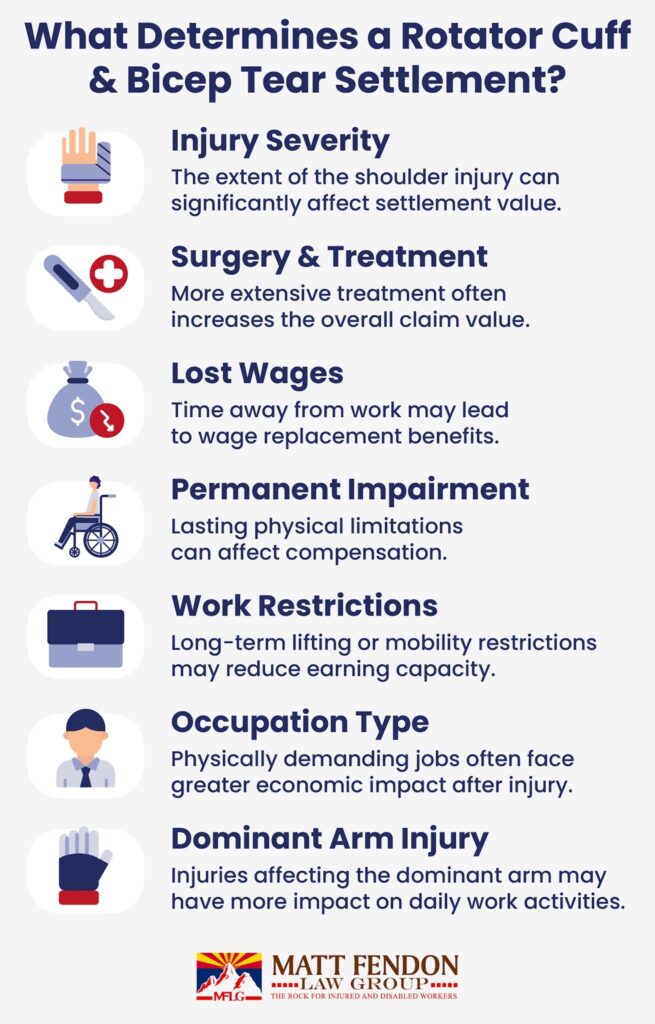
What Factors Affect a Workers’ Compensation Settlement Amount?
Several factors can affect workers’ compensation settlements for rotator cuff or bicep tear injuries.
Important factors include:
- Extent of the tear: A larger rotator cuff tear or complete bicep tear may increase the claim value.
- Surgery: Rotator cuff surgery, biceps tendon repair, or repeat surgery can affect settlement.
- Age: Age may affect healing, recovery, future work ability, and medical opinions.
- Dominant arm: A dominant arm injury may affect work capacity more than a non-dominant shoulder injury.
- Occupation: Heavy labor jobs may result in greater wage loss than jobs that require less shoulder use.
- Prior injuries: A prior shoulder injury can complicate causation and settlement value.
- Medical treatment: More treatment usually means higher medical bills and a more developed claim.
- Permanent impairment: A permanent impairment rating can affect permanent partial disability benefits.
- Work restrictions: Long-term lifting or overhead restrictions can affect future earning capacity.
- Lost wages: More time off work may increase temporary total disability or wage-loss benefits.
- MMI: Maximum medical improvement often determines when permanent impairment can be rated.
- Disputes: A denied claim, disputed surgery, or low impairment rating can affect negotiations.
A workers’ compensation attorney can review these factors and determine whether the settlement offer reflects the true value of the injury.
Rotator Cuff Surgery and Workers’ Comp Settlement
A rotator cuff surgery workers’ comp settlement often looks different from a claim that resolves with physical therapy alone. When rotator cuff surgery or a biceps tendon repair is required, the claim usually involves higher medical bills, a longer recovery, and a greater chance of permanent work restrictions.
A rotator cuff workers’ comp settlement may also be affected by whether the surgery succeeds, whether a second procedure is needed, and what impairment remains once the worker reaches maximum medical improvement. For these reasons, a workers’ comp rotator cuff settlement that involves surgery is often more developed than one that does not.
Workers’ Compensation Settlement for a Bicep Tear
A workers’ comp bicep tear settlement depends on how serious the injury is and whether it appears alongside a rotator cuff tear. A workers’ comp bicep tendon tear can affect lifting, gripping, and overhead work, especially when the dominant arm is involved.
As with a rotator cuff injury workers’ comp settlement, the value of a biceps tear claim often turns on the medical treatment required, any permanent impairment, and how the injury affects the worker’s ability to return to work.
How Arizona Workers’ Compensation Benefits Are Calculated
Arizona workers’ compensation is a no-fault system. That means an injured worker may receive medical and compensation benefits for a job-related injury regardless of who caused the accident. However, workers generally cannot sue their employer except in limited circumstances.
In an accepted Arizona workers’ compensation claim, benefits may include medical treatment, temporary disability benefits, and permanent disability benefits. For a torn rotator cuff and bicep tear, the most important benefits are often medical treatment, lost wages, temporary total disability, and permanent partial disability.
Arizona law provides that temporary total disability benefits are generally paid at 66 2/3% of the worker’s average monthly wage during the period of disability. This is often called TTD.
Permanent partial disability benefits may be available when a worker reaches maximum medical improvement but is left with a lasting impairment. Arizona divides these injuries into two categories, and the difference matters for a shoulder injury.
Most shoulder injuries, including a rotator cuff tear, are treated as “unscheduled” injuries in Arizona. Unscheduled permanent partial disability is based on the worker’s loss of earning capacity. In general, it is paid at 55% of the difference between the worker’s earnings before the injury and after the injury.
Some isolated arm injuries may instead fall into the “scheduled” category, which is calculated differently and runs for a set period established by law.
Because a rotator cuff and bicep tear can involve both the shoulder and the arm, which category applies depends on the specific medical findings and the circumstances of the claim. A workers’ compensation attorney can review the medical evidence and explain how the impairment is likely to be classified.
How to File a Workers’ Compensation Claim in Arizona
Workers’ compensation claims involving rotator cuff tears, bicep tears, and other injuries typically begin when the worker reports the injury to the employer. The worker should explain how the injury occurred, when symptoms began, and which job duties caused or aggravated the condition.
After reporting the injury, the worker should seek medical treatment as soon as possible. It is important to tell the doctor that the injury is work-related so the medical records accurately document the connection between the shoulder condition and the worker’s job duties.
To officially open a workers’ compensation claim, the worker must file a Worker’s Report of Injury with the Industrial Commission of Arizona.
The required paperwork can be submitted through the Industrial Commission’s Claims Division online, by mail, or in person. In many cases, the treating physician completes the form during a medical appointment and submits it on the worker’s behalf.
Generally, a worker must file a claim within one year of the injury or of when the injury became manifest.
Once the claim is filed, the Industrial Commission notifies the employer’s workers’ compensation insurance carrier. The carrier generally has 21 days to investigate the claim and determine whether to accept or deny benefits.
During the claims process, workers should:
- Keep copies of medical records and work restrictions.
- Track missed work time and lost wages.
- Attend medical appointments and follow treatment recommendations.
- Respond to reasonable requests for information related to the claim.
- Monitor claim status and benefit payments.
- Consult a workers’ compensation attorney if benefits are delayed, disputed, or denied.
Shoulder injury claims can become more challenging when injuries are not reported promptly, medical records fail to connect the condition to workplace activities, filing deadlines are missed, or the insurance carrier argues that the injury resulted from a pre-existing condition rather than work-related duties.
Call Matt Fendon Law Group About Your Shoulder Injury Settlement
A workers’ compensation settlement for rotator cuff and bicep tear injuries can depend on various factors such as the extent of the injury, treatment, and long-term effects.
If you were hurt on the job in Arizona, a workers’ compensation attorney can review your claim, explain how Arizona workers’ compensation benefits are calculated, and help protect your recovery.
Call Matt Fendon Law Group today at (800) 229-3880 for a free consultation.