
Yes. An Arizona workers’ compensation insurer or self-insured employer may offer a settlement even if you do not have a lawyer, but an offer is not guaranteed. The adjuster represents the insurer or employer, not you.
There is no legal requirement for you to have legal representation when making a workers’ compensation claim or settling your claim. That being said, there are many good reasons to have legal guidance from an attorney during settlement negotiations and before you enter into settlement discussions or sign a settlement agreement.
Matt Fendon Law Group represents injured workers in Arizona in all aspects of the workers’ compensation process, from initial evaluation through filing claims, dealing with insurance adjusters, appealing denied claims, and reopening closed claims.
Our highly experienced workers’ compensation attorneys have decades of combined experience helping our clients navigate workers’ comp claims and settlements, working to ensure that they receive fair compensation and fair treatment from employers, insurers, and the Industrial Commission of Arizona (the ICA).
Even if you do not use our legal advice to negotiate your workers’ comp settlement, we can review it for you so you understand all its provisions and are aware of any potential pitfalls. To speak with one of our workers’ compensation lawyers for a free consultation, call our law firm at (800) 229-3880 or reach us online anytime.
Does Workers’ Compensation Always Offer a Settlement?
Workers’ compensation insurance carriers do not always offer you a settlement for your workers’ compensation claim, nor are they required to under Arizona law. For example, if your workplace injury does not keep you from work for long and should result in a straightforward, full recovery, then you may never get a settlement offer.
In these cases, your workers’ compensation claim may continue to work through the Arizona workers’ compensation benefits system until your claim is closed or as long as you are eligible to keep receiving permanent disability benefits.
How Much is a Workers’ Compensation Settlement Worth?
The total value of your settlement depends on multiple factors, like the type of injury you have, how much medical care you need, what types of treatment or surgery you may need, the amount of work you may miss, and Arizona’s workers’ compensation laws.
Before accepting an offer, compare it with the value of the benefits you may be giving up, including:
- Medical bills for past, future, and ongoing care.
- Applicable temporary wage-loss and permanent disability benefits, including any reduced earning-capacity award.
- Other costs related to your claim, like vocational rehabilitation and physical therapy.
You can calculate a reasonable settlement estimate on your own, but we recommend talking to a Matt Fendon Law Group workers’ compensation attorney who will know how to estimate the future cost of your injury and negotiate a fair settlement for you.
When Will Workers’ Compensation Offer a Settlement?
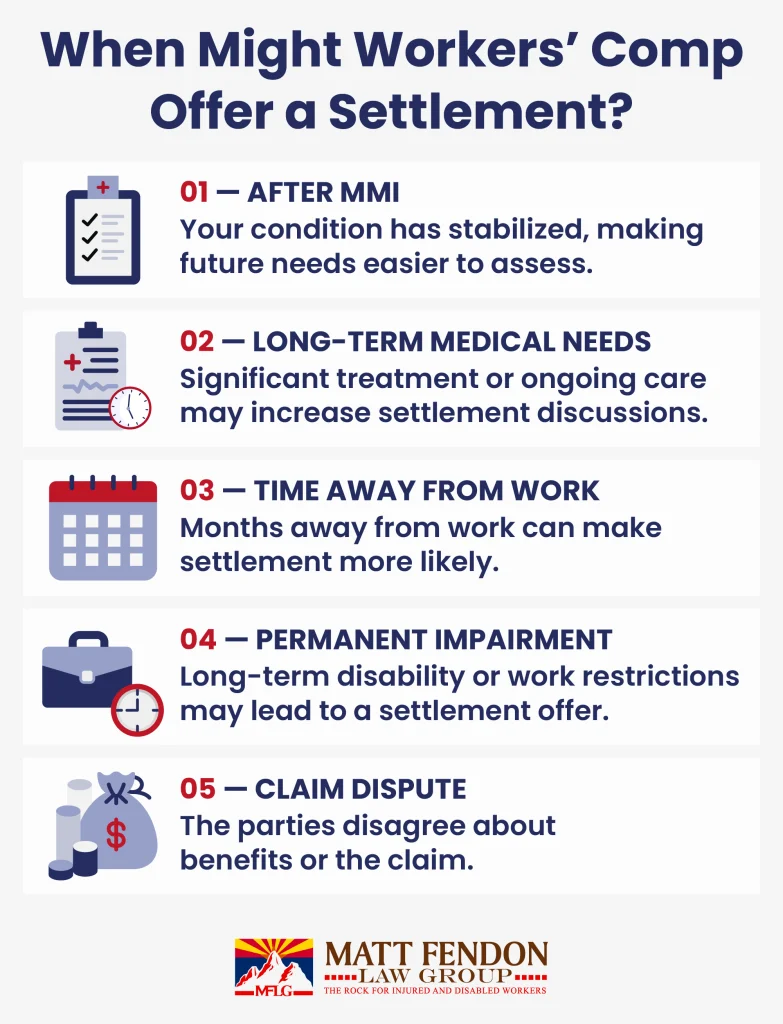
Whether and when a workers’ compensation insurer will make a settlement offer depends on factors including the nature of your claim, its supporting medical evidence, whether any disputes arise, and the willingness of you and the insurer to negotiate.
A key consideration about when the insurer is more inclined to make you a settlement offer is to remember that the insurance company is a for-profit business. It is in the insurer’s interest to keep settlement payouts as low as possible.
So, generally, the more the insurance company perceives the likelihood that you will need long-term care and benefits, the greater the chance becomes that it will seek to cut its losses by seeking to settle early.
Settlements are therefore more common for cases that involve months away from work, significant medical bills, or a permanent disability.
The ICA’s current Claims Adjusting Manual identifies disputed settlements, full-and-final settlements, supportive-care settlements, and lump-sum payments as forms of settlement. What follows are some common situations when you may receive a settlement offer.
After Your Temporary Disability Ends
If you are receiving temporary benefits under workers’ compensation, then these benefits may come to an end when your treating doctor determines that you have reached maximum medical improvement (MMI).
You may receive a settlement offer at this point because your medical condition has stabilized enough to make it easier to assess the long-term potential value of remaining issues, such as future medical needs, work restrictions, supportive care, permanent disability, and reduced earning capacity.
Insurance companies may offer to settle when you have recovered as much as possible but have not yet returned to your pre-injury condition as a way to avoid paying you permanent benefits if you are potentially facing a long or unpredictable recovery.
During a Genuine Dispute About Your Claim
You might receive a settlement offer if the insurance company is disputing your claim’s compensability or about your medical treatment, the nature or extent of your disability or impairment, or your loss of earning capacity.
In these cases, the kind of settlement offer you may receive may be affected because of the existence of the dispute. In particular, you may not receive a full and final settlement offer because the Arizona law that authorizes these kinds of settlements, Arizona Revised Statutes (ARS) 23-941.01, applies only to accepted claims.
Supportive-Care Settlement Agreements
ARS 23-941.03 permits final settlement of undisputed supportive medical maintenance benefits for known conditions after your temporary disability ends. The insurance company must provide a summary of reasonably anticipated supportive care and projected costs, identify the covered conditions, file the agreement, and obtain ICA approval.
What Is a Full-and-Final Settlement?
You can settle your workers’ compensation claim in one of two general ways. One way is through a settlement that allows you to possibly reopen your claim if your condition worsens or otherwise requires treatment that could not have been anticipated at the time you settled it.
The other possibility is a full and final settlement agreement.
Under current ARS 23-941.01, a full-and-final settlement allows you to agree to settle compensation, benefits, penalties, or interest on an accepted claim. This is often paid to you as a lump-sum settlement.
At the same time, you waive any future entitlement to benefits on your claim, including the future right to seek rearrangement of compensation under ARS 23-1044(F) and the future right to reopen your claim under ARS 23-1061(H) because of future complications in your medical needs.
If you have a lawyer and the statutory requirements are satisfied, then an ICA administrative law judge (ALJ) must approve the agreement.
If you are not represented, the approval process requires an ALJ to conduct an inquiry on the record to confirm your understanding and make specific findings. This inquiry can take place in person, by telephone, or via video conference.
During this hearing, the ALJ must make specific factual findings and conduct a detailed inquiry into whether the worker understands:
Some of these points of understanding include:
- The agreement must be written and signed by you and the insurance carrier, Special Fund, self-insured employer, or an authorized representative.
- The agreement must describe the medical conditions identified and contemplated by the settlement and attach detailed medical and indemnity disclosures supplied by the insurer.
- The agreement must identify reasonably anticipated future medical, surgical, and hospital benefits that it covers, their projected costs, and the method used to calculate them.
- The agreement must account for your total future indemnity benefits.
- The agreement must take into account your age, if applicable, your life expectancy, and the source used when determining life expectancy.
A full-and-final settlement agreement must also contain signed attestations that you understand the rights you are releasing, that treatment money should be set aside for your future industrial care, that the parties reasonably addressed Medicare and other government payors, that liens and unpaid medical charges were investigated, and that the settlement was not produced by coercion, fraud, duress, misrepresentation, or undisclosed side agreements.
Note that these safeguards in the claims process do not make the ICA or the ALJ your “advocate” in the same sense as if you had a lawyer to represent you. ICA guidance warns self-represented workers that the insurer will have counsel and that a workers’ compensation lawyer can advise you whether a settlement is in your best interest.
Once the ICA gives final approval to the agreement, payment must be made within 15 days. If the agreement ends medical benefits, the insurance company must notify the attending physician. The insurance company generally remains responsible for preapproval treatment not included in the settlement, unless that treatment is disputed or its payment was included in the agreement.
What Cannot Be Included in a Full-and-Final Settlement?
A full-and-final settlement cannot resolve issues that result in total and permanent disability under ARS 23-1045(C) or (D). It also may not include claims unrelated to your workers’ compensation claim.
Review the Rights Released by a Full-and-Final Settlement
ARS 23-941.01 permits settlement of all or part of an accepted claim, but defines a full-and-final settlement as waiving future benefits and the right to reopen or rearrange rights. Do not assume that calling an agreement “partial” preserves those rights; counsel should review the release and current ICA requirements.
Accordingly, if you are negotiating a full-and-final settlement agreement that purports to be “partial full-and-final,” you should have the exact release language and filing strategy reviewed by a workers’ compensation lawyer before signing it. There is no such settlement as a “partial full and final settlement.” Any settlement titled in that manner will be rejected by an ALJ. The term itself is contradictory.
Why a Quick Settlement Offer Deserves Careful Review
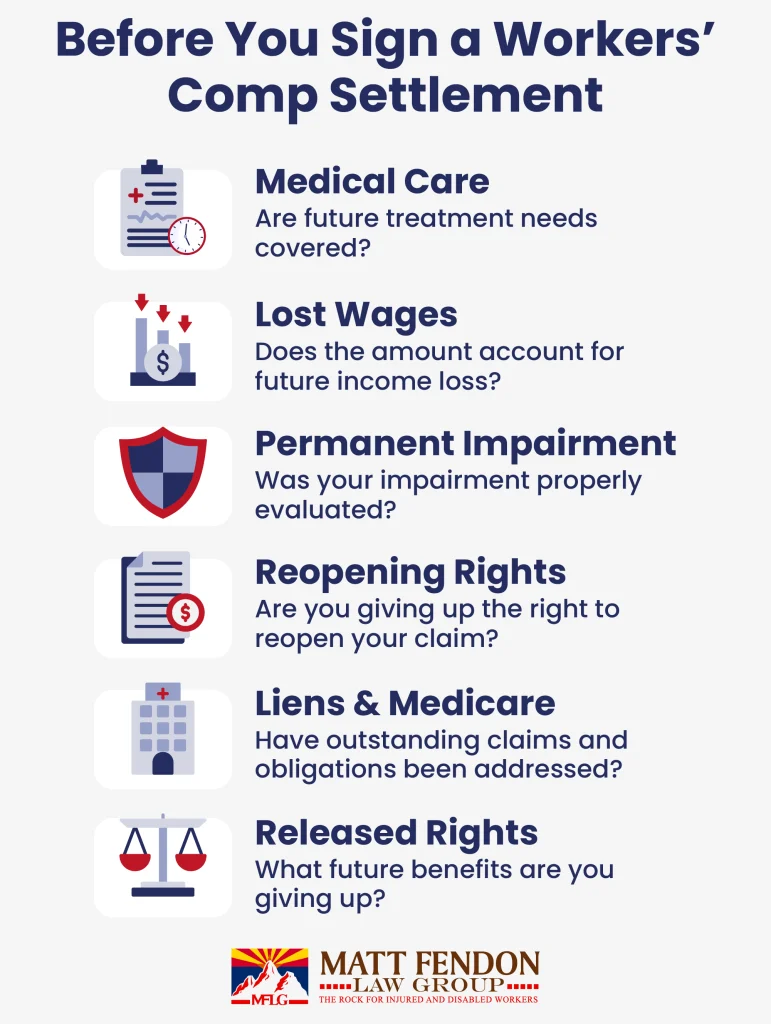
A settlement figure can look substantial without showing whether it is enough to replace the benefits that you are giving up in exchange. Before evaluating an offer, you should understand at least:
- Whether all your accepted medical conditions are listed.
- Whether your active treatment is complete.
- Whether any permanent impairment has been rated correctly.
- What future supportive or active ongoing medical care is reasonably expected.
- Whether you can return to the previous job you performed before your work injury or illness.
- How any loss of your earning capacity is calculated.
- Which claim reopening and rearrangement rights you are waiving.
- Whether bills, liens, and Medicare recovery claims have been resolved.
- What settlement amount will remain after fees, costs, liens, and required allocations are accounted for.
How Can a Workers’ Compensation Lawyer Help With Your Settlement?
As we have seen above, nothing in Arizona’s workers’ compensation law prevents you from being able to negotiate on your own with a workers’ compensation insurance company, but if you do so, then you may be at a disadvantage.
Most insurance companies have claim adjusters who are experienced, savvy negotiators whose loyalty is to the insurers they work for. These same insurance companies will have access to skilled workers’ compensation lawyers of their own.
The first offer may not fully account for future care, wage-loss benefits, or the rights you would release. Review the calculation and supporting evidence before deciding whether to accept it.
You can “level the playing field” in settlement negotiations by hiring an experienced workers’ compensation attorney of your own, like one Matt Fendon Law Group can give you.
Whether you should get a lawyer for your workers’ compensation case depends on your specific situation. There are many factors for careful consideration that can affect your financial future, including:
- The severity of your injuries.
- How long you will be out of work.
- If you have a pre-existing condition in your medical history.
- If your employer or insurance carrier disputes your claim.
- If there are delays in receiving compensation.
- If the settlement is insufficient for your future medical expenses or living expenses.
- If your employer has retaliated against you for filing a claim.
- The possibility of appeal and litigation if your claim is denied.
One of our workers’ compensation lawyers can review whether an insurer’s offer correctly accounts for accepted conditions, future medical care, impairment, earning capacity, present-value assumptions, settlement allocations, Medicare, liens, and the rights being released.
Ask for a written explanation of fees and costs.
Talk With a Matt Fendon Law Group Attorney About Your Settlement
If an insurer has made you an offer or is asking you to discuss a full-and-final settlement, a Matt Fendon Law Group workers’ compensation benefits attorney can evaluate the proposed terms, your benefits being released, and the long-term issues that may not be obvious from the gross settlement number.
Even if you decide to pursue your workers’ compensation claim without legal representation, speaking with an experienced Matt Fendon Law Group workers’ compensation attorney about your case before you initiate settlement discussions can be beneficial. A member of our legal team can explain Arizona’s workers’ compensation laws, the process of filing a claim, and how to get a fair settlement.
Call our law office any time, any day, at (800) 229-3880 to schedule a free consultation, or use our online contact form. You don’t have to go it alone when it comes to getting the maximum compensation you need in the workers’ compensation settlement process. Call Matt Fendon Law Group today before you accept any kind of settlement offer.