
There is no reliable single average for a torn meniscus workers’ compensation settlement in Arizona. Its value depends on the accepted injury, treatment, wages, work restrictions, permanent impairment, future care, and the rights being released. Each knee has two menisci, cartilage cushions that help stabilize movement and distribute weight between the thigh and shin bones.
Meniscus tears are common knee injuries, and Arizona workers’ compensation covers past and future medical costs associated with work-related meniscus claims as well as some wage replacement benefits.
In this guide, we at Matt Fendon Law Group cover the basics of what you need to know about meniscus tears at work and what you can receive through a workers’ compensation settlement for a meniscus injury.
If you have injured your knee while on the job, or if you have questions about Arizona workers’ comp and meniscus tears, call Matt Fendon Law Group at (800) 229-3880 or contact us using our online consultation form to schedule a free case evaluation with one of our experienced Arizona workers’ compensation attorneys.
How Does a Torn Meniscus Happen?
A torn meniscus can occur when your knee experiences a sudden, sharp twisting or turning force, especially when bearing weight. This force can cause a rip in the cartilage.
Meniscus tears are described by their shape and location; common patterns include radial, horizontal, flap, bucket-handle, and complex tears.
Work-Related Causes of Meniscal Tears
Not all meniscus tears happen at work, but especially if your job duties require extensive physical activities, then employment-related meniscus injuries can happen in several ways. Some of the most common of these causes are:
- Sudden twisting or turning movements, especially while your foot is planted and your knee is bent. Construction workers, warehouse workers, and delivery drivers are particularly susceptible to this kind of meniscus tear.
- Heavy lifting, particularly if you lack adequate knee support. Warehouse workers, movers, and manual laborers face this risk daily. When combined with a twist during the lift, the risk is especially high.
- Slips, trips, and falls, like landing hard on a knee after slipping or tripping. Wet floors, uneven surfaces, and construction sites are common settings for these injuries.
- Prolonged kneeling or squatting can place continuous pressure on your knees, contributing to wear and tear over time. Plumbers, electricians, carpet installers, tile workers, and mechanics frequently develop meniscus tears through this kind of cumulative trauma.
- Repetitive stress that puts strain on your knees can lead to gradual wear and, eventually, a meniscal tear.
- Collisions, including work-related car accidents or accidental collisions with machinery, equipment, or even other colleagues, can lead to direct trauma to your knees.
Torn Meniscus Symptoms
Common meniscus injury symptoms include:
- Feeling your knee give way when you try to use it or put weight on it.
- Difficulty fully straightening your knee.
- Feeling like your knee is locked in place when you try to use it.
- Chronic pain in the knee, especially when twisting or rotating your leg.
- A popping sensation in the knee.
- Swelling or stiffness in the knee.
It can take hours or even days for a torn meniscus injury to manifest fully, so even if you walk away after an injury-causing event, it is important to look out for any signs or symptoms that may indicate damage to your knee.
The Arizona Workers’ Compensation Framework for Meniscus Tears
Arizona workers’ compensation is generally a no-fault benefit insurance system. This means that you do not have to prove that the employer was negligent in causing your injury. In return, except for limited situations like intentional conduct of your employer in causing your injury, workers’ compensation is your sole remedy for a work-related injury or illness.
Potential workers’ compensation benefits you can receive for a meniscus tear injury include reasonably required medical care, temporary compensation for qualifying wage loss, permanent compensation, and, in appropriate cases, vocational rehabilitation.
The Industrial Commission of Arizona (ICA) regulates the Arizona workers’ compensation system and adjudicates disputes, while your employer’s insurance carrier ordinarily investigates the claim, accepts or denies it, pays benefits, and issues claim-status notices.
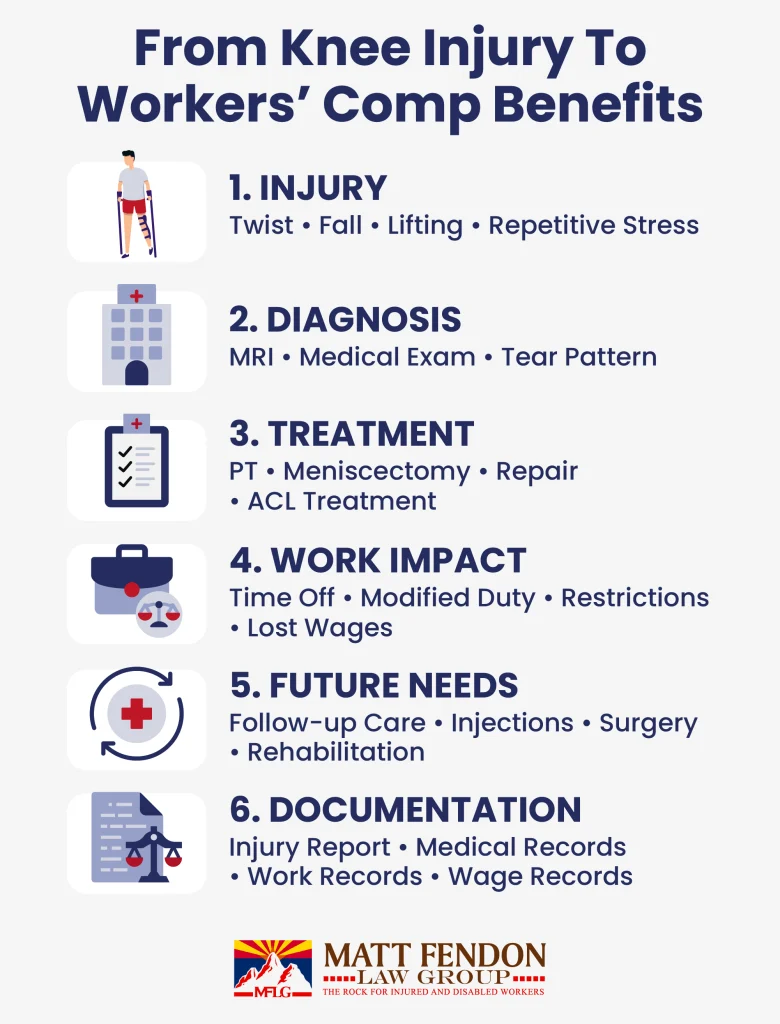
Claim Reporting, Filing, and Deadlines
Arizona requires you to report the accident and resulting injury to your employer “forthwith.” This means promptly under the circumstances. Your employer must then report the accident to its insurance carrier and the ICA within 10 days.
The employer’s report does not replace your responsibility to file a claim. Delayed reporting can create factual disputes and, in some circumstances, jeopardize your workers’ compensation benefits, although the ICA has statutory authority to excuse certain failures after an investigation.
You must file your written claim with the ICA within one year after the injury occurred or your right to compensation accrued. For a condition that is not immediately recognized as work-related, this one-year period begins when the injury becomes manifest or you know or with reasonable diligence you should know, that a compensable injury exists.
Once the ICA notifies the insurance carrier (or your self-insured employer, as the case may be) of your properly filed claim, then the insurance company generally has 21 days to accept or deny it.
For a meniscus claim, compensability commonly requires proof of legal causation (that your accident occurred in the course of your employment) and medical causation (that the work-related event caused, aggravated, or contributed to your diagnosed knee condition).
If the causal relationship of your meniscus tear is not obvious, then Arizona courts require competent medical testimony. If the doctors disagree, then an administrative law judge (ALJ) resolves the conflict based on the evidence.
If the insurer denies your claim, then you have 90 days to protest the denial or other adverse Notice of Claim Status through a written Request for Hearing to the ICA. A late filing ordinarily generally makes the insurer’s determination final.
Workers’ Compensation Benefits Potentially Available in Meniscus Tear Cases
Workers’ compensation settlements are based in large part on the value of the workers’ compensation benefits you would be expected to be eligible for if you do not settle your claim. Here are some of the main benefit categories that you, your workers’ compensation lawyer, and the insurance company will consider during claim settlement negotiations.
Medical Benefits
For a compensable claim, you are entitled to medical, surgical, hospital, nursing, medication, supplies, braces, crutches, and other treatment reasonably required at the time of injury and during disability.
For a meniscus tear, treatment may include evaluation, magnetic resonance imaging (MRI), orthopedic care, physical therapy, injections, arthroscopy, repair, meniscectomy, rehabilitation, and medically necessary follow-up.
Outside of ICA‑approved self-insured directed‑care programs under A.R.S. § 23‑1070, Arizona law allows the injured worker to choose the treating physician. The employer may send the worker for one evaluation, but this does not establish the attending doctor.
After that first visit you may choose a physician, but returning to the employer’s doctor can establish that physician as your attending doctor.
Once an attending doctor is selected, changing doctors ordinarily requires a referral, carrier agreement, or ICA approval.
The insurance carrier may require periodic independent medical examinations. Refusing or obstructing a properly requested examination can suspend compensation. If you believe an examination is unnecessary, cumulative, or improperly located, then you may seek a protective order, but you should not ignore the appointment.
Temporary Disability Compensation
Temporary disability provides partial wage replacement benefits during the time in which you are recovering from your injury. Forms of temporary disability include:
- Temporary total disability (TTD): ordinarily 66⅔% of your established average monthly wage while your injury temporarily prevents work.
- Temporary partial disability (TPD): ordinarily 66⅔% of the difference between your pre-injury wages and post-injury earning capacity while working under temporary restrictions.
- Waiting period: temporary disability compensation is not paid for the first seven days. It begins on day eight if your incapacity extends beyond seven days. If your temporary disability continues for one additional week, or 14 days total, then it is computed from the date of your injury.
A light-duty release does not by itself guarantee TPD payment. There must be a qualifying loss of earnings attributable to the injury. So, you must preserve every work-status note, modified-duty offer, pay stub, schedule, and monthly earnings report.
Permanent Disability: Scheduled or Unscheduled
A meniscus-only injury that produces permanent partial loss of use confined to your leg will ordinarily be analyzed under the leg schedule in ARS 23-1044(B). This statute assigns 50 months for complete loss of a leg; a partial-loss award uses the same schedule in proportion to the percentage of loss.
The monthly factor is generally 50% of your average monthly wage for partial loss of use, or 75% if the loss medically prevents your return to the work you performed when you were injured.
Your meniscus tear claim may instead become unscheduled if the symptoms functionally affect an unscheduled body part, if multiple qualifying impairments are involved, or because of certain prior permanent disabilities.
Unscheduled permanent partial compensation is based on your loss of earning capacity, generally 55% of the difference between your average monthly wage and your reduced monthly earning capacity.
The ICA considers your prior disabilities, occupational history, physical limitations, available work, post-injury wages, and age. A permanent impairment can, therefore result in no current monetary award if it causes no proven loss of earning capacity. Permanent total disability is generally compensated at 66⅔% of your average monthly wage.
When the treating or examining physician finds your knee medically stationary (also called reaching maximum medical improvement), the carrier may close your active benefits with or without permanent impairment. Supportive medical maintenance may be authorized to maintain function after the stationary date.
Claim Closure
If a closed accepted condition later presents a new, additional, or previously undiscovered condition, you may petition to reopen your claim with a supporting physician’s statement unless you surrendered that right in a full-and-final settlement.
Why Two Torn Meniscus Claims Can Have Very Different Outcomes
The pattern and location of your meniscus tear matter. Different injuries can have different effects on important factors like blood supply and healing potential and on how the injury affects your mobility, whether or when you can go back to work, and whether you can return to your previous job.
All of these considerations can influence the kinds of workers’ compensation benefits you may receive and the value of your claim’s potential settlement value.
Partial Meniscectomy vs. Meniscus Repair: Settlement Impact
The type of surgery you undergo—open or arthroscopic—is one of the most significant factors in your torn meniscus settlement, as are multiple surgeries.
The surgical approach alone does not determine settlement value. Documented treatment costs, recovery, work restrictions, permanent impairment, and future care are more useful measures.
The majority of meniscus surgeries are performed arthroscopically, through two or three small incisions using a camera and specialized instruments. Arthroscopic surgery is less invasive, heals faster, and has fewer complications. However, some complex tears, particularly those involving the meniscal root or posterior horn, may require mini-open or open surgical approaches.
The two primary arthroscopic procedures, partial meniscectomy and meniscus repair, have unique implications for your claim.
Partial Meniscectomy (Arthroscopic Trimming)
A partial meniscectomy removes damaged meniscal tissue. Recovery is often shorter than after repair but varies. Removing tissue can increase stress on knee cartilage and the risk of osteoarthritis; it does not make bone-on-bone contact or progressive arthritis inevitable.
If medical evidence supports a risk of future arthritis or the need for additional treatment, settlement discussions should account for the reasonably anticipated care and its projected cost. Do not assume every partial meniscectomy will require injections or a knee replacement.
Meniscus Repair (Arthroscopic Suturing)
A meniscus repair sutures the torn tissue together to preserve the meniscus. Rehabilitation usually takes longer than after partial meniscectomy, but weight-bearing restrictions and reinjury risk vary with the tear and repair method; follow the surgeon’s specific protocol.
A longer recovery or documented risk of additional treatment can affect temporary benefits and settlement value. A meniscus repair does not automatically produce a larger settlement than a partial meniscectomy.
ACL and Meniscus Combined Injuries
Combined anterior cruciate ligament (ACL) tears and meniscus tears are common in work-related injury cases. This is because the two structures work together to stabilize your knee. When the ACL ruptures, the sudden instability often damages the meniscus. Combined injuries can affect treatment, work restrictions, and long-term impairment, but do not establish a settlement ranking.
ACL reconstruction with concurrent meniscus repair requires extensive surgery and 6 to 12 months of rehabilitation and possible permanent disability based on significant functional loss, permanent instability risk, and a possible increased risk of arthritis. Impairment must be assessed without assuming that each injured knee structure produces a separately payable award.
Your Return-to-Work Timeline After Meniscus Surgery
Return-to-work timing affects temporary benefits and settlement value, but a calendar estimate is not medical clearance. The examples below are general planning illustrations; the surgeon’s restrictions and the actual demands of the job control.
- Partial meniscectomy, sedentary job: Return to work in 2 to 4 weeks. Minimal temporary disability benefits. Early return reduces settlement value but preserves earnings.
- Partial meniscectomy, physical job: Modified duty at 4 to 6 weeks, full duty at 8 to 12 weeks. Moderate temporary disability benefits. You may have permanent restrictions against deep squatting and repetitive kneeling.
- Meniscus repair, sedentary job: Return to work in 4 to 8 weeks with limited mobility. Extended period of crutch use (6 weeks typically). Significant temporary disability benefits.
- Meniscus repair, physical job: Modified duty at 3 to 4 months, full duty at 5 to 6 months if you are cleared for it. Some workers need longer restrictions or a different role; neither permanent work loss nor a higher settlement is inevitable.
- ACL + meniscus repair: Return to sedentary work at 2 to 3 months. Full physical duty may take substantially longer and requires individualized medical clearance.
What if the Insurance Company Claims Your Meniscus Tear is Because of Degeneration or Arthritis?
The cartilage in your knees tends to wear down with age. As you get older, the chance of a meniscus injury happening outside the context of a work injury increases. It is a common tactic by workers’ compensation insurance companies to make an apportionment claim that your meniscus tear injury is at least in part attributable to a naturally occurring cause, such as cartilage degeneration or knee arthritis.
Apportionment is a significant negotiation issue in torn meniscus settlement values. Meniscus tears are susceptible to apportionment based on insurer claims of age-related degeneration, degenerative versus traumatic tears, prior knee injuries, and in some cases obesity.
In apportionment knee-injury claims, Arizona law recognizes that workplace activities can aggravate pre-existing conditions. If your work activities cause a worsening of a knee condition beyond its natural progression, that aggravation is covered by workers’ compensation.
Arizona focuses on whether your work activity caused the aggravation. The insurer may still argue that your injury was pre-existing to minimize the claim. To overcome this argument, you need to prove that your accident or work duties changed, aggravated, or worsened the condition.
This requires demonstrating a clear mechanism of injury, contemporaneous medical notes that match the history, and objective findings showing that your work activity caused a worsening beyond natural degeneration. An experienced workers’ compensation attorney can challenge excessive apportionment by obtaining a report from a medical expert explaining that the work injury caused or aggravated the condition requiring treatment.
This is why prior knee records can have a significant impact on your workers’ compensation claim. Records showing no earlier symptoms, no prior restrictions, a materially different tear, or a clear change after the work event may support causation.
The ultimate conclusion should come from a combination of considerations, including a physician who has reviewed the cause of your meniscus tear, medical examination findings, medical imaging results, and prior medical records.
Preparing for Settlement: What You Should Document
Settlement negotiation success and the value of your settlement depend greatly on the evidence you present. Here are some persuasive forms of evidence to gather in advance.
- The initial injury report: the date, time, exact location, task, your body position, the direction of the twist or impact, whether your foot was planted, any pop, immediate pain, swelling, locking, instability, and why the activity was work-related. Identify witnesses and preserve the incident report.
- Medical treatment proof: emergency, clinic, orthopedic, therapy, and operative records; MRI images and report; X-rays; photographs of swelling; medication history; referrals; treatment requests and denials.
- The baseline: disclose relevant prior knee symptoms, imaging, injuries, injections, restrictions, or surgery accurately. Obtain the actual prior records so that medical experts can distinguish the old condition from the claimed work-related change.
- Work capacity: every no-work or light-duty note, permanent restriction, job description, physical-demand information, accommodation offer, missed shift, failed return-to-work attempt, and communication about restrictions.
- Wages: pay stubs, overtime and bonus information, W-2s, concurrent covered employment, schedules, and evidence explaining unusually high or low pre-injury periods. The presumptive wage base often begins with the 30 days before injury, but a broader method may be used when that period does not fairly represent earning capacity.
- Recovery: appointments attended, therapy completed, home exercises, symptom changes, functional milestones, complications, and reasons for any missed care. Your compensation may be reduced or suspended after appropriate proceedings for refusal of reasonably necessary treatment or conduct that impedes recovery.
- The claim file: ICA claim number, carrier correspondence, every Notice of Claim Status, wage determination, independent medical exam notice and report, hearing request, award, and proof of the date each document was received.
Arizona Meniscus Tear Workers’ Compensation Settlements
Arizona settlements differ in the rights they resolve. Some address specific disputed benefits or supportive care while preserving other rights; a statutory full-and-final settlement broadly waives future claim benefits. A payment structure alone does not determine which rights survive.
Settlements That Preserve Some Rights
Settlement under ARS 23-941.03 may resolve all or part of undisputed future supportive medical maintenance benefits for identified, known conditions after your temporary disability has ended.
The agreement must describe your conditions and projected supportive care costs, requires ICA approval, and applies only to the supportive care described. The insurance carrier remains responsible for your treatment and rights not covered by the agreement.
Full-and-Final Settlement
Under ARS 23-941.01, you may negotiate a full-and-final settlement of an accepted claim with the insurance company or a self-insured employer after your temporary disability has ended by final notice, ICA award, or stipulation.
Under ARS 23-1025, an employee’s agreement to waive compensation rights is generally void unless Arizona’s workers’ compensation law authorizes it. An ICA-approved full-and-final settlement under ARS 23-941.01 waives future benefits on the claim, including supportive care, and the rights to reopen or rearrange compensation.
By contrast, a separate supportive-care settlement under ARS 23-941.03 releases only future supportive medical maintenance benefits for the known conditions described in that agreement. Before signing, have counsel confirm the settlement type, the benefits and conditions it covers, and the rights you are releasing.
A full-and-final settlement agreement must be written and signed, describe your contemplated medical conditions, acknowledge your opportunity for counsel, and disclose anticipated future medical care and cost methodology, future indemnity calculations, present-value assumptions, and the portions allocated to medical and indemnity rights.
It must also address government payor interests, liens, unpaid medical charges, and the absence of coercion or undisclosed agreements. If you have legal representation, then a full and final settlement is approved when the statutory requirements are met. If you are unrepresented, then you must appear before an ALJ for a detailed inquiry.
Arizona’s full-and-final statute also requires reasonable steps to protect the interests of Medicare, Medicaid, the Indian Health Service, and Veterans Affairs.
Why Online “Average Workers’ Compensation Settlements” Are Not Predictive in Meniscus Tear Cases
Some law firms try to offer ranges for what you might anticipate in a typical settlement of torn meniscus cases. This attempt to calculate an average settlement value, however, is subject to considerable variation. An online average may mix denied and accepted claims; repairs and minor trimming procedures; workers with different wages; scheduled and unscheduled disabilities; claims with no impairment and claims with permanent work restrictions; open-medical agreements; and full-and-final releases.
A verdict summary differs from a workers’ compensation settlement, and a calculator cannot evaluate disputed causation, physician credibility, future surgery, an ACL or cartilage injury, prior disability, employability, Medicare, or the legal effect of release language.
Because of these factors, at Matt Fendon Law Group, we believe that the real knee injury settlements are highly dependent on your specific facts. This is why we recommend that you contact us to schedule a free consultation and case evaluation before we discuss the potential settlement value of your claim.
Factors That Can Affect the Value of Your Meniscus Tear Settlement
No matter which form of settlement you choose, when negotiating your claim value, you will need to address multiple considerations with the insurer. Some of the more important factors that can influence your settlement value include:
- The severity of the tear: A more extensive or complex tear might result in a higher settlement due to increased medical costs and recovery time.
- Your medical bills: The total cost of knee surgeries, therapies, medications, and other treatment plans can significantly affect the settlement amount.
- Your lost wages: Compensation for missed workdays, reduced earning capacity, or permanent disability can increase the settlement’s value.
- Your future medical needs: If you need ongoing treatment, therapy, or future surgeries, this can increase the settlement amount.
- Job requirements: The nature of your work, including whether it involves heavy lifting or prolonged standing that you can no longer tolerate, can influence the settlement value.
- Your legal representation: Counsel can assess the evidence, benefit calculations, and rights being released, but cannot guarantee a better result.
Principal Claim Value Drivers
The table below covers additional factors specific to meniscus tear cases and how they can affect settlement value.
| Factor | Why it matters in an Arizona meniscus tear claim |
| Injury mechanism and tear pattern | A well-documented pivot, fall, direct impact, squat, or twist that is medically consistent with the diagnosed tear may strengthen causation.A vague history, conflicting dates, or imaging findings described as degenerative may lead to a more contested claim. |
| Prompt, consistent medical evidence | Early reporting, examination findings, swelling, locking, loss of motion, contemporaneous work history, and a reasoned medical opinion can be more persuasive than a diagnosis recorded long after the event. |
| Conservative treatment versus surgery | A claim resolved with limited treatment and full-duty release presents different medical and wage exposure from one requiring arthroscopy, repair, repeat surgery, or prolonged rehabilitation. |
| Repair versus meniscectomy | General rehabilitation benchmarks are approximately three to six months after repair and three to six weeks after partial meniscectomy.Actual recovery and work release depend on the tear, procedure, job demands, complications, and treating surgeon. |
| Other knee structures | ACL or other ligament injury, cartilage damage, fracture, bone bruising, instability, or post-traumatic arthritis may expand treatment, restrictions, impairment, and future-care questions.Multiple injured structures do not automatically determine whether a disability is legally scheduled or unscheduled. |
| Lost time and restrictions | “No work,” modified duty, standing/walking limits, kneeling or climbing restrictions, and whether the employer can accommodate them affect temporary wage-loss exposure.Permanent inability to perform the date-of-injury occupation can also change a scheduled-benefit formula. |
| Your average monthly wage | Compensation is tied to the legally established average monthly wage, not an internet settlement chart.For injuries occurring during the calendar year 2026, the statutory maximum average monthly wage is $6,131.00. |
| Permanent impairment and future care | A permanent lower-extremity rating, ongoing restrictions, supportive care, a probable need for additional surgery, or a credible risk of reopening can materially affect the rights under discussion.Arizona uses the most recent applicable American Medical Association Guides as a rating reference, but the Arizona Supreme Court has cautioned against blind application where the Guides do not accurately address the impairment. |
Talk with Matt Fendon Law Group About Your Meniscus Tear Claim
Like all Arizona workers’ compensation claims, a torn meniscus claim requires careful preparation and is deadline-dependent. Matt Fendon Law Group can guide you when it comes to evaluating medical opinions, imaging results, wage calculations, work restrictions, scheduled-versus-unscheduled classification, future-care exposure, and exact settlement language for your individual claim.
Our highly experienced workers’ compensation attorneys focus on representing injured workers in all kinds of work-related injury and illness claims, including knee injury cases.
To request case-specific advice, contact Matt Fendon Law Group through our online contact form or call us at (800) 229-3880.