Averages for workers’ compensation stress claim settlement amounts range from $5,000 to $50,000. However, the value of your particular claim is dependent on Arizona law and the details of your case.
Matt Fendon Law Group represents Arizona workers in all types of compensation claims, including those for stress. This post addresses stress claims based on working conditions.
To learn how to pursue a claim in Arizona, or for help filing, call Matt Fendon Law Group in Phoenix or Scottsdale at (602) 562-9111 or contact us online to speak with an experienced lawyer.
What Affects a Workers’ Compensation Stress Claim Settlement Amount in Arizona?
You may find workers’ compensation stress claim settlement amounts online ranging from $5,000 to $50,000 or more, but these are national estimates that reflect different states’ benefit structures. Arizona calculates workers’ compensation benefits using statutory formulas, so national averages do not reliably predict what your claim may be worth.
In Arizona, the value of a stress-related settlement depends on the severity of your diagnosed condition, the duration of your disability, your medical treatment costs, your permanent impairment rating, and whether your claim is accepted or disputed by the insurance carrier. Temporary total disability benefits, for example, are calculated at two-thirds of your average monthly wage up to a statutory cap.
Note that Arizona workers’ compensation does not include damages for pain and suffering. Pain and suffering may only be pursued through a separate third-party personal injury claim if someone other than your employer contributed to your injury.
What is the General Rule in Arizona for Stress or Mental Injury Workers’ Compensation Claims?
Stress by itself is not usually covered under Arizona workers’ compensation. Arizona Revised Statutes (ARS) Section 23-1043.01(B) says a mental injury, illness, or condition counts only if one of these factors is a main contributing cause:
- A work-related compensable physical injury caused your mental health condition; or
- Your mental health condition was the result of an unexpected, unusual, or extraordinary work-related stress.
If your mental injury, illness, or condition is the result of identifiable physical trauma at your job, then Arizona workers’ compensation generally treats this the same as a physical injury claim if you can provide medical evidence that links your mental health condition to the physical injury. The work injury must be a substantial contributing cause of the mental health condition (ARS Section 23-1043.01(B)).
This statute covers all Arizona workers, including firefighters and certified peace officers, who can also receive workers’ compensation for PTSD treatment outlined below.
Claims not tied to physical injuries are subject to a higher proof standard. You must show your stress was work-related and also unexpected, unusual, or extraordinary for your job, and the job-related stress was a substantial contributing cause of the mental health condition.
Routine or predictable workplace stress—such as deadlines, heavy workloads, discipline, or conflicts—does not qualify for workers’ compensation.
What to Do if You Are Considering Filing a Claim for Mental Stress
If you think workers’ compensation covers your work-related stress or a mental health condition affecting your ability to work, take these steps to prepare your claim:
- Seek medical evaluation from a licensed practitioner familiar with work‑related injuries.
- Document everything related to your symptoms, events at work, and medical treatment.
- Notify your employer promptly about your injury as required by Arizona’s workers’ compensation laws.
- Consult a workers’ compensation attorney experienced in psychological injury claims.
What Evidence Supports a Stress-Related Workers’ Compensation Claim in Arizona?
You must prove that your work caused your mental injury, illness, or condition. Provide evidence linking your condition to your employment.
Here are the kinds of evidence that can be persuasive in supporting a workers’ compensation claim in Arizona.
Medical Documentation Evidence
You need competent medical evidence to support your claim. Without it, your claim will fail.
This evidence can consist of a formal diagnosis by a qualified medical professional of a condition, like PTSD, a major depressive disorder, or an anxiety disorder, with a causation opinion stating that your employment has caused your mental health condition.
Proof of the Stressful Event or Events
If your claim is not tied to a physical injury, you must provide both medical and objective evidence of specific, identifiable stressful work events that directly caused your claim. Show your stress exceeded ordinary workplace stress or pressure.
Examples of persuasive job-related stress evidence here can be:
- Incident reports
- Employer records
- Police, emergency, or accident reports
- Emails, radio logs, or dispatch records
- Witness statements or testimony
Evidence the Stress Was “Unexpected, Unusual, or Extraordinary”
This requirement is the most difficult to prove and is the main reason most claims fail. You need to show your stress was unexpected, unusual, or extraordinary for your specific job—not just traumatic. Would someone with your training and job duties find this stress unexpected, unusual, or extraordinary?
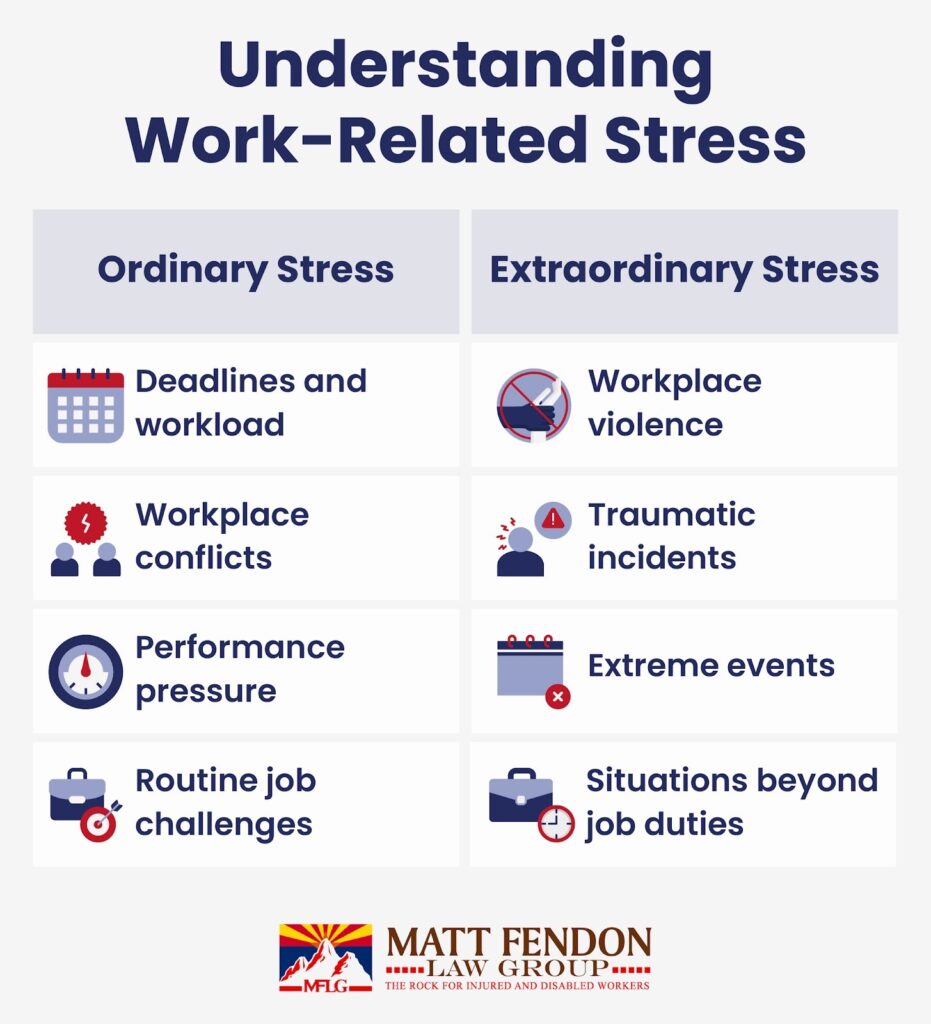
For example, workplace violence may be unexpected, unusual, or extraordinary if you work in an office environment, but if you are a police officer, it may not be.
Relevant evidence here includes:
- Job descriptions and training materials
- Testimony about what is routine as opposed to exceptional in your occupation
- Expert testimony from your supervisors or industry experts
- Comparative evidence that shows how often similar incidents occur in your job
Temporal and Causal Connection Evidence
Show your symptoms started after the work event, and that no other more likely non-work cause exists. Prove this with:
- Medical diagnosis and medical records of treatment
- Showing the absence of prior similar symptoms
- Testimony regarding when your symptoms began
If you had a pre‑existing mental health condition, this does not necessarily bar a subsequent workers’ compensation claim, but you will need to prove that events at your job aggravated that pre-existing condition.
Special Rules for First Responders
ARS 23-972 provides for coverage and authorized treatment for firefighters and certified peace officers after a PTSD claim has been accepted under Arizona workers’ compensation law.
This statute does not create a presumption of PTSD. A firefighter or certified peace officer must still first meet the requirements of ARS 23-1043.01(B) above, specifically that the PTSD must be the result of stress that is unexpected, unusual, or extraordinary for the profession of a firefighter or certified peace officer (Matthews v. Industrial Commission of Arizona, 251 Ariz. 561 (2022)).
ARS 23-972 authorizes workers’ compensation to pay for one complete course of treatment with midomafetamine prescribed by a health care provider if an independent medical examination deems it reasonable and necessary, and the treatment follows the treatment guidelines established by the Industrial Commission of Arizona (the ICA).
However, this provision is conditionally enacted and only takes effect upon FDA approval of midomafetamine-assisted therapy for the treatment of PTSD. As of this writing, the FDA has not approved this treatment, so this provision has not yet been triggered.
The following table summarizes how Arizona workers’ compensation applies to claims arising from mental injury, illness, or condition.
| Statute | Purpose |
|---|---|
| ARS 23‑1043.01(B) | Governs compensability of PTSD and mental‑stress claims (unexpected/unusual/extraordinary stress) |
| ARS 23‑972 | Provides coverage and authorizes treatment after PTSD claim is accepted (firefighters & peace officers only) |
| Matthews v. ICA (2022) | Confirms strict application of ARS 23‑1043.01(B) to first responders |
Why Stress-Related Workers’ Compensation Claims Succeed or Fail
The following table summarizes common factors that lead to successful or unsuccessful claims for Arizona workers’ compensation benefits for a work-related mental injury, illness, or condition.
| Elements of a Successful Claim (All must be proven) | Reasons for Claim Denials (Any will suffice) |
|---|---|
| You have a clear medical diagnosis of a mental injury, illness, or condition | The stress you experienced was ordinary job stress |
| Your medical evidence includes a clear medical causation opinion | You do not have a clearly diagnosed mental injury, illness, or condition by a qualified medical professional |
| You have proof of a specific work event that led to the mental injury, illness, or condition | The medical opinion evidence in support of your claim was vague or conclusory in nature |
| Your evidence shows that the event was extraordinary in relation to your job | Your claim does not include readily identifiable extraordinary event that led to the mental injury, illness, or condition |
| Your evidence shows a timeline linking your symptoms to the extraordinary event | Employer evidence contradicts your description of the workplace conditions or the events that you claim caused the mental injury, illness, or condition |
How Other Laws Can Interact With Workers’ Compensation Claims for Stress
Some other federal laws can apply in specific situations to work-related stress claims.
Federal Workers and Psychiatric Injuries
Federal employees and certain specialized worker classes are covered by federal workers’ compensation programs, such as the Federal Employees’ Compensation Act administered by the U.S. Department of Labor. These programs have their own rules for compensable conditions, including stress and mental injury, based on federal standards and medical evidence.
How Stress Leave and Workers’ Compensation Intersect
If your stress or mental health condition qualifies as a serious health condition, you may be entitled to job‑protected leave under the federal Family and Medical Leave Act (FMLA) under the U.S. Department of Labor while you pursue medical treatment. FMLA leave is separate from workers’ compensation, but it can be used concurrently in some cases.
Do You Have Questions About Stress and Workers’ Compensation?
For workers’ compensation benefits purposes, stress-related harm can be hard to prove when compared to physical health claims. This is why it is important to work with an experienced Arizona workers’ compensation law firm when you are considering making such a claim, and when you are preparing your claim.
Your supporting medical and other evidence will be key to a successful benefits claim. A skilled Arizona workers’ compensation attorney can help you gather and organize your supporting evidence to present a strong case to the ICA and your employer’s insurance company.
Matt Fendon Law Group’s workers’ compensation attorneys have decades of combined experience representing injured workers, including those with claims based on work-related stress. If you believe that you are experiencing stress or mental health issues because of conditions or an event at your work, call us at (800) 229-3880. Or you can use our contact form to schedule a free, no-obligation consultation with an experienced workers’ compensation attorney about your work-related stress injury.