Carpal tunnel syndrome is one of the most common repetitive stress injuries in the workplace. Employees who spend years typing, assembling products, operating machinery, scanning items, using vibrating tools, or performing other repetitive hand and wrist movements may eventually develop symptoms that interfere with their ability to work.
Fortunately, Arizona workers’ compensation benefits may be available for qualifying repetitive-motion injuries. A successful claim can provide medical treatment, wage-replacement benefits, and, in some cases, a workers’ comp settlement that reflects the condition’s long-term effects.
If you developed carpal tunnel syndrome because of your job, the Scottsdale workers’ comp attorneys at Matt Fendon Law Group can help.
Call Matt Fendon Law Group today at (800) 229-3880 for a free consultation.
Can Carpal Tunnel Qualify for Arizona Workers’ Compensation?
Arizona workers’ compensation law covers many repetitive stress and repetitive motion injuries, including carpal tunnel syndrome, when the condition is related to employment.
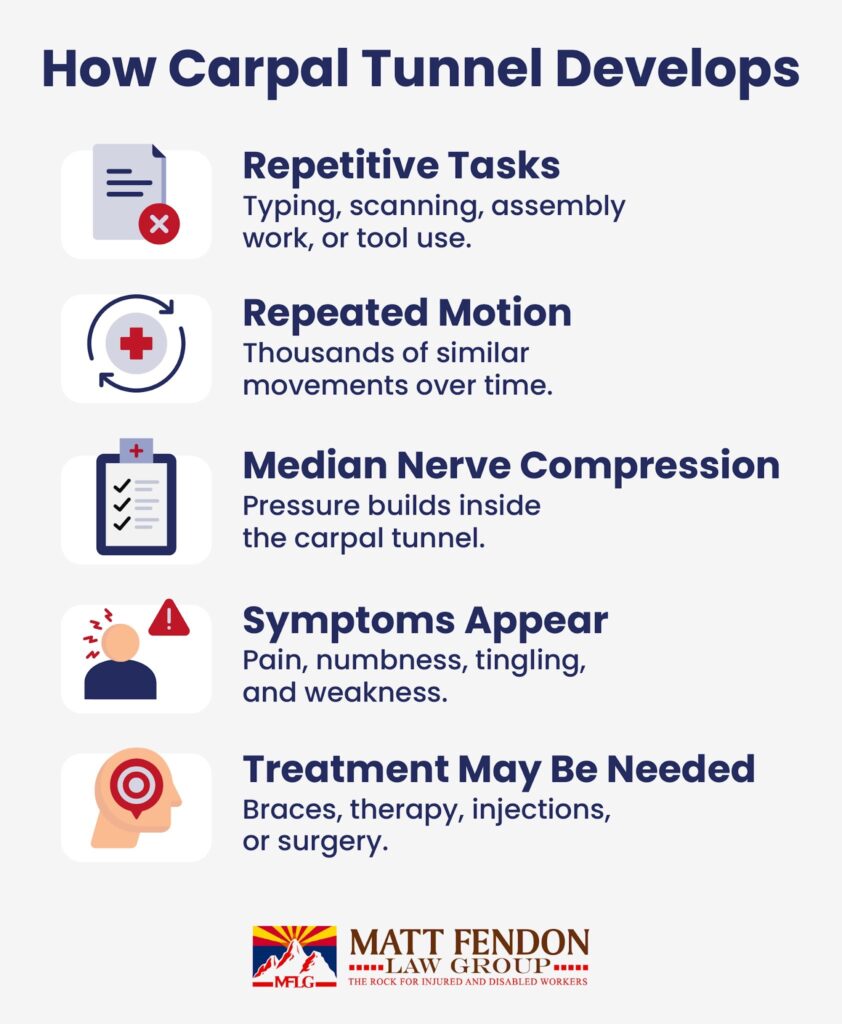
Unlike a traumatic workplace accident, a repetitive strain injury develops gradually. Workers often perform the same movements thousands of times over months or years before symptoms become severe enough to require medical treatment.
Because repetitive injuries develop slowly, timing matters. In Arizona, you generally have one year to file your claim with the Industrial Commission of Arizona.
For a gradual condition like carpal tunnel syndrome, that one-year clock typically starts when you knew — or should have known — that your condition was related to your work, rather than on a single accident date.
A successful workers’ comp claim generally requires evidence showing that workplace duties substantially contributed to the condition. Common examples include:
- Data entry and typing positions
- Assembly line work
- Manufacturing jobs
- Cashier positions
- Construction work involving vibrating tools
- Warehouse work
- Mechanical repair jobs
- Repetitive hand-intensive occupations
The fact that carpal tunnel syndrome can also occur outside of work does not automatically prevent benefits. The key issue is whether the work activity contributed to the injury.
Workers’ comp provides medical treatment and wage-replacement benefits, but it does not pay for pain and suffering. Those damages are only available through a separate personal injury claim against a negligent third party.
Understanding Carpal Tunnel Syndrome
Carpal tunnel syndrome occurs when the median nerve becomes compressed as it passes through the carpal tunnel in the wrist. Pressure on the median nerve can cause pain, numbness, tingling, weakness, and loss of grip strength in the hand and fingers.
Many workers first notice symptoms while performing routine tasks. Over time, the condition can progress from occasional discomfort to significant limitations that affect both work and daily activities.
Common symptoms of carpal tunnel syndrome include:
- Numbness in the thumb, index finger, middle finger, or ring finger
- Tingling sensations in the hand
- Burning pain that may travel up the arm
- Weakness in the hand or wrist
- Difficulty gripping objects
- Frequent dropping of tools or other items
Without treatment, carpal tunnel symptoms may worsen and eventually require surgery.
What Is the Average Settlement for Carpal Tunnel Workers’ Comp Claims?
There is no universal settlement amount for every workers’ comp carpal tunnel settlement.
Some claims resolve for relatively modest amounts, while others result in significantly larger recoveries when surgery, permanent impairment, or long-term work restrictions are involved.
Nationally, the average cost of a carpal tunnel workers’ compensation claim was roughly $34,055 in 2020–2021, according to the National Council on Compensation Insurance. In Arizona, settlements involving nerve-damage conditions like carpal tunnel syndrome are often cited in the range of about $15,000 to $60,000.
These figures are national and regional estimates only — they are not a prediction or guarantee of what any individual claim is worth. Every case is different, and the actual value depends on your wages, your impairment rating, and the findings of the Industrial Commission of Arizona.
Factors That Affect a Workers’ Comp Carpal Tunnel Settlement
Several factors can significantly increase or decrease the value of a carpal tunnel workers’ comp settlement.
Severity of the Injury
Mild symptoms that respond to conservative treatment generally produce smaller settlements than severe cases involving permanent nerve damage.
Workers who experience ongoing pain, weakness, numbness, or loss of function often have higher-value claims.
Whether Surgery Is Required
The need for carpal tunnel surgery frequently affects settlement value.
Workers who undergo carpal tunnel release surgery usually incur higher medical expenses and longer recovery periods than those treated with braces, medication, or injections alone.
Depending on the circumstances, treatment may involve:
- Open release surgery
- Endoscopic release procedures
- Post-surgical therapy
- Extended medical treatment
Cases involving surgery often yield larger workers’ comp settlement values because the injury’s overall impact is greater.
Ability to Return to Work
A worker who fully recovers and returns to the same position may have a different claim value than someone who can no longer perform the job.
Long-term restrictions, reduced earning capacity, or permanent inability to perform previous duties can substantially affect a settlement.
Dominant Hand Versus Non-Dominant Hand
In many occupations, injury to the dominant hand creates greater functional limitations than injury to the non-dominant side.
The impact can be even more significant when the condition is bilateral, meaning both hands are affected.
This distinction has a concrete basis in Arizona law. A hand injury is treated as a “scheduled” injury under A.R.S. § 23-1044(B), which sets benefits based on a fixed schedule.
Permanent loss of use of the dominant hand is compensated at 55% of your average monthly wage for 50 months, while the non-dominant hand is compensated for 40 months. Carpal tunnel syndrome usually causes a partial loss of use rather than a total one, so these figures are typically prorated to match the percentage of impairment a doctor assigns.
Occupation
The same diagnosis can have very different consequences depending on the worker’s job.
For example:
- A data entry employee whose job requires constant typing may experience major work limitations.
- An assembly line worker may be unable to perform repetitive production tasks.
- A mechanic may struggle with grip strength and using tools.
The effect on future employment opportunities often becomes part of settlement negotiations.
Permanent Impairment Rating
Some workers receive a permanent impairment evaluation after reaching maximum medical improvement.
A physician may assign an impairment rating using recognized standards, including the AMA Guides. The rating can affect eligibility for certain benefits and may influence settlement discussions.
How Is Carpal Tunnel Syndrome Diagnosed?
Medical evidence plays a central role in any workers’ comp claim involving carpal tunnel syndrome.
A physician may begin with a physical examination and a review of symptoms. However, insurance carriers often require objective medical testing before accepting a claim or agreeing to a workers’ comp settlement.
EMG Testing
An EMG (electromyography) evaluates how well muscles and nerves function. EMG results can help physicians determine the severity of nerve damage and rule out other conditions.
Nerve Conduction Studies
A nerve conduction study measures how quickly electrical signals travel through the median nerve. Slowed conduction can indicate compression consistent with carpal tunnel syndrome.
Because EMG and nerve conduction studies provide objective findings, they often serve as key evidence in settlement negotiations and workers’ compensation hearings.
How Long Does a Carpal Tunnel Workers’ Comp Claim Take?
The timeline varies from case to case.
Some claims resolve within several months. Others take a year or longer, particularly when surgery is involved or when the insurance carrier disputes the claim.
A typical timeline may include:
- Reporting the injury
- Medical evaluation
- Diagnostic testing, such as an EMG or nerve conduction study
- Acceptance or denial of the claim
- Medical treatment
- Recovery period
- Evaluation for permanent impairment
- Settlement negotiations
In many cases, it is difficult to determine the value of a workers’ comp settlement until treatment is complete and physicians understand the injury’s long-term effects.
Why Are Some Carpal Tunnel Claims Denied?
Insurance companies do not automatically approve every workers’ comp claim involving carpal tunnel syndrome.
Common reasons for denial include:
- Allegations that the condition is unrelated to work
- Preexisting medical conditions
- Insufficient medical evidence
- Disputes regarding repetitive stress exposure
- Failure to report symptoms promptly
- Questions regarding causation
Strong medical documentation often plays a critical role in overcoming these challenges.
When Should You Speak With a Workers’ Comp Lawyer?
A workers’ compensation attorney can help at any stage of the process, but legal representation becomes particularly important when:
- Your claim has been denied
- Surgery has been recommended
- The insurer disputes whether the condition is work-related
- You cannot return to work
- You have permanent restrictions
- A settlement offer seems inadequate
The value of a workers’ comp carpal tunnel settlement often depends on issues that are not immediately obvious, including future medical expenses, impairment ratings, work restrictions, and lost earning capacity.
Speak With a Scottsdale Workers’ Comp Attorney Today
Carpal tunnel syndrome can affect every aspect of your career, from daily job duties to long-term earning potential. Whether your condition resulted from typing, assembly line work, tool vibration, or another repetitive motion activity, Arizona workers’ compensation benefits may be available.
The Scottsdale workers’ comp attorneys at Matt Fendon Law Group help injured employees pursue the benefits and compensation they deserve after a workplace injury.
Call (800) 229-3880 or contact us online today for a free consultation with an experienced Arizona workers’ compensation lawyer.