
Arizona does not impose a single, universal end date on every workers’ compensation claim.
How long your benefits last depends on multiple factors, including your necessary medical care, how long you need temporary wage-loss payments, and whether you are entitled to receive permanent disability compensation.
These benefits are subject to different rules, and one benefit can end while another continues. Which Arizona workers’ compensation benefits you can receive after a work-related injury or illness, and how long you can receive them, is a matter that Matt Fendon Law Group can help you to understand. Our experienced workers’ compensation attorneys work with injured workers to file workers’ comp benefits claims, negotiate with insurance companies to settle claims, and appeal denied claims.
To learn how long you can receive the maximum amount of workers’ compensation benefits you deserve, call our law office at (800) 229-3880 or use our online contact form.
Arizona Benefits Do Not All Run on the Same Clock
Arizona’s workers’ compensation law provides for benefits you need during a period of disability. This includes compensation for reasonably necessary medical expenses, temporary compensation until you reach your point of maximum medical improvement (MMI), and permanent compensation in qualifying cases after you reach MMI.
For example, you may return to a light-duty job and stop receiving temporary total disability payments while continuing to receive medical treatment. Or, you might finish active medical treatment but qualify for a scheduled permanent award or an unscheduled award based on reduced earning capacity.
So, the answer to how long your workers’ compensation benefits last depends on which benefit you are receiving, your medical status, any work restrictions, your earnings, and whether you have a permanent impairment.
The easiest way to understand how long you can be on workers’ compensation is to separate the main categories of benefits available under Arizona workers’ compensation.
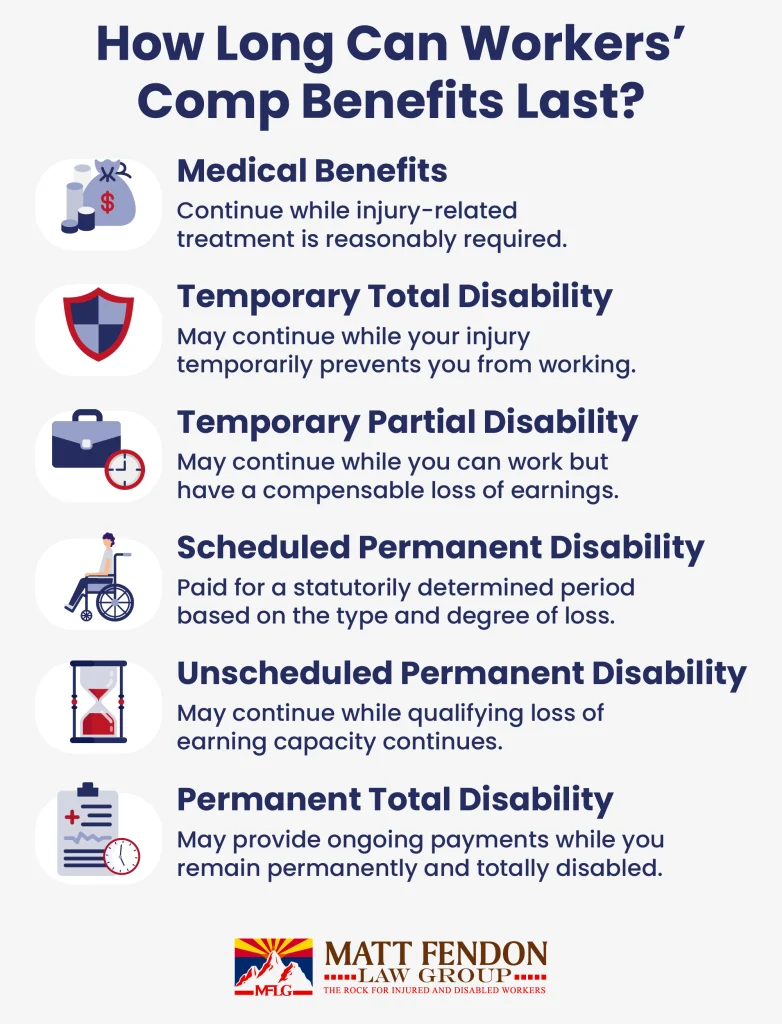
| Benefit | General duration |
| Medical benefits | Medical benefits continue while treatment related to the accepted injury is reasonably required.Active treatment may end when you become medically stationary, although qualifying supportive care may continue. |
| Temporary total disability | This is paid to you during the period while you are temporarily unable to work, subject to Arizona’s waiting-period rules and other eligibility requirements. |
| Temporary partial disability | You can receive this partial benefit while you can work, but have a compensable reduction in your earning ability during the temporary disability period. |
| Scheduled permanent disability | This benefit is paid to you for a statutorily determined number of months, based on the listed body part and degree of loss. |
| Unscheduled permanent partial disability | This is based on your loss of earning capacity. It may continue while your qualifying disability continues, subject to later adjustment if your earning capacity changes. |
| Permanent total disability | If you qualify, Arizona law provides for ongoing payments during your lifetime. |
How long you can receive benefits under workers’ compensation is subject to disputes with your employer’s workers’ compensation insurer or your employer if it is self-insured. Examples of such disputes can be whether your medical treatment is still necessary, whether you can return to suitable employment, whether your physical restrictions are injury-related, whether your impairment is permanent, and how your earning capacity should be measured.
How Long Do Medical Benefits Last?
Under workers’ compensation, you can receive medical treatment, surgery, hospital visits, nursing care, medication, medical supplies, prosthetic devices, and other treatment reasonably required at the time of your injury and during the period of your disability.
Arizona workers’ compensation law does not set a fixed number of doctor visits, treatment months, or years of medical care. Instead, the central questions are whether your care remains reasonably required and whether it is related to an accepted industrial injury.
Medical benefits are separate from partial-wage-replacement disability checks. The Industrial Commission of Arizona (ICA) distinguishes a medical-only claim, in which injury-related medical expenses are paid but no temporary compensation is due, from a time-loss claim, in which you can receive both medical treatment and qualifying wage-loss compensation.
This means that returning to work does not necessarily mean that all your medical care must stop.
For a medical-only claim, your medical bills generally continue to be paid until your doctor states that you need no further treatment. If you voluntarily stop treatment, however, then the insurance carrier may seek to close your claim without a formal discharge from the doctor. So, attending your medical appointments, following your treatment plan, and promptly addressing gaps in your care can be important in preserving your right to receive medical care.
What Happens When Your Active Treatment Ends?
Your treating doctor may eventually find that you have reached your point of MMI. This does not necessarily mean that you feel completely recovered. It generally means that the doctor believes your condition will not materially improve with additional active treatment.
At this point, the workers’ compensation insurer may issue a Notice of Claim Status to close your claim for active benefits.
If you still need limited treatment to keep a stationary condition stable, the ICA describes the situation as supportive care. Supportive care is not automatic, and whether you receive it depends greatly on your medical evidence.
How Long Do Temporary Disability Benefits Last?
Arizona’s temporary disability statutes describe temporary benefits compensation as payable during your period of disability. Temporary benefits generally continue while your accepted temporary condition remains and you are experiencing a qualifying loss of earnings.
Temporary benefits may end or change when you return to work, are released to a different work status, become medically stationary, or no longer have a compensable wage loss.
Temporary Total Disability Benefits
Temporary total disability, often called TTD, generally applies when your work injury temporarily prevents you from working. Arizona law sets TTD compensation at two-thirds (66⅔ percent) of your established average monthly wage, subject to the applicable statutory wage limit. You receive TTD during the period of your temporary total disability.
Arizona has a waiting period for receiving disability compensation for lost wages:
- Compensation is not paid for the first seven days after your workplace injury.
- If your incapacity lasts longer than seven days, then your TTD compensation begins on the eighth day.
- But if your disability continues for one additional week beyond those first seven days, then TTD compensation begins from the date of your injury.
Temporary Partial Disability Benefits and Light Duty
Temporary partial disability, or TPD, can apply when your doctor permits you to return to work with restrictions, but your injury still reduces what you can earn. Arizona law generally calculates TPD as 66⅔ percent of the difference between your pre-injury wages and the wages you can earn afterward.
Work restrictions alone do not necessarily support TPD compensation. Accurate work-status notes, pay records, schedules, and documentation of modified-duty offers can be important.
- If modified work is available to you without a qualifying wage difference, the statutory formula may result in no TPD payment.
- If you earn less due to injury-related restrictions, the wage difference may support temporary partial compensation.
What Happens When Your Condition Becomes Medically Stationary?
Your MMI, or medically stationary status, is often a turning point in the kind of workers’ compensation benefits you can receive, but it is not necessarily the end of every benefit available to you. Once your active treatment is complete, your claim may close without permanent impairment, close with supportive care, or proceed to a permanent-disability determination.
How Long Do Permanent Disability Benefits Last?
If your medical evidence supports a permanent impairment, the next question is whether your impairment is scheduled or unscheduled. This classification can substantially affect both how the award is calculated and how long you can receive payments.
Scheduled Permanent Injuries
Arizona’s scheduled-injury statute lists certain losses involving fingers, toes, hands, arms, feet, legs, vision, and hearing, among other specified impairments. The law assigns a payment period to each listed loss. So, for example, you can receive 15 months of benefits for the complete loss of a thumb, 40 or 50 months for a hand, depending on whether it is the minor or major hand, and 50 months for a leg. Partial loss is generally paid for a proportional duration of the scheduled period.
Because the payment duration is set by statute, these awards normally have a defined end date. The precise rate and duration depend on the body part, impairment percentage, and other statutory considerations, including special rules that may apply when the impairment prevents your return to the work performed at the time of injury.
Unscheduled Permanent Injuries
A permanent impairment that does not fall within the scheduled category may be treated as unscheduled. The ICA gives examples of unscheduled permanent injuries, including certain back, shoulder, hip, and occupational-disease cases, as well as some combinations of impairments or cases involving a prior impairment.
The classification of an injury as an unscheduled permanent one is fact-specific, so the body part alone should not be treated as the only factor.
For an unscheduled permanent partial disability, your compensation generally equals 55 percent of the difference between your pre-injury average monthly wage and your reduced monthly earning capacity caused by the disability. Arizona law requires consideration of factors such as your previous disability, occupational history, physical limitations, post-injury work, wages, and age.
If the permanent impairment does not reduce your earning capacity, then there may be no monthly permanent award even though a medical impairment exists.
An unscheduled award may be subject to change. Arizona law permits adjustment when:
- Your condition changes your earning capacity; or
- Your earning capacity decreases because of your injury without a physical change; or
- When your earning capacity increases.
Workers receiving permanent compensation must also provide the required annual earnings information; failure to do so may result in suspension of benefits until the report is filed.
Permanent Total Disability Benefits
If you have a qualifying permanent total disability, then Arizona workers’ compensation law provides compensation at 66⅔ percent of your average monthly wage for as long as you remain permanently totally disabled. Whether you are permanently and totally disabled is a legal and medical determination and should not be assumed merely because you cannot return to your previous job.
Claim Closure and the 90-Day Deadline
Arizona workers’ compensation claims can be closed for any of several reasons. Common ones include:
- Medical closure, when your treating medical professional discharges you from active care and determines that you have reached MMI. You may still be eligible for permanent disability or supportive care benefits.
- Voluntary cessation of treatment occurs when you stop medical treatment without being discharged by your doctor.
- Failure to attend a properly requested independent medical examination may suspend compensation until the examination is completed; suspension differs from final claim closure.
- When you reach a full and final settlement of your claim with the insurance company.
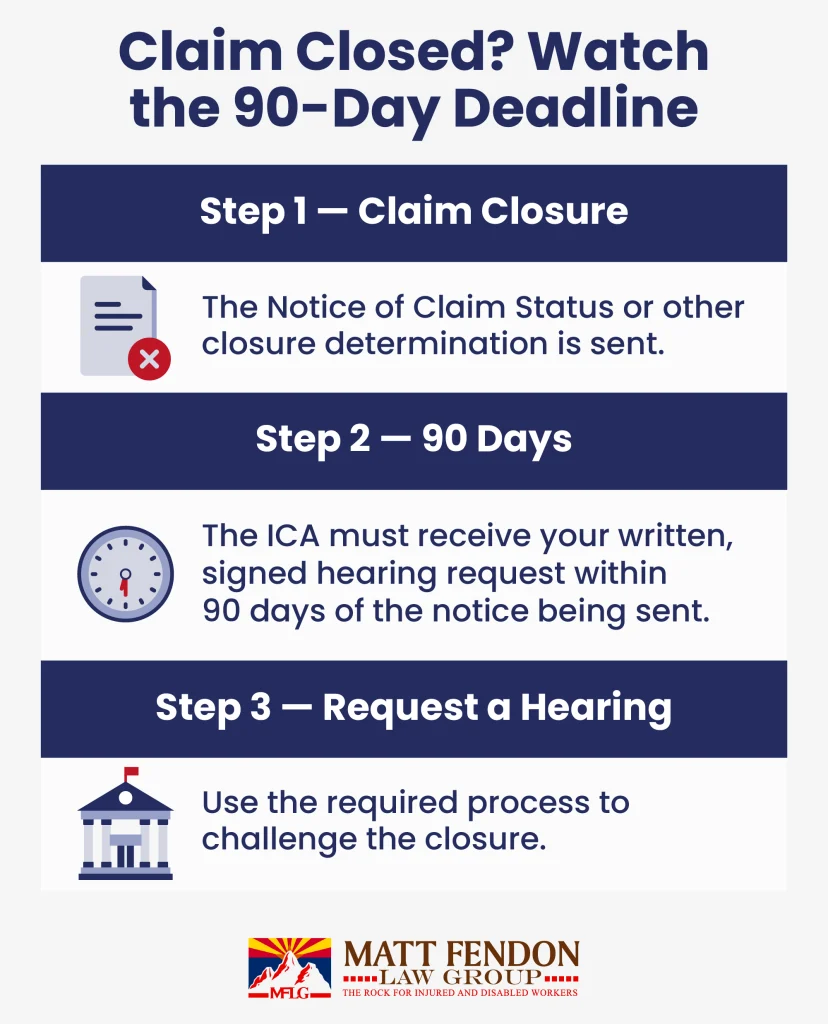
A claim closure can affect your active medical treatment, temporary compensation, and your path to possible permanent benefits. You should read every Notice of Claim Status and ICA award promptly, including its stated closure date, work status, permanent-impairment finding, and protest language.
If you want to contest the closure of your claim, you must request a hearing under ARS 23-947. This notice must generally be in the ICA’s possession within 90 days after the notice is sent. Check the notice’s instructions and have counsel promptly verify the deadline.
Note that merely calling the insurance adjuster, discussing the disagreement with a doctor, or beginning a lawyer search is not a substitute for meeting the filing deadline. Arizona law requires you to make a written, signed hearing request, and the ICA provides a Request for Hearing form.
If you do not make a timely request, then the closure determination generally becomes final, subject only to narrow statutory exceptions.
Can a Closed Arizona Workers’ Compensation Claim Be Reopened?
A previously accepted claim may be reopened for a new, additional, or previously undiscovered temporary or permanent condition related to your work-related injury. Arizona generally allows you to seek reopening later if you meet this standard; the ICA describes this as a lifetime right to reopen.
You must file your petition with the ICA, and it must be accompanied by a physician’s statement describing your current physical condition as it relates to the claim.
There are important limits on your ability to reopen a closed claim. For example:
- A final denial of your original claim generally cannot be bypassed through reopening unless an exception permits a late hearing request.
- Increased subjective pain alone is not enough to reopen your claim if it is not accompanied by changed objective physical findings.
- A claim cannot be reopened solely to obtain diagnostic or investigative testing.
Your timing can affect your recoverable benefits when you seek to reopen a closed claim:
- No monetary compensation is payable for a period before you file the petition to reopen.
- Certain reasonable medical, hospital, and laboratory expenses incurred within the 15 days before filing may be payable if reopening is granted.
- Pre-filing surgical benefits are generally unavailable, except for a qualifying medical emergency, for which the applicable statute permits up to seven days before filing.
A full and final lump sum settlement may resolve your future rights and prevent the reopening of matters covered by the settlement. If you are considering a full and final settlement of your claim, you should consult with an experienced Arizona workers’ compensation attorney to understand exactly which medical and compensation rights you are going to relinquish in the settlement.
What to Do If Your Benefits Stop or the Insurance Carrier Seeks Closure of Your Claim
If the workers’ compensation insurance company proposes to reduce or stop your benefits or to close your claim, here are some steps to take to protect your rights under Arizona workers’ compensation:
- Read the entire notice immediately. Identify what has changed, the effective date, the reason given, and the protest deadline.
- Compare the notice with the medical evidence. Obtain the report supporting the closure, and check whether your treating physician believes you are medically stationary, need further active treatment, require supportive care, or have permanent restrictions or impairment.
- Preserve work and wage documentation. Keep restriction slips, job offers, pay stubs, schedules, time records, and communications about light-duty work. Temporary partial and unscheduled permanent benefits can depend on what you can earn after the injury or illness.
- Continue complying with all medical requirements. Attend authorized treatment and properly scheduled examinations, follow any restrictions, and document problems in obtaining care.
- Do not let negotiations consume your protest period. If you disagree with a closure, termination, wage determination, or impairment finding, determine whether a written hearing request must reach the ICA within 90 days. Limited exceptions exist, but relying on a late-filing exception is risky.
- Ask whether reopening or a protest is the correct procedure. A timely protest challenges a current notice before it becomes final. Reopening generally addresses a new, additional, or previously undiscovered condition after an accepted claim has closed. The time requirements for these two procedures are not interchangeable.
- Seek legal advice promptly. The effectiveness of your response can depend on the notice, medical reports, prior awards, earning history, and settlement documents. An early review can help your attorney identify the actual deadline and the evidence needed to protect your claim.
Contact Matt Fendon Law Group About Your Arizona Workers’ Compensation Benefits
If your workers’ compensation wage replacement benefit checks have stopped, your treatment has been denied, or your employer’s workers’ compensation insurance company is trying to close your claim, then understanding how you might still receive workers’ comp benefits can feel overwhelming.
Matt Fendon Law Group offers workers’ compensation consultations for injured Arizona workers to help them obtain workers’ compensation coverage and benefits.
Call our law firm at (800) 229-3880 or through our online contact page to request a free initial consultation with one of our experienced workers’ comp lawyers.
Remember, in a workers’ compensation case, you have important deadlines when challenging a reduction in benefits or a claim closure, and reopening a closed claim has specific legal requirements in the claims process that you must navigate carefully. Don’t wait for your rights to expire; call Matt Fendon Law Group today.