After a workplace injury in Arizona, your treating physician may conclude that you can return to light-duty work.
A light-duty assignment can help you return to the workplace while you continue physically and mentally recovering from your injuries. It also offers your employer and the insurance company a potential way to save money in workers’ compensation benefits.
When you are cleared for light-duty work, you may have questions about what qualifies as a light-duty job, what your relationship with your employer will be while you are on light duty, and how light-duty work may affect your workers’ compensation benefits.
At Matt Fendon Law Group, we represent Arizona workers who rely on workers’ compensation while recovering from work injuries, occupational illnesses, or medical conditions. In this blog post, we examine some of the common considerations you may encounter as an injured worker when your doctor clears you for light duty.
If you need help with your workers’ compensation case, please call us at (800) 229-3880 or use our contact form to speak with an experienced workers’ compensation lawyer in a free consultation.
What is Light-Duty Work Under Workers’ Comp?
Temporary disability benefits can continue until you reach maximum medical improvement or your work capacity changes.
Light-duty work in Arizona workers’ compensation refers to modified or reduced physical demand work that allows you to go back to work while still recovering from a job-related injury. Light-duty work is meant to support your safe and gradual return to work under certain physical and medical restrictions, without aggravating your injury.
Light Duty Work Examples
Light-duty tasks can take many forms. Examples include:
- Reassignment to a new job
- Being excused from certain strenuous tasks, like lifting heavy objects
- A part-time work schedule
- Inventory of parts and supplies
- Inspecting fire extinguishers and eye wash stations
- Completing safety inspections
- Administrative work, like sorting and delivering mail, filing paperwork, shredding documents, or answering phone calls
- Train new employees
- Performing cleaning duties
- Any other change to work conditions that meets a worker’s medical needs
Your employer may also ask you to perform your pre-injury job, but at a slower and more relaxed pace.
Medical Approval is Needed for Light-Duty Work
Your treating doctor must clear you to return to light-duty work. The work you do must conform to your doctor’s medical recommendations; your employer cannot make you do work that you are not cleared to do.
How Many Hours Can You Work on Light-Duty?
The number of hours you can spend on light-duty work is based on your doctor’s restrictions. You can work as many hours as your doctor approves.
How Does Light-Duty Work Affect Your Relationship With Your Employer?
If your doctor clears you for work under light-duty restrictions, Arizona’s workers’ compensation law does not create an obligation on your employer to offer you a light-duty job.
In some situations, a job search may be relevant to determining loss of earning capacity, but Arizona law does not automatically require injured workers to seek other employment to continue receiving temporary disability benefits.
You must report any income you earn while receiving benefits, but reporting job search activity depends on the circumstances of your claim.
Does Your Employer Have to Keep Your Old Regular Job Available for You?
Your employer may have to keep your previous position open for your return if you take “protected leave.” Arizona workers’ compensation law itself does not create any protected leave, but protected leave can arise if another federal law creates it.
Examples of laws that can create protected leave or a similar protection include:
- The Family and Medical Leave Act (FMLA). The FMLA can create up to 12 weeks of unpaid, job-protected leave for a serious health condition, including a work-related injury. If the FMLA applies, your employer must restore you to the same or an equivalent position when you return to work.
- The Americans with Disabilities Act (ADA). If your work injury results in a qualifying disability, the ADA can create the equivalent of protected leave. The ADA prohibits termination based on a disability and requires employers to consider reasonable accommodations when they do not create an undue hardship.
- Arizona Paid Sick Leave (Fair Wages and Healthy Families Act): This Arizona state law requires employers to provide paid sick leave, which can be used for a work-related illness or injury. Your employer cannot retaliate against you for taking this leave.
If none of these protected situations apply to your work injury, illness, or medical condition, then your job is not protected, and your employer can legally fill your old position during your recovery.
Can You Refuse Light-Duty Employment?
You may be justified in declining light-duty if the work is unsafe, violates medical restrictions, or presents objectively unreasonable conditions.
You may also be entitled to decline a light-duty role without being fired or disciplined if you are exercising your family leave rights under the FMLA. But the FMLA may not protect your ability to keep receiving workers’ compensation benefits once your doctor clears you for light-duty work.
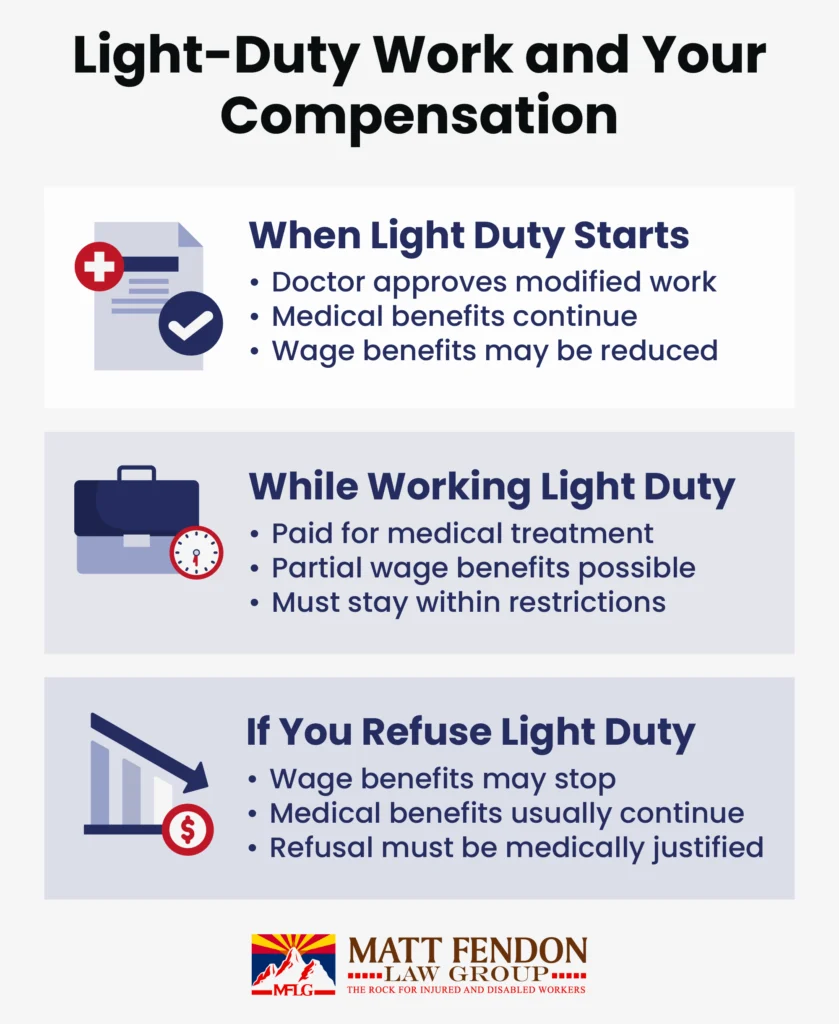
If an employer offers light-duty status to you that is within your medical restrictions, and you refuse, the workers’ compensation insurer and the ICA may use this refusal to terminate any temporary workers’ compensation benefits you are receiving.
You will still be able to receive medical benefits under workers’ compensation.
How Does Going on Light Duty Affect Your Workers’ Compensation Benefits?
In Arizona, as an injured worker, you can continue to collect workers’ compensation benefits while on a light-duty assignment, including compensation for your ongoing medical treatment costs until you reach maximum medical improvement and temporary wage loss disability benefits.
Temporary disability benefits are generally calculated at 66⅔% of lost earning capacity, subject to statutory caps.
Do You Have Questions About Light-Duty Work Under Arizona Workers’ Compensation?
The decision whether to accept light-duty work is one you should consider carefully. There are multiple considerations to keep in mind. Here are a few of them:
- Does your treating physician’s medical clearance for you to perform light-duty work accurately take into account your true light-duty work restrictions? Does it risk putting you back to work too soon, or in a way that could risk re-injury or a worsening of your condition?
- Is your employer trying to push you too far, too fast in your light-duty work, to the point where your job duties push the limits or exceed your work restrictions?
- Has your employer punished you or retaliated against you in any way after you returned to light-duty work?
If any of these situations occur, or others in which you believe that your rights to workers’ compensation benefits may be put at risk due to the circumstances of a light-duty work position, it can be in your best interest to consult with an experienced Arizona workers’ compensation law firm like Matt Fendon Law Group.
Since 2008, our attorneys have been focused on fighting for workers who find themselves in difficult situations due to workplace injuries. We provide comprehensive legal representation for those who need aid from workers’ compensation. When you call us, you will speak directly with a workers’ compensation lawyer who fully understands Arizona workers’ compensation law.
If you have been injured on the job and want to know how Arizona’s workers’ compensation laws affect your workers’ compensation claim, call us at (800) 229-3880 or contact us online to schedule a free, no-obligation consultation.