Permanent or partial vision loss is compensable under Arizona workers’ compensation as a scheduled injury or through settlement with your employer’s insurance carrier.
Estimating how much you might receive for a vision loss claim can be hard because the state of Arizona does not maintain any official figures for eye injury settlements. Estimates vary widely by the severity of the eye injury, with many minor claims valued in the low thousands of dollars, while claims involving the loss of an eye or blindness can run into the six figures.
In this post, we consider vision loss claims under Arizona’s workers’ compensation law. We explain how the law treats vision loss as a scheduled injury claim, how it may become an unscheduled claim, and the considerations that go into negotiating a vision loss settlement with a workers’ compensation insurance company.
If you have suffered a work-related eye injury in Arizona, Matt Fendon Law Group workers’ compensation lawyers can help. Call our law office at (800) 229-3880 or reach out to us online to schedule a free consultation about your potential workers’ compensation claim.
How Does Arizona Workers’ Compensation Law Treat Vision Loss?
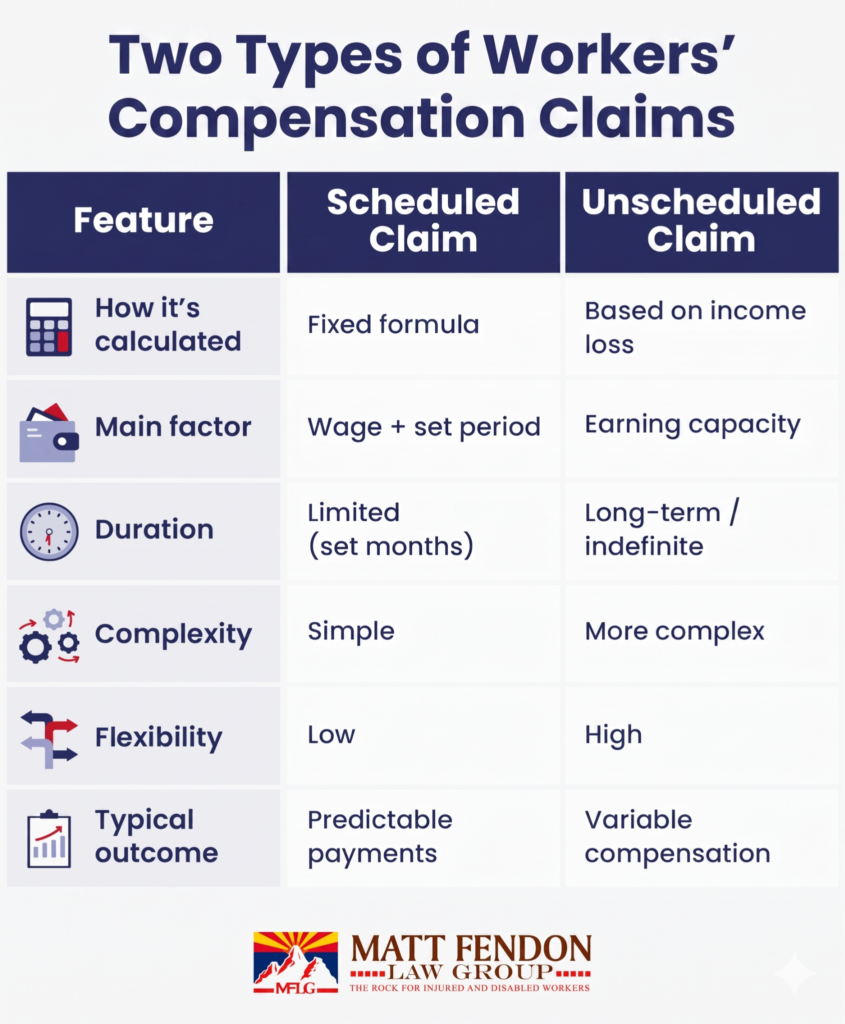
Arizona workers’ compensation laws treat workplace injury claims as scheduled or unscheduled for compensation benefits. Depending on circumstances, a vision loss claim can be scheduled or unscheduled.
Vision Loss as a Scheduled Injury Claim
An eye injury starts out as scheduled by default under Arizona Revised Statutes (ARS) 23-1044(B). The value of a scheduled injury depends greatly on what your average monthly wage was before the work accident happened and whether you lost an eye by enucleation (a surgical procedure that involves removing the eyeball).
- If the loss of the eye involves enucleation, the compensation you can receive is 55% of your average monthly wage for 30 months.
- If the loss of sight in one eye is permanent and complete without enucleation, the compensation benefits are 55% of your average monthly wage for 25 months.
You receive these payments monthly rather than as a lump sum.
Many vision injuries do not involve the complete loss of sight in one eye. In these cases, once you have reached the point of maximum medical improvement for your eye injury, a physician must assign a percentage of permanent impairment that remains. This usually means referring to the AMA Guides to the Evaluation of Permanent Impairment. The percentage of impairment is then applied to the statutory schedule for the eye to determine how many months of benefits you can receive.
Vision Loss as an Unscheduled Injury Claim
Unscheduled eye injuries are those that do not fall within the scheduled categories above. Examples of how vision loss can be unscheduled include pre-existing permanent impairments or multiple impairments from the same work-related incident.
Prior Permanent Impairment
This is a common way for an eye injury to become unscheduled. The pre-existing impairment does not need to have been work-related, and can have affected a body part other than an eye. The pre-existing impairment does not need to have affected your earning capacity at the time it occurred.
For example, let’s say that you had a prior 10% permanent impairment to your knee from a non-industrial accident, then you suffer a 20% permanent loss of vision to one eye because of a work injury. In this case, your eye injury becomes unscheduled.
Multiple Impairments From the Same Injury
If a single work accident causes a combination of a scheduled injury and another scheduled or unscheduled permanent impairment, this can be the basis of an unscheduled injury claim.
For example, if the same incident at work causes you to lose partial vision in one eye (a scheduled injury) and a permanent neck impairment, your workers’ compensation is treated as an unscheduled claim.
Calculating Compensation for Unscheduled Claim Settlement
An important difference between scheduled and unscheduled injuries is how they are compensated under Arizona law. Under ARS 23-1044(C), unscheduled permanent disability benefits are calculated at 55% of the difference between your pre-injury average monthly wage and your post-injury earning capacity. Unlike scheduled injuries, unscheduled benefits are not restricted to a set number of months.
An unscheduled injury claim can result in benefits that last for years or even for the rest of your life, depending on circumstances like your age, education, work history, physical limitations, labor market conditions, and your post-injury earning ability.
Although unscheduled injury compensation claims can result in payments over an indefinite period, they are still subject to periodic reviews and, depending on the findings of those reviews, can be increased, decreased, or ended through the rearrangement process pursuant to ARS Section 23-1044(F).
As you may imagine, workers’ compensation insurance carriers often prefer to pay settlements on scheduled claims over unscheduled ones. For insurers, a scheduled injury settlement is largely a math calculation, based on how many remaining months of your scheduled claim period remain plus your medical bills.
Unscheduled claim settlements, however, present insurers with more of a forecasting issue than a mathematical calculation. They need to consider how many discounted years of wage loss to calculate, as well as your future medical expenses.
An unscheduled settlement payout can easily be considerably more than a scheduled one, especially in cases where your vision loss may worsen, and unlike a scheduled settlement, an unscheduled one can have the potential to last for an indefinite time.
This is why, when you are negotiating a settlement for an unscheduled claim, insurance carriers are more likely to contest the claim based on arguments like pre-existing injuries, or whether the impairment is permanent, or whether multiple impairments actually combine to affect your lost earning capacity.
How Do Workers’ Compensation Monthly Benefits Compare to Settlement of Vision Loss Claims?
After a vision loss injury, you will be faced with the question of whether your best choice is to rely on monthly benefit payments through Arizona workers’ compensation or to settle your claim with your employer’s insurance company. Here are the pros and cons of each option.
Monthly Benefit Considerations
Under workers’ comp, you can continue to receive compensation for medical bills after an eye injury, even after your scheduled payments are paid out. Examples of such future medical costs include follow-up ophthalmology appointments or hospital visits, corrective lenses, and necessary surgery.
The advantages of staying with workers’ compensation instead of settlement are that your compensation payments are predictable, your medical treatment benefits remain covered even if complications occur in the future, and you do not have to go through the potential stress involved in negotiating with an insurance company.
Some possible downsides of remaining within the system of workers’ compensation are that you receive no up-front funds, and scheduled injury compensation payments do not increase even if your vision loss affects your future earning ability.
Settlement Considerations
Settlements can be structured, in which you negotiate with the insurance company for regular payments or an initial lump sum combined with follow-up payments over time, or a full-and-final settlement, which is usually a lump-sum payment that is meant to account for all your claims, including possible future claims for lost wages and future medical treatment costs.
Advantages of settlement include the possibility that you can negotiate for a lump sum up front, which can give you the financial flexibility to pay for costs related to job retraining, debt payment, relocation, or any other purpose, and you are not subject to ongoing monitoring by the insurance company or periodic reviews of your vision loss condition.
A significant possible disadvantage of settlement is that you can end up assuming the risk that your eye impairment may worsen in the future without being able to reopen your claim.
It is important to note that Arizona workers’ compensation does not cover pain and suffering damages. If your workplace eye injury was caused by the negligence of a third party other than your employer, you may be able to pursue a separate personal injury claim for pain and suffering.
The following table sets out some of the considerations that can go into your decision whether to settle your vision loss claim or to use the workers’ compensation claims process.
| Issue | Workers’ Compensation Monthly Benefits | Lump‑Sum Settlement |
|---|---|---|
| Payment timing | Monthly over statutory period | One‑time payment |
| Amount basis | Fixed by statute | Negotiated |
| Future medical care | Remains covered | Usually waived |
| Risk of condition worsening | Carrier bears risk | Worker bears risk |
| Ability to reopen | Possible for medical | Typically no |
| Cash flexibility | Limited | High |
| Oversight | ICA + carrier | None after approval |
What Kinds of Injuries Can Result in Workers’ Compensation Vision Loss Claims?
Many types of work-related eye injuries can form the basis of a workers’ compensation claim. Here are some common causes:
- Scratched eye (corneal abrasion)
- Penetrating objects
- Foreign object in the eye
- Burns (including chemical burns)
- Eye swelling
- Eye bleeding (subconjunctival hemorrhage)
- Inflammation of the iris (traumatic iritis)
- Hyphema (bleeding in the anterior chamber of the eye)
- Detached retina
- Ultraviolet light burns
- Eyelid laceration
- Injury secondary to orbital bone fracture
If you have eye pain or vision loss, stop work immediately and seek treatment. Failing to address eye injuries promptly can lead to long-term vision problems that may be irreversible.
How Can I Make an Eye Injury Claim?
After a workplace eye injury, here is a brief overview of steps to take to preserve your workers’ compensation claim.
Once you have addressed your medical needs, you should take the following steps to make your eye injury claim:
- Report your workplace injury to your employer as soon as possible.
- Seek medical attention, and let the treating doctor know that your injury is work-related.
- File a claim with the ICA.
Once you have filed your claim, your employer and the workers’ compensation insurance company will review it. The insurance company may require you to undergo an independent medical evaluation.
- If the insurer accepts your claim, your medical and wage-replacement benefits can begin.
- If the insurer denies your claim, you have the right to request a hearing before an ICA administrative law judge.
Have You Suffered an Eye Injury at Work?
Vision loss can be a serious medical condition with long-term effects on your ability to make a living. Eye injuries can worsen over time, a possibility that you must consider when deciding whether to seek a claim settlement if a dispute arises between you and your employer’s insurer.
An experienced Arizona workers’ compensation law firm, like Matt Fendon Law Group, can help you understand your legal options as an injured employee in the aftermath of a work-related injury, including whether you may qualify for scheduled or unscheduled fair compensation benefits.
If you are engaged in a dispute with the insurance carrier, including a claim denial, we can help you negotiate a settlement for the maximum compensation you deserve or represent you in an appeal to the ICA.
Our workers’ compensation claim attorneys have many years of experience helping injured workers in Arizona navigate the state’s workers’ compensation claim system. Call us at (800) 229-3880 for help. Or use our online contact form to schedule a free, no-obligation consultation.