Having your workers’ comp claim denied can be frustrating, especially when you are dealing with medical bills, lost wages, and uncertainty about your future.
Fortunately, a denial is not always the final decision. Arizona’s workers’ compensation system gives injured workers the right to challenge a denial and present evidence supporting their claim.
If you have received a workers’ comp claim denial notice, contact Matt Fendon Law Group at (800) 229-3880 for a free consultation.
What Should You Do if Your Workers’ Compensation Claim Is Denied?
If you receive a Notice of Claim Status stating that your workers’ compensation claim has been denied, take action immediately.
After your workers’ comp claim is denied, the first step is to review the reasons for the denial carefully. The insurance carrier must provide a written explanation of why it denied the claim. Understanding the basis for the denial helps determine what evidence may be needed during the appeals process.
You should also continue receiving appropriate medical treatment whenever possible. Medical records are often among the most important evidence in a workers’ comp claim denial case. Delays in treatment can give the insurance company additional arguments against your claim.
Gather any documentation related to the injury, including accident reports, witness statements, medical records, photographs, and communications with your employer. The more evidence available, the stronger your position may be during an appeal.
Most importantly, do not ignore the deadline to challenge the denial. Arizona law imposes strict filing requirements that can affect your ability to pursue benefits.
Why Are Workers’ Compensation Claims Denied in Arizona?
There are many reasons for workers’ compensation denials, but several issues occur more frequently than others.
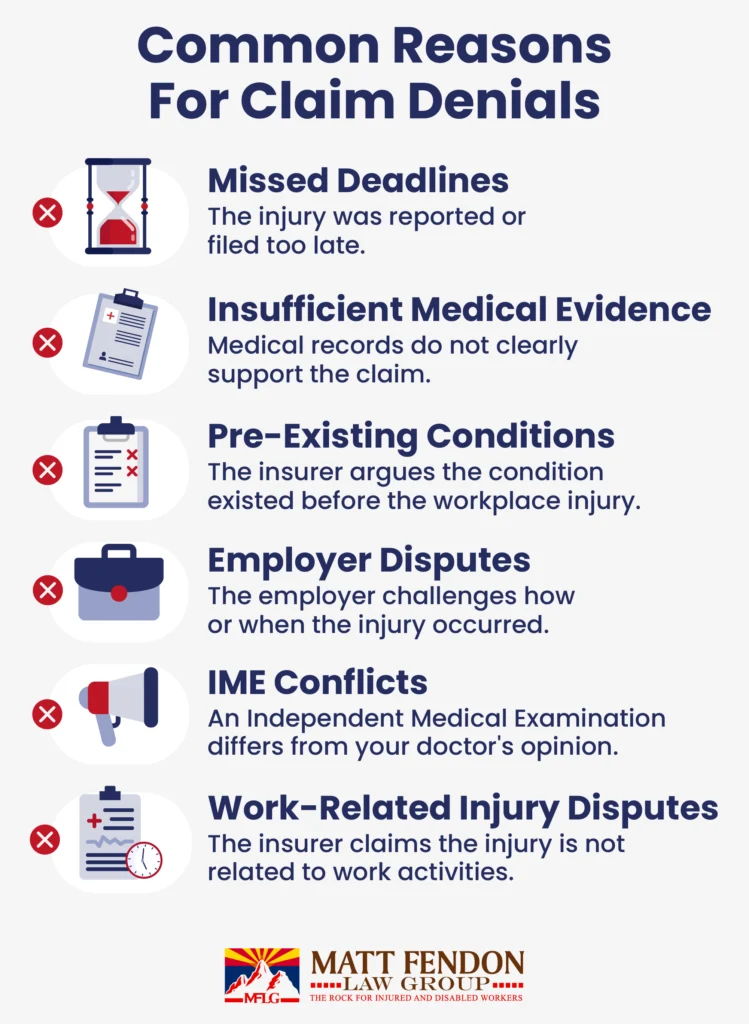
Missed Deadlines
One of the most common reasons for denial involves missed deadlines. An employee generally must report a work-related injury promptly and comply with Arizona workers’ compensation filing requirements.
If the insurance company believes the injured worker waited too long to report the injury or file a claim form, it may deny the claim.
Disputes Over Whether the Injury Is Work-Related
Another common issue is causation.
The insurance carrier may argue that the injury did not occur during the course and scope of employment. For example, an employer may dispute whether an accident happened while the employee was performing job duties.
When causation is disputed, medical evidence and witness testimony often become critical.
Lack of Medical Evidence
Workers’ compensation benefits depend heavily on medical documentation.
If medical records do not clearly connect the injury to work activities, the insurance company may deny the claim. Claim denials may occur when treatment records are incomplete, inconsistent, or fail to address causation.
Strong medical evidence can help establish both the existence of an injury and its connection to the employment relationship.
Pre-Existing Condition Arguments
Another common scenario involves pre-existing conditions.
The insurance carrier may argue that the symptoms stem from a prior injury, a degenerative condition, or an unrelated medical issue rather than a workplace accident. In many cases, the dispute centers on whether work activities aggravated or accelerated an existing condition.
Employer Disputes
Sometimes employers dispute the facts surrounding the claim.
The employer may challenge how the injury occurred, whether the employee was performing job duties, or whether the accident happened at all. These disputes can result in a workers’ comp denied decision that must be resolved through the appeals process.
Independent Medical Examination Disputes
The insurance carrier may require an Independent Medical Examination (IME).
If the IME physician reaches conclusions that differ from your treating doctor, the insurance company may rely on that opinion to deny benefits. Disputes involving an Independent Medical Examination are frequently litigated before an Administrative Law Judge.
How to Appeal a Workers’ Compensation Claim Denied in Arizona
If your workers’ comp claim is denied, your case does not automatically end unless you fail to take additional action. Arizona provides a formal appeals process through the Industrial Commission of Arizona.
File a Request for Hearing Within 90 Days
The most important deadline involves filing a Request for Hearing.
If you disagree with a Notice of Claim Status, you generally have 90 days to file a Request for Hearing with the Industrial Commission of Arizona. Missing the 90-day deadline can significantly limit your ability to challenge the denial.
The Request for Hearing initiates the formal appeal process.
Prepare for the Hearing Process
After the Industrial Commission receives the Request for Hearing, the matter will be assigned to an Administrative Law Judge.
During the period leading up to the hearing, both sides may exchange evidence and conduct discovery. This process often includes gathering medical records, obtaining expert testimony, identifying witnesses, and preparing documentation that supports the claim.
Evidence developed during this stage can play a major role in the outcome of the case.
Attend the Hearing Before an Administrative Law Judge
The hearing functions similarly to a trial, although it is less formal than court proceedings.
The injured worker has the burden of proof and must demonstrate that the injury is compensable under Arizona workers’ compensation law. Witness testimony, medical evidence, expert testimony, and employment records may all be presented.
The Administrative Law Judge will review the evidence, evaluate witness credibility, and determine whether benefits should be awarded.
Request Post-Award Review
If either party disagrees with the Administrative Law Judge’s decision, a Request for Review may be filed within 30 days of the date the decision is mailed. Missing this 30-day deadline can end the appeal.
The Administrative Law Judge will then re-examine the evidence and arguments and determine whether the original decision should remain in place or be modified.
Appeal to the Arizona Court of Appeals
Following the review, additional appeals may be available through the Arizona Court of Appeals. This step is taken by filing a Petition for Special Action in Division One of the Arizona Court of Appeals within 30 days of the Decision Upon Review.
Appeals at this level focus on legal issues and whether the law was applied correctly. The Arizona Court of Appeals does not simply retry the case. Instead, it reviews the record developed during the workers’ compensation proceedings.
What Evidence Helps Overturn a Workers’ Compensation Claim Denial?
A successful appeal often depends on presenting strong evidence.
Important evidence may include:
- Medical records and treatment notes
- Physician opinions regarding causation
- Accident reports
- Witness statements
- Employment records
- Expert testimony
- Diagnostic imaging and test results
- Documentation of lost wages and work restrictions
The stronger the evidence, the greater the likelihood of overcoming a denied workers’ compensation claim decision.
What Benefits May Be Available After a Successful Appeal?
If the denial is overturned, the injured worker may become eligible for several types of workers’ compensation benefits.
Available benefits may include:
- Medical benefits
- Temporary disability benefits
- Permanent disability benefits
- Wage loss compensation
- Reimbursement for medical bills
- Future medical treatment related to the injury
The specific benefits available depend on the nature and severity of the injury.
It is important to understand what Arizona workers’ compensation does not cover. The system does not pay for pain and suffering. Those damages are only available through a separate third-party personal injury claim, not through the workers’ comp system itself.
A workers’ comp attorney can review your situation and explain whether a separate claim against a third party may also apply.
How Can a Workers’ Compensation Attorney Help After a Denial?
A denied workers’ comp claim can quickly become complicated.
An experienced workers’ comp attorney understands the Industrial Commission process, applicable deadlines, evidentiary requirements, and hearing procedures.
A workers’ comp lawyer can gather supporting evidence, coordinate with medical providers, prepare witnesses, challenge unfavorable IME opinions, and present arguments before an Administrative Law Judge.
Having legal representation can also help avoid procedural mistakes that could affect the outcome of an appeal.
Whether the issue involves medical evidence, causation, employer disputes, or a pre-existing condition, a workers’ comp attorney can help build the strongest possible case.
Contact Matt Fendon Law Group for Help Appealing a Denied Claim
If your workers’ comp claim denied notice has arrived, do not assume the insurance company’s decision is final. Many injured workers successfully challenge a denial through the Arizona appeals process.
The attorneys at Matt Fendon Law Group help injured workers throughout Scottsdale, Phoenix, and communities across Arizona pursue the workers’ compensation benefits they need after their claims have been denied.
Call Matt Fendon Law Group at (800) 229-3880 today for a free consultation and learn how we can help with your workers’ compensation appeal.