
Work-related hearing impairment is compensable under Arizona’s workers’ compensation system, including through settlements.
How much you can recover in settlement for on-the-job hearing loss depends on multiple factors, including how the hearing loss occurred, the period of time over which the excessive noise injury occurs, what your average monthly wage was, and the effect of the hearing loss on your ability to earn income in the future.
Matt Fendon Law Group represents Arizona employees with workers’ compensation benefits claims, including medical benefits and partial wage-replacement benefits for hearing loss.
To speak with an experienced workers’ compensation attorney, call our law firm at (800) 229-3880 or use our online contact form to schedule a free case evaluation with us.
Is There an Average Value for Arizona Workers’ Compensation Hearing Loss Settlements?
No official average settlement value exists in Arizona for hearing loss-related workers’ compensation claims. Arizona does not track or publish average settlement figures for workers’ compensation hearing-loss claims.
In Arizona, workers’ compensation for occupational hearing loss is considered to be a scheduled injury claim. This means that payment for workers’ compensation claims for hearing loss are based on a statutory formula. This formula takes into account the following factors:
- The percentage amount of your permanent impairment
- What your average monthly wage was
- The number of months of compensation you can receive by law
The statutory formula that the Arizona workers’ compensation system uses considers whether your hearing loss occurred in one ear or both ears, plus whether your hearing loss is total or partial. So, for example:
- If you have permanent hearing loss in one ear, you can receive 55% of your average monthly wage for up to 20 months.
- If you experience permanent hearing damage in both ears, you can receive 55% of your average monthly wage for up to 60 months.
- If you suffer partial hearing loss, you will receive a related percentage of what you would have received for a total hearing loss claim.
With this in mind, it is possible to provide some estimates of possible hearing loss claim values:
- For partial hearing loss that is mild to moderate in nature, you might receive a few thousand dollars in compensation.
- For significant hearing loss in one or both ears, settlement values can range from $10,000 to $30,000, especially when the supporting medical evidence is strong, and if you were earning close to the maximum limit for average monthly wage-based compensation.
- For severe or near-total hearing loss in both ears, settlement payouts can be in the tens of thousands of dollars.
These settlement amounts, like Arizona workers’ compensation claim payments, do not factor in intangible claims like pain and suffering, emotional distress, or loss of life.
How Does Workers’ Compensation Pay for Hearing Loss Claims?
Hearing loss claims take into account the following factors when determining whether you can claim compensation for hearing loss, and how much and for how long those compensation benefits will last.
Is Your Hearing Loss Compensable Under Workers’ Compensation?
The starting point for all workers’ compensation claims and settlements is that your claim must be work-related. The key factors here are:
- Does a causal connection exist between workplace noise at your job and hearing loss?
- Is the hearing loss due to a sudden event, or did it develop gradually over time?
- What is the nature of your hearing loss?
- What was the duration and intensity of the noise exposure or other cause of your hearing loss?
- Did your hearing loss occur during the course of your work with more than one employer?
You will need medical evidence to support your claim when making your claim with your employer and in settlement negotiations with your employer’s workers’ compensation insurance company. Examples of medical evidence include:
- Objective test results performed by an audiologist or ears, nose, and throat (ENT) physician, such as audiograms
- A medical opinion that links your hearing loss to your work, either directly or as a contributing factor (Arizona does not require your employment to be the main cause for workers’ compensation eligibility)
- Detailed work history showing significant, prolonged exposure to noise levels, including information like relevant equipment and tools you were using, noise levels, and how many hours per day you were exposed
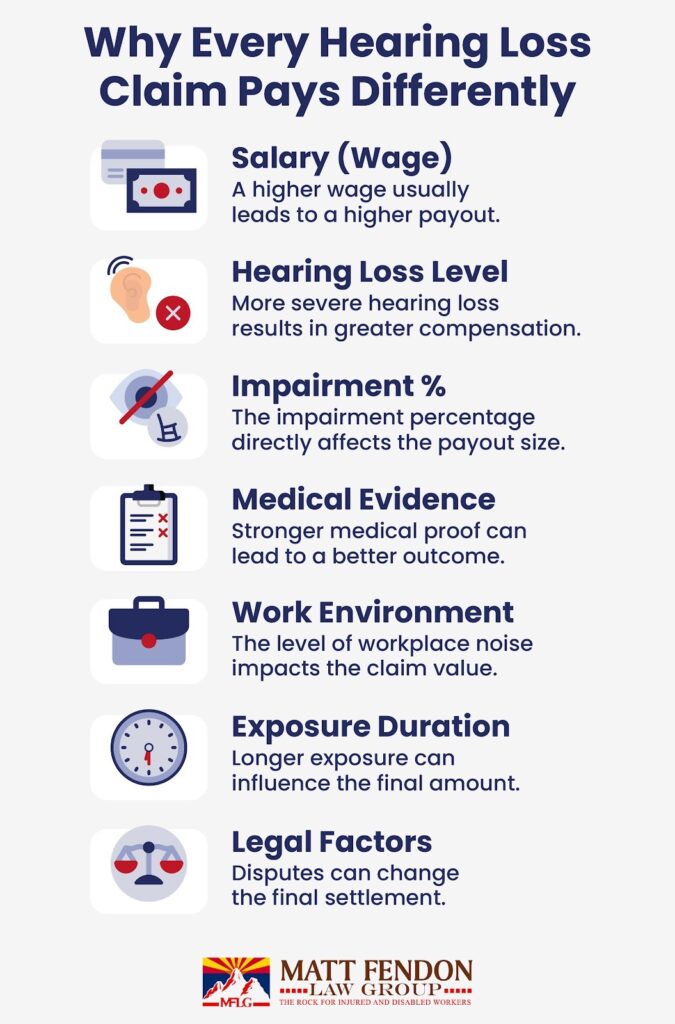
Evidence of harmful noise at work can include employer noise surveys, any available records kept by the Occupational Safety and Health Administration related to your employer’s business, safety manuals and personal protection equipment policies, and statements from your coworkers describing noise conditions at work.
Your evidence does not need to precisely establish the noise levels you were exposed to, like decibel measurements. Credible testimony can be effective, especially if you work in an industry or occupation that is known for noise exposure.
What is Your Impairment Rating for Hearing Loss?
Arizona workers’ compensation uses the AMA Guides to the Evaluation of Permanent Impairment when assessing the extent of your hearing loss. However, this is not the only consideration in your medical evaluation. Your impairment rating will usually take the form of a percentage of permanent impairment, which will be a key element in the determination of how much compensation for hearing loss you receive.
What is Your Average Monthly Wage?
Under ARS 23‑1041(A), your average monthly wage is based on the wages paid to you during the month in which you were injured, if you were continuously employed for at least 30 days. This applies if you were continuously employed for at least 30 days before your injury and includes your regular salary or hourly wages, overtime pay if you regularly earned it, and shift differentials or guaranteed pay.
If you had been employed less than 30 days, your average monthly wage calculation will be based on a wage that would reasonably represent what your monthly earning capacity was. In this case, the Industrial Commission of Arizona (the ICA) may consider wages you were making at past jobs, and wages that other employees make in a similar job to the one you had at the time of your injury.
In a few situations, like if your work was seasonal or intermittent or otherwise, if the 30-day presumptive average monthly wage provided for under ARS 23-1041(G) does not fairly represent your earning capacity, an administrative law judge may use more than one month of earnings to make the calculation.
Note that the average monthly wage in Arizona is subject to an annual cap. For 2026, the maximum average monthly wage is $6,131.
What is the Nature and Extent of Your Noise-Induced Hearing Loss?
The value of your workers’ compensation for hearing loss increases depending on factors, including whether it occurs in one or both ears, how much of the loss occurs in speech-relevant frequencies, and whether the condition is permanent and stationary.
Over How Long a Period Did Your Hearing Loss Take Place?
Work-related hearing impairment can happen suddenly, but often occurs gradually. This can have a bearing on your settlement, especially if the hearing loss occurred over a period long enough that it spans your work with multiple employers.
Sudden Hearing Loss
Sudden hearing loss can happen because of a single, identifiable event like an explosion, gunshot, or equipment failure that causes hearing impairment immediately or shortly after the incident.
Gradual or Cumulative Hearing Loss
Hearing loss related to your employment can develop slowly, over months or even years of constant or repeated exposure to loud noises. There may be no one identifiable accident or other incident that you can trace the hearing impairment to, and you may not notice your hearing loss symptoms until well after you have suffered significant hearing damage.
Arizona does not require you to identify a specific accident date in long-term exposure hearing loss cases. The one-year filing deadline generally begins when the injury becomes manifest, and the employee knows, or reasonably should know, that the condition is work-related and compensable, often established by medical diagnosis.
An important distinction between sudden and gradual hearing loss claims is that workers’ compensation insurance companies are more likely to argue that your settlement value should be subject to apportionment in gradual onset cases, trying to assign at least some of your hearing loss to non-work causes or that it is at least partly age-related.
What is Your Scheduled Injury Classification Under Arizona Law?
The Arizona law governing scheduled injuries is Arizona Revised Statutes (ARS) Section 23-1044(B). This statute contains the listing, or “schedule,” of certain injury types for which workers’ compensation is payable, including hearing impairment.
For permanent and complete hearing loss, you can receive 55% of your average monthly wage as follows:
- Under ARS 23-1044(B)(18), if your hearing loss is in one ear, for 20 months
- Under ARS 23-1044(B)(19), if your hearing loss is in both ears, for 60 months
For partial hearing loss, the compensation rate depends on whether you can return to the work you were performing at the time of your injury. If you can return to your pre-injury work, compensation is paid at 50% of your average monthly wage for a proportional number of months based on your percentage of impairment. If you are unable to return to your pre-injury work due to the hearing loss, the rate increases to 75% of your average monthly wage.
Will You Need Future Medical Care?
In settlement negotiations for hearing loss injuries, an important consideration will be whether you will need future treatment, such as follow-up audiology appointments, hearing aids, or other ongoing supportive care. If these needs exist, your settlement cannot be closed out unless it is a valid, full, and final settlement approved by the ICA.
Do Any Disputes Exist About Your Workers’ Compensation Claim?
Sometimes, your employer or your employer’s insurance company may not agree with all the aspects of your hearing loss claim. For example, a dispute can arise about the strength of your medical evidence, whether your injury relates to a pre-existing condition, how much your medical expenses are, or whether multiple employers or insurance companies are involved.
Special Fund Compensation
A twist that can occur in gradual hearing loss claims is when your last employer is no longer in business, or was uninsured, or was self-insured but went bankrupt, or if your last employer’s workers’ compensation insurance carrier has become insolvent.
In these cases, you may still receive compensation from the ICA’s Special Fund Division. The Special Fund Division may pay medical and disability benefits to the extent authorized by statute, depending on the basis for Special Fund liability.
To receive special fund compensation, you must still prove that your hearing loss is work-related and that your hearing impairment is related to your last employment. If you can do this, your hearing loss will still be treated as a scheduled injury for workers’ compensation.
The Special Fund Division can still investigate whether your hearing loss claim is compensable, can deny your claim, or request a hearing before an administrative law judge in contested cases in the same way that a workers’ compensation insurance company might otherwise do.
If, for any reason, the Special Fund Division can prove that your last employment did not result in any injurious exposure, your workers’ compensation claim may be denied completely in a gradual hearing loss case because the last injurious exposure rule could mean that your claim will fail. After all, prior employers are not automatically held responsible.
Have You Suffered Hearing Loss Because of Your Work?
If you have experienced hearing problems because of a noisy environment at your current employment, even if it began with a past employer, you may be able to receive workers’ compensation benefits under Arizona law. An experienced workers’ compensation lawyer with Matt Fendon Law Group can help to:
- Evaluate your possible claim.
- File your claim with your employer.
- Gather medical evidence and other proper documentation to support your claim.
- Negotiate with your employer’s workers’ compensation insurance company, or with your employer if it is self-insured, or with the Special Fund Division.
- Appeal any denial of your claim.
Because, especially in gradual or cumulative cases, the hearing loss claims process can be complex, having a law firm like Matt Fendon Law Group that focuses on Arizona workers’ compensation claims can make a difference in how much compensation you receive in settlement. To learn more about medical treatment and financial compensation you can receive in connection with your possible employment-related hearing loss claim, or any other workplace injury claim, call our law offices at (800) 229-3880, or you can reach us online to talk with an experienced and skilled Arizona hearing loss lawyer in a free consultation.