If you experience heat exhaustion related to your work, then under Arizona workers’ compensation, you may be eligible to receive benefits or to settle your workers’ compensation claim with your employer’s workers’ compensation insurer.
In this article, we cover how heat exhaustion happens at work, its signs and symptoms, how to file an Arizona workers’ compensation claim, the benefits available, and the factors that can affect your settlement.
Why Choose Matt Fendon Law Group for Your Heat Exhaustion Settlement?
Many heat‑exhaustion claims eventually settle with the insurer after the claim is filed or accepted, but you need to negotiate with an insurance company first. Even if you have a strong claim for workers’ compensation benefits, these negotiations are not always open-and-shut matters, and the insurer can contest the existence of your claim or its value.
Having an experienced workers’ compensation attorney on your side in these settlement negotiations can make a real difference in how much you receive in settlement for a heat exhaustion claim. This skilled and experienced legal representation is what you will have when you retain Matt Fendon Law Group.
We are a dedicated Arizona workers’ compensation law practice. Workers’ compensation claims and appeals are all we do.
This means that when you have a Matt Fendon Law Group lawyer on your side, you can be confident that your attorney will have extensive experience handling not only claims but also be a savvy negotiator who will work to pursue the fair compensation available to you under Arizona workers’ compensation, whether through a structured payout or a Full and Final Settlement.
To speak with one of our skilled Scottsdale attorneys about your heat-related injuries and what they may be worth, call us at any time at (800) 229-3880, or you can reach us online for a free consultation.
Is Heat Exhaustion Covered Under Workers’ Compensation?
Heat exhaustion is a condition for which you can receive Arizona workers’ compensation. You will need to follow the requirements set by Arizona’s workers’ compensation system for filing a claim.
How to File a Claim for Heat Exhaustion Under Workers’ Compensation
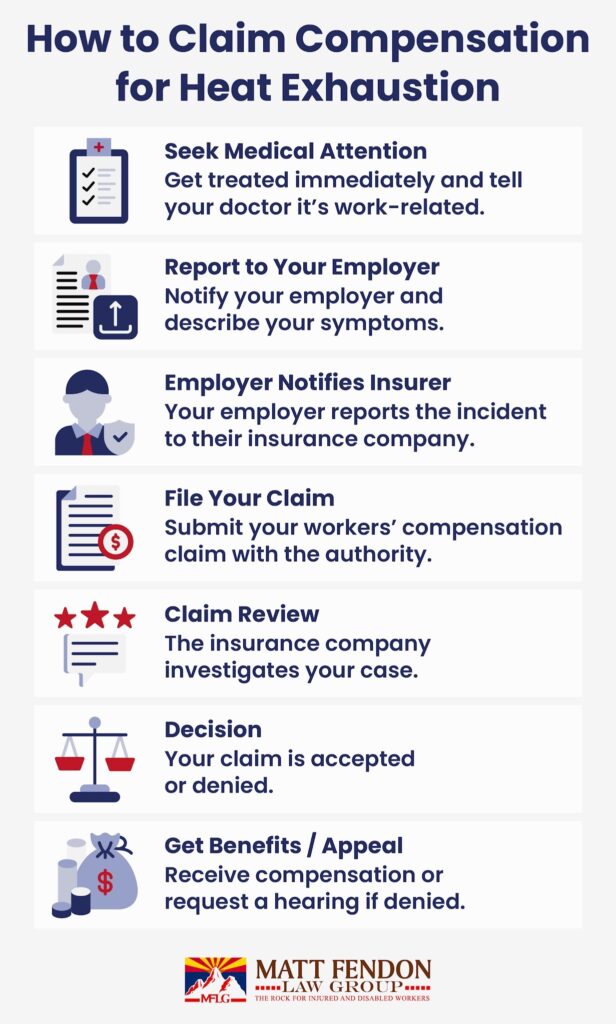
You file a workers’ compensation claim for heat-related illnesses in the same way as any other claim. Here are the steps.
Seek Medical Attention and Identify Your Heat Exhaustion as Work‑Related
Seek immediate medical attention, including emergency medical care if necessary. As soon as possible, see a doctor and inform that person during your examination that your heat-related condition is connected with your employment.
Medical documentation of diagnosis and treatment is important in heat exhaustion claims because this condition is not the result of trauma, and often only becomes apparent over time.
Report the Heat Exhaustion to Your Employer
Arizona law requires you to file your claim with the ICA within one year. Prompt employer reporting is strongly recommended because delays can lead insurers to dispute the claim. Your report should include:
- The date and time of your heat exposure
- Where you were working when you experienced heat exhaustion
- The symptoms you experienced
- A statement that you believe the heat exhaustion is work‑related
Failure to report promptly is one of the most common grounds insurers use to dispute heat‑exhaustion claims, so it is essential that you report to your employer without delay.
Your Employer Reports Your Injury to Its Insurance Carrier
After receiving your notice, your employer must:
- Report your injury or illness to your workers’ compensation insurance carrier
- Provide you with the insurance company’s name and policy information
Do not confuse your employer’s reporting obligation with your responsibility to file a workers’ compensation claim. Employers are required to report known work injuries to their insurer, but this does not replace your obligation to file your own claim with the ICA.
File Your Workers’ Compensation Claim With the ICA
You file your workers’ compensation claim with the Industrial Commission of Arizona (the ICA). Generally, you will complete your claim in combination with your treating doctor. You must file your claim within one year after you know, or reasonably should know, that your heat-related illness is connected to your employment.
The ICA Notifies the Insurance Carrier
Once the ICA receives the claim, it will assign it a claim number and notify your employer’s insurance carrier. The carrier will then begin investigating your claim. This is the point when your heat‑exhaustion claim officially becomes part of Arizona’s workers’ compensation system.
The Insurance Company Issues a Notice Accepting or Denying Your Claim
Under ICA rules, the insurance carrier must issue a Notice of Claim Status after reviewing your claim. The insurer may accept your claim, or deny it, or issue what is known as medical-only acceptance, meaning that it will cover treatment but not wage benefits.
If the insurer accepts your claim, then your authorized medical treatment continues, and you may be able to receive temporary disability benefits if your heat-related illness caused you to miss work.
Request a Hearing if the Insurer Denies Your Claim
If the insurance carrier denies your claim, then you have the right to request a hearing before an ICA Administrative Law Judge (ALJ). You must file a Request for Hearing within 90 days of the denial.
What Evidence Is Persuasive to Support Your Claim?
When you are filing a heat exhaustion workers’ compensation claim, the quality of your supporting evidence will have a strong bearing on how favorably the ICA and the workers’ compensation insurance company will view it. Here are some ways you can bolster your supporting evidence.
A Clear Medical Diagnosis Linking Heat Exposure to Your Symptoms
Insurers and the ICA place considerable emphasis on your medical records. The most helpful evidence includes:
- A documented diagnosis of heat exhaustion or another heat‑related illness
- Your doctor’s treatment notes describe your symptoms consistent with heat illness
- Medical records that specifically note workplace heat exposure as the cause or contributing factor
Physician Statements on Work‑Related Causation
Beyond your diagnosis of heat exhaustion, the insurer will look for explicit causation language from your medical provider. Helpful evidence includes:
- Physician statements that work heat exposure “caused” or “substantially contributed to” your heat-related illness
- Opinions explaining how exertion, temperature, or lack of cooling led to heat exhaustion
Prompt Reporting to Your Employer
Documentation showing that you reported your symptoms to a supervisor promptly and identified your work as the cause will significantly improve your chances of claim acceptance.
The ICA has repeatedly noted that delayed reporting undermines compensability, particularly for non‑traumatic conditions like heat illness.
Evidence of Hot Work Conditions
Objective evidence of workplace heat exposure helps establish causation. Examples include:
- Outdoor work during high temperatures or excessive heat
- Indoor work with poor ventilation or heat‑producing equipment
- Descriptions of radiant heat, like sun exposure, asphalt, ovens, or machinery
- High physical exertion during your work shift
Timing and Circumstances of Your Symptoms
Your claim is more likely to be accepted when your supporting evidence shows that your symptoms began during your performance of your work or shortly afterward, and that no alternative non‑work causes are likely.
Witness Statements or Supervisor Reports
Although not required, supporting written statements help reinforce your claim. These can include:
- Coworkers who observed your symptoms
- Supervisors who observed that you stopped due to heat exhaustion
- Reports of other employees who were experiencing heat stress that day
Records Showing Limited Cooling, Water, or Rest Opportunities
Arizona has issued detailed guidance to employers that identifies water, shade, rest, and acclimatization as key heat‑risk controls.
You do not need to show that your employer was negligent to establish a workers’ compensation claim, but evidence showing that water, shade, or rest breaks were limited, or a heat‑illness prevention plan was absent, can support causation of your heat exhaustion by showing sustained heat exposure.
Consistent Claim Paperwork
Your claim will be stronger and less subject to challenge when your report and your doctor’s Report of Injury describe your heat exposure accurately. ICA publications identify inconsistent descriptions as a frequent reason for disputes or denials.
What Benefits Does Workers’ Compensation Provide for Heat Exhaustion?
If the insurance company accepts your claim, then you may be eligible to receive some or all of the following workers’ compensation benefits.
Medical Benefits (Always Provided)
This includes all reasonable and necessary medical care related to your heat exhaustion condition. These must be paid for by the workers’ compensation carrier.
Examples of medical benefits you can receive include:
- Medical bills for emergency treatment (ER visits, IV fluids, hospitalization)
- Follow‑up doctor visits and diagnostic testing
- Prescription medications
- Specialist referrals if complications arise
- Medically ordered physical or work‑hardening restrictions
There are no deductibles or copays for accepted workers’ compensation medical care in Arizona. Coverage continues while the claim remains open and treatment is medically necessary. Future medical care can be settled in a Full and Final Settlement if both parties agree and the ICA approves it.
Temporary Disability (Wage‑Loss) Benefits
Temporary disability benefits apply only if your heat exhaustion causes you to miss time from work or to be subject to work restrictions.
You can receive temporary total disability benefits or temporary partial disability benefits.
Temporary Total Disability Benefits (TTD)
You may receive TTD if your doctor says you cannot work at all because of heat exhaustion.
TTD benefits pay two-thirds of your average monthly wage, subject to a statutory maximum wage cap. These benefits begin after you have been disabled for seven calendar days, but if your temporary disability lasts for 14 days or longer, then you receive benefits for those first seven days, too.
Temporary Partial Disability Benefits (TPD)
If you can return to work but only on light duty or for reduced hours or pay, then you may receive TPD partial lost wage benefits to make up part of the difference between your pre‑injury wages and your post‑injury earnings.
Permanent Disability Benefits (Less Common, but Possible)
Most heat‑exhaustion claims resolve without permanent impairment. But if your heat-related illness results in any of the following:
- Permanent inability to work in high‑heat environments
- Organ damage or neurological complications
- Restrictions preventing return to prior employment
Then you may be eligible for permanent disability benefits. In these cases, heat exhaustion is usually treated as an unscheduled injury, meaning that your compensation is based on your loss of earning capacity, which factors in considerations like your age, education, work history, and medical restrictions.
Supportive Medical Care (After Your Claim Stabilizes)
If your active treatment for a heat injury ends but you still need future care, such as periodic doctor visits, medical monitoring, or ongoing medication, the insurance carrier may authorize supportive care and review or modify it through the ICA hearing process.
Workers’ compensation covers supportive care costs after your wage benefits stop, as long as supportive care is medically justified.
Vocational Rehabilitation (Situational)
If heat‑exhaustion complications permanently keep you from going back to your prior job, then you may qualify for vocational assistance like job placement assistance, labor market evaluations, or work accommodation assessments.
These benefits are not automatic; they depend on your sustained loss of earning capacity.
Benefits That Are Not Available Under Arizona Workers’ Compensation
Absent intentional behavior by your employer that causes your heat exhaustion or other heat-related illness, workers’ compensation insurance, if it is available to you, is your exclusive remedy.
Arizona workers’ compensation does not provide for remedies that are otherwise covered by personal injury claims, like pain and suffering damages, emotional distress compensation, or punitive damages against your employer.
The table below summarizes the kinds of benefits that may be available to you for an on-the-job heat exhaustion claim.
| Benefit Type | Available for Accepted Heat Exhaustion Claim? |
|---|---|
| Medical expenses | Always |
| Temporary wage benefits | If work time is lost |
| Permanent disability | If lasting impairment exists |
| Supportive care | If medically necessary |
| Vocational rehab | Case‑specific |
| Pain and suffering | Not available |
Factors That Can Affect Heat Exhaustion Settlements
Many heat illness workers’ compensation claims settle, either in a structured payout or a lump sum, which can also serve as a Full and Final settlement.
During negotiations with your employer’s insurance company, several factors can come into play that can affect how much your settlement is worth. Here are some of the more common considerations your workers’ compensation lawyer can take into account when dealing with the insurance carrier.
The Severity of Your Heat‑Related Illness
The medical seriousness of your heat exhaustion is one of the most significant factors in determining your settlement value. Claims involving hospitalization, IV treatment, organ complications, or progression toward heat stroke generally result in higher settlement values than mild cases treated with rest and fluids.
Medical Evidence and Diagnosis
As we have seen above, strong medical documentation evidence is key not only to a successful workers’ compensation claim, but also to its value.
Time Lost From Work
Insurers often classify claims as medical‑only or time‑loss for administrative purposes, but Arizona law does not formally distinguish these categories. If you qualify for temporary disability wage benefits, these can increase your claim’s worth.
Your Average Monthly Wage
Temporary and permanent disability payments are calculated using your average monthly wage, subject to an annual statutory cap set by Arizona law. A higher average monthly wage generally leads to higher compensation benefits, which, in turn, affects the potential settlement value.
Permanent Impairment or Work Restrictions
If your heat exhaustion results in lasting work restrictions, then this can make it possible to consider permanent disability considerations based on loss of earning capacity.
Causation and Work Conditions
For heat exhaustion covered under workers’ compensation, your work must be a contributing cause of the illness. Your claim will be stronger when your job duties clearly require extended exposure to extreme heat.
Employer Heat‑Safety Compliance
As noted, although employer negligence in its work practices is not a required factor to receive workers’ compensation, if you can provide evidence showing your employer failed to provide required or recommended heat illness protections like water, shade, rest breaks, or heat‑illness prevention plans, the insurance company may be less willing to dispute compensability.
Disputes With the Insurance Carrier
Especially if your heat exhaustion claim could result in a high settlement, the insurance company may seek ways to fight it. Some common insurer negotiation strategies to challenge the value of your claim, or even your eligibility for workers’ compensation benefits, include:
- Disputing whether your claim is really work-related, or was caused by activities outside of work.
- Your heat exhaustion symptoms were caused by other medical conditions unrelated to your employment.
- You did not seek prompt medical attention.
- You have not provided sufficient medical evidence to support your claim or its value.
- You delayed reporting your heat-related illness to your employer, which the insurer might argue means that your symptoms were not serious.
- You are exaggerating your symptoms (insurance companies may use an independent medical examination with an insurer-provided doctor to bolster this argument).
- Your employer offered you light-duty work, but you declined it, or your work restrictions are overly cautious, or you could have gone back to work sooner than you did.
- Your evidence does not support a claim that your heat exhaustion was because of sustained heat exposure or a heat risk that is specific to your job.
- Your employer complied with heat safety measures to protect workers by making sure that water was available to you, shade or ventilation existed, and you were permitted frequent breaks (these arguments work to weaken the causal link between your work and your symptoms).
The table below summarizes common insurer disputes and their intended effects.
| Insurer Dispute | Why It Matters |
|---|---|
| Not work‑related | Eliminates all benefits |
| Pre‑existing condition | Shifts blame off the employer |
| Documentation gaps | Justifies denial or closure |
| Late reporting | Technical claim denial |
| Minimal severity | Reduces wage benefits |
| Light duty available | Cuts off compensation |
Do You Have a Claim for Work-Related Heat Exhaustion in Arizona?
Heat exhaustion often can be remedied by sufficient rest and by staying hydrated, but as we show above, it can be a serious condition in itself and a contributor to other work-related harm that can trigger Arizona workers’ compensation benefits for which you can receive a settlement.
Matt Fendon Law Group workers’ compensation lawyers can help you to prepare your heat exhaustion claim, negotiate with your employer’s insurer, and represent you in an ICA appeal hearing if your claim gets denied. We will fight to ensure you receive the fair compensation you deserve through workers’ compensation benefits or a settlement payout.
To speak with one of our dedicated Scottsdale workers’ compensation attorneys, call us right away at (800) 229-3880 or use our online contact form to set up a free initial consultation about your workers’ compensation case.