
Arizona’s workers’ compensation system treats payment for prescription and over-the-counter (OTC) medications as a subset of medical costs: if your medications are reasonably required to treat your current or future work-related injury or illness, workers’ compensation will pay for them.
For injured workers, Arizona’s Pharmaceutical Fee Schedule applies to retail medications, online and mail-order pharmacies, and medications administered or dispensed by healthcare providers.
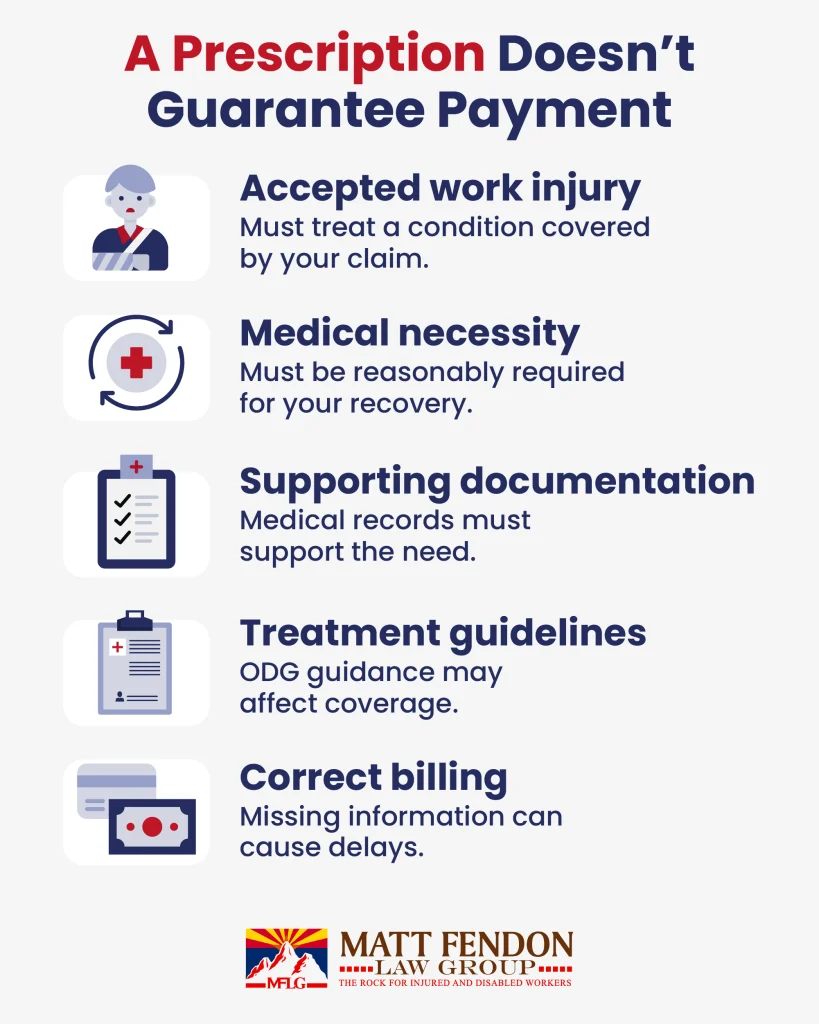
Although this process seems straightforward, issues can arise with workers’ compensation insurance carriers regarding payment for your prescription medications. Issues can arise about acceptance of your workers’ compensation claim, whether a medication is reasonably necessary for your treatment, pharmacy billing information, treatment guidelines, and more.
How Matt Fendon Law Group Can Help You in a Workers’ Compensation Prescription Medication Dispute
Matt Fendon Law Group attorneys focus on Arizona workers’ compensation law matters. When you hire a member of our legal team for help with your workers’ compensation claim, including prescription medication disputes with insurance companies, you can be confident that you will have an attorney who is highly experienced with applicable workers’ compensation laws, court decisions, Industrial Commission of Arizona (ICA) procedures, and settlement negotiations.
Our leading attorney, Matt Fendon, has assisted clients with workers’ compensation matters for almost 20 years and is a certified specialist in workers’ compensation through the State Bar of Arizona.
You can call us at any time, any day, at (800) 229-3880 to speak with a workers’ compensation specialist and to set up a free initial consultation, or use our online contact form.
Arizona’s Standards for Workers’ Compensation Prescription Coverage
Arizona Revised Statutes (ARS) Section 23-1062(A) requires that an injured employee receive medical treatment, nursing, medicine, supplies, and related benefits reasonably required at the time of the injury or occupational disease and during the period of disability. The ICA pharmaceutical schedule applies this legal standard to prescription and OTC medications.
Arizona uses the Official Disability Guidelines, or ODG, as its evidence-based treatment reference. The ODG Drug Formulary labels drug classes as either preferred (first-line) or not recommended as first-line treatments.
A not-recommended designation does not mean that the drug can never be covered by workers’ compensation. It means the prescriber should explain why the medication is appropriate and medically necessary for the patient, such as by addressing prior medication trials, contraindications, treatment responses, or the reason a preferred alternative is unsuitable.
- Compounded drugs receive additional scrutiny. The pharmacy bill must identify each reimbursable ingredient and its National Drug Code.
- Only an FDA-approved topical compound ingredient is reimbursable under the current schedule. Arizona caps reimbursement for a topical compound at the lesser of the calculated amount or $240 for a 30-day supply (per the current ICA Pharmaceutical Fee Schedule; caps may change in future updates).
Claim Acceptance and Prescription Coverage
Before Your Claim is Accepted
Under ARS 23-1061(M), carriers generally have 21 days to accept or deny a claim. During this period, a pharmacist may be unwilling to release a medication without a first-fill card, payment authorization, or another source of payment.
A temporary first fill does not necessarily mean that the entire claim has been accepted. Likewise, a pharmacy rejection during the 21-day investigation period does not by itself decide whether the injury or medication is legally compensable.
After Your Claim is Accepted
The ICA identifies prescriptions as a payable medical expense on accepted medical-only claims. An accepted medical-only claim can cover your prescription costs even if you did not miss enough work to receive temporary disability payments.
Once an accepted claim covers your treatment, you are not responsible for a health care provider’s medical bill or for a payment dispute between the provider and the insurance company.
An insurance carrier may dispute a particular prescription if it believes the drug treats an unrelated condition, is not medically necessary, falls outside supported treatment guidelines or lacks adequate documentation.
Treatment for a condition outside the accepted industrial injury may be denied, even if other benefits on the claim remain open.
After Your Claim is Closed
If your claim has been closed, then continued medication may need to be included in an award or notice for supportive medical maintenance benefits. If a new, additional, or previously undiscovered industrial condition later appears, then reopening may be necessary.
Arizona allows a previously accepted claim to be reopened with medical support, but a full and final settlement can waive future reopening rights.
How Workers’ Compensation Prescriptions Are Billed
Workers’ compensation pharmacy billing is different from ordinary health insurance billing. The pharmacy normally submits your prescription to the workers’ compensation insurer, self-insured employer, or its pharmacy benefit manager rather than charging a conventional health-plan copay.
When you are at the pharmacy, it helps to have:
- Your employer’s name
- The date of your injury
- The insurance company and adjuster information
- ICA and insurer claim numbers, if available
- The insurance carrier’s pharmacy card or first-fill form
- Pharmacy benefit manager help-desk information
- The prescription and the prescriber’s contact information
A point-of-sale rejection may simply mean that your claim has not been loaded into the pharmacy benefit management system, that the pharmacy used the wrong billing route, that your claim number does not match, or that further approval is needed.
First-Fill Prescriptions
Many employers and carriers provide a temporary first-fill card or form for a new injury. These programs are meant to let a participating pharmacy dispense a limited initial supply before your full claim has been established in the insurer’s system.
When you are receiving an initial prescription, ask your employer or the adjuster for:
- The first-fill form or electronic pharmacy card
- The pharmacy benefit manager’s name and the pharmacy help-desk number
- A participating pharmacy location
- Any limits on drugs, quantity, or days supplied
Does Arizona Require Prior Authorization for Prescription Drugs?
Arizona’s rules state that it is not necessary to obtain pre-authorization to ensure payment for reasonably required treatment, including medications. Still, a medical provider may request preauthorization to obtain a payment commitment and avoid the risk of a later medical-necessity denial.
Pharmacies also frequently seek authorization through a pharmacy benefit manager before releasing a prescription.
For a complete request, the insurance company generally must respond within seven business days by approving, partially approving, denying, identifying missing information, or notifying the health care provider that an independent medical examination has been requested.
A timely independent medical examination (IME) request pauses this decision period. The insurance company must issue its decision within seven business days after receiving the final IME report. A denial of a medical necessity claim must include supporting reasons and must be sent to you or your attorney.
Why a Prescription May Be Rejected or Denied
The table below summarizes some of the common reasons why your prescription medication may be delayed or denied.
| Issue | What it may mean |
|---|---|
| Your claim is not accepted, or claim data is missing | The insurance company or pharmacy benefit manager cannot yet verify compensability, eligibility, or the correct billing route. |
| The prescribed medication addresses an unaccepted condition | The insurance carrier disputes whether the drug is causally related to your industrial injury or occupational disease. |
| Insufficient medical-necessity documentation | The request may lack office notes, diagnosis, prior treatment history, dosage rationale, or an explanation supporting departure from the ODG. |
| ODG drug is not first-line. | The medication requires medical substantiation. |
| A brand-name drug is requested when a generic is available | The prescriber may need to document that substitution is not intended or medically appropriate. |
| Compound or repackaged-drug billing problem | The bill may omit required ingredients or original-manufacturer information or include a non-reimbursable component. |
| Unauthorized change of treating doctor | Once your attending doctor has been selected, Arizona generally requires approval from the attending doctor, insurance carrier, or the ICA before changing providers. |
| Your claim is closed without supportive medication | The insurer may contend that your active treatment has ended and no continuing supportive-care medication has been awarded. |
A Prescription is Not Automatically Covered Because a Doctor Wrote It
Even though you have a prescription for your medication, the workers’ compensation insurer may still examine whether:
- The medication treats an accepted body part, diagnosis, or occupational disease
- The drug is reasonably required for your condition
- The prescription came from a properly licensed provider acting within the provider’s authority
- The dose, duration, and formulation are medically supported
- A less costly generic equivalent is appropriate
- The pharmacy or health care provider submitted sufficient billing and medical information
Arizona generally requires generic substitution when appropriate. If a prescriber believes the brand-name drug is medically necessary, the prescription should clearly state “dispense as written,” “do not substitute,” “medically necessary,” or similar language indicating that substitution is not intended.
What to Do When Your Prescription Is Denied or Delayed
Here are some steps you can take to help resolve the situation when your employer’s insurer challenges your prescribed medication:
- Get the exact reason. Ask the pharmacy for the rejection message or code and ask whether it contacted the pharmacy benefit manager help desk. Request the carrier’s written denial if the issue involves medical necessity rather than billing data.
- Confirm the claim information. Verify the insurance carrier, adjuster, claim number, accepted body part, and pharmacy processor. A counter-rejection caused by mismatched information may be corrected without a legal hearing.
- Involve the prescriber. Ask the treating provider to submit the Arizona MRO-1.1 form with relevant office notes, diagnosis, dosage, prior medication trials, treatment response, and an explanation of why the requested drug is reasonably required.
- Request reconsideration when appropriate. You or a health care provider can use Section III of the MRO-1.1 form. If the insurance company does not respond within seven business days or denies treatment supported by the ODG, then you or the provider may be able to bypass reconsideration and request ICA administrative peer review.
- Use the correct ICA dispute process. If an IME supports the denial, then administrative peer review is unavailable, and you may request an investigation under ARS 23-1061(J). If the insurance carrier issued a formal Notice of Claim Status denying your entire claim, then you generally have 90 days to request a hearing instead.
- Consider a bad-faith complaint when delay is unreasonable. Arizona identifies unreasonable delay in payment, authorization, or receipt of medical treatment as potential bad faith. The ICA may investigate a signed complaint and, if bad faith or unfair processing is proven, may award statutory penalties. A bad-faith complaint does not replace a hearing request or extend a protest deadline.
You should also speak with your prescriber before changing or discontinuing a medication. Arizona’s guidance cautions against immediately stopping certain existing medication merely because it is not supported by the ODG, particularly when rehabilitation, detoxification, or medically supervised weaning is disputed.
Reimbursement When You Pay Out of Pocket
For treatment related to an accepted claim, you are not responsible for the provider’s medical bill or a billing dispute between the pharmacy and carrier. The ICA instructs workers who personally paid an accepted industrial medical expense to send their receipts to the carrier for reimbursement.
To reduce avoidable delay, you should submit:
- The itemized pharmacy receipt and proof of payment
- Prescription label showing drug, dosage, quantity, and fill date
- Prescriber information
- Claim number and date of injury
- A short, written reimbursement request
- Any authorization or medical-necessity documentation
Keep copies and proof of delivery. Arizona requires provider billings to contain accurate patient, claim, provider, coding, service date, and medical-report information, so incomplete documentation can slow review.
If your claim was initially denied but later accepted or found compensable, then reimbursement may still be possible. The current fee schedule covers medication dispensed by a provider or non-public pharmacy between an initial denial and later acceptance when you timely protested the denial and the other schedule requirements are met.
Future Medication Costs and Settlement Decisions
Full and final settlements of workers’ compensation claims are allowed in Arizona. Under this settlement arrangement, you may waive entitlement to future workers’ compensation benefits and your right to reopen your claim.
Prescription coverage deserves careful attention before you enter a full and final settlement. The settlement must identify any contemplated medical conditions, disclose reasonably anticipated future medical care and projected costs, and disclose how much of the settlement represents future medical benefits.
Before settling your future medical rights, consider:
- Your current medications, doses, and refill frequency
- The expected duration of your treatment
- Brand-versus-generic assumptions
- Medication monitoring and prescriber visits
- Potential future drugs or treatment changes supported by your medical record
- Non-Medicare-covered medication expenses
- Whether supportive care or some medical benefits will remain open
- Who will bear the risk if your prescription prices exceed the projection
Arizona’s required disclosures do not guarantee that projected costs will equal actual lifetime expenses. Once your future medical rights are closed, you may become responsible for medication costs addressed by the settlement.
Medicare adds another layer to consider. Arizona requires settlement parties to consider and take reasonable steps to protect Medicare and other governmental payers.
The Centers for Medicare and Medicaid Services (CMS) describes a Workers’ Compensation Medicare Set-Aside Arrangement as funds allocated for future Medicare-covered treatment and prescriptions related to the work injury. These funds generally must be properly exhausted before Medicare pays related expenses.
CMS review is voluntary, but under CMS guidelines, reviews can be done on qualifying proposals involving a Medicare beneficiary with a settlement of more than $25,000 or a worker reasonably expected to enroll within 30 months when the anticipated total settlement exceeds $250,000.
Because long-term prescriptions can represent a significant part of your future medical exposure, you should not evaluate a settlement solely by its immediate lump-sum amount. An experienced workers’ compensation attorney, like one of ours at Matt Fendon Law Group, can review your medical evidence, prescription history, projected pricing, supportive-care language, and Medicare implications before your future rights are released.
Talk With a Matt Fendon Law Group Workers’ Compensation Attorney About Your Prescription Medications
Prescription disputes can involve more than a declined pharmacy transaction. The real issue may be claim acceptance, an excluded diagnosis, inadequate medical documentation, ODG criteria, an insurer’s review process, claim closure, or the proposed settlement of your future medical rights.
If an Arizona workers’ compensation insurance company is delaying, limiting, or denying your prescription medication, or if you are considering a settlement that may end your future prescription coverage, call Matt Fendon Law Group at (800) 229-3880.