Yes, workers’ compensation may cover time off work if you are unable to perform your job duties because of a work-related injury or illness.
In Arizona, injured workers may qualify for wage replacement benefits in addition to medical benefits, but the amount you receive and when payments begin depend on the circumstances of your claim.
If you have been injured on the job and are missing work, contact Matt Fendon Law Group.
Call (800) 229-3880 today for a free consultation with an experienced Scottsdale workers’ compensation attorney.
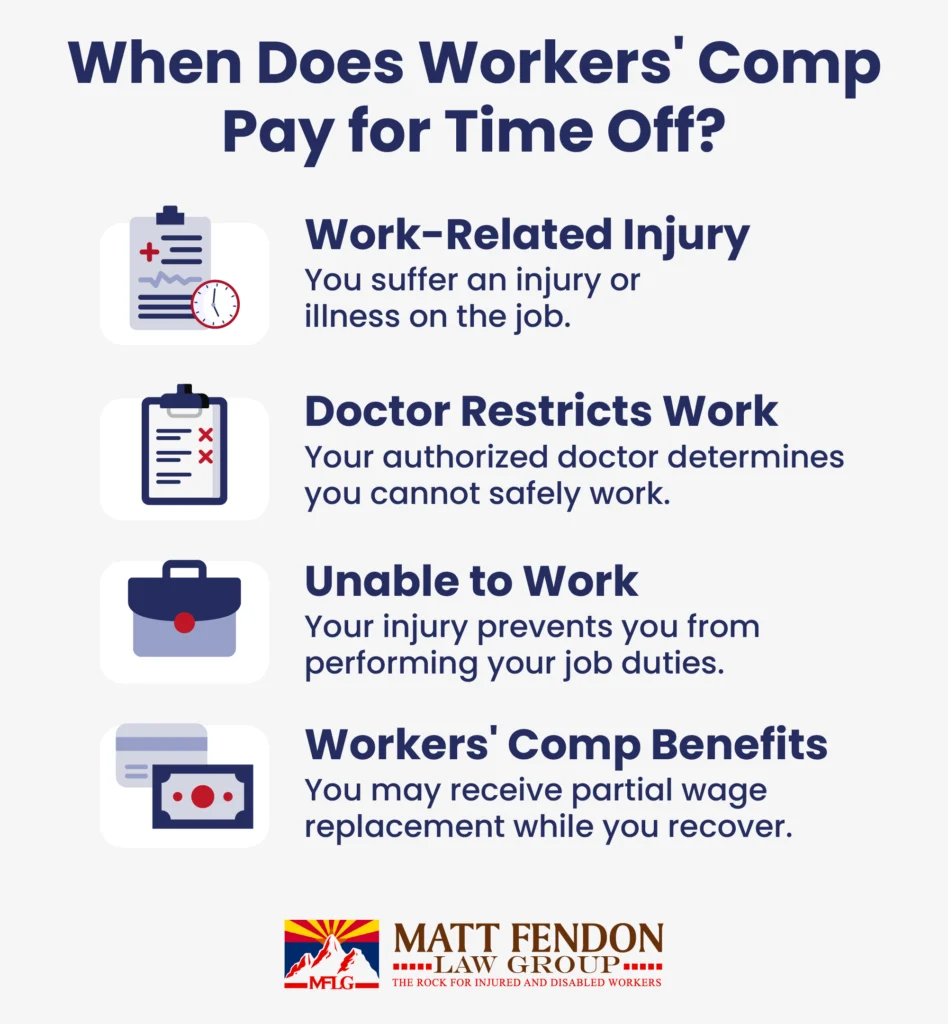
When Does Workers’ Compensation Pay for Time Off?
Whether workers’ compensation pays for time off depends on the severity of your injury and your doctor’s work restrictions.
If your authorized treating physician or attending physician determines that you cannot safely perform your job, you may qualify for temporary disability benefits.
Common examples include:
- Recovering from surgery
- Serious back injuries
- Broken bones
- Head injuries
- Severe burns
- Repetitive stress injuries
- A work-related illness requiring extended treatment
The medical evidence in your workers’ compensation claim will determine whether time off work is medically necessary.
What Is the Seven-Day Waiting Period?
Arizona workers’ compensation includes a seven-day waiting period before wage replacement benefits begin.
This waiting period applies only to wage-replacement benefits, not to medical care. Your medical benefits are covered from the day of your injury, regardless of how much time you miss from work.
If your disability lasts more than seven days, you may become eligible for temporary disability benefits. If your disability lasts more than 14 days, those first seven days become payable too — benefits are paid retroactively to your first day out of work.
Because the rules can become complicated, injured workers should discuss their specific situation with a workers’ compensation attorney.
How Much Will Workers’ Compensation Pay?
Temporary disability benefits are generally based on your average monthly wage.
Arizona workers’ compensation typically pays approximately two-thirds of your average monthly wage, subject to the state’s maximum compensation rate and maximum monthly benefit established by law.
The exact compensation rate depends on several factors, including:
- Your average monthly wage
- The date of your injury
- Current statutory maximums
- Your work restrictions
An experienced workers’ comp attorney can help determine whether your monthly compensation payments have been calculated correctly.
Does Workers’ Compensation Pay for Pain and Suffering?
No.
Arizona workers’ compensation does not pay for pain and suffering. Workers’ comp is a no-fault system that provides medical benefits and wage replacement. Still, it does not compensate for the physical pain or emotional distress caused by a work-related injury.
In some cases, if a third party contributed to your injury, you may be able to pursue a separate personal injury claim that includes pain and suffering. An experienced workers’ compensation attorney can review your situation and explain your options.
Temporary Total Disability
Temporary total disability benefits are available when an injured worker is completely unable to work during recovery.
If your doctor determines you cannot perform any work while recovering from your work-related injury, you may qualify for temporary total disability benefits until your condition improves or you reach maximum medical improvement (MMI).
Temporary Partial Disability
Not every injured worker is completely unable to work.
If your physician releases you to light-duty work or modified duty, but you earn less than before your injury, you may qualify for temporary partial disability benefits.
Temporary partial disability helps compensate workers for the difference between their pre-injury earnings and their reduced wages during recovery.
What Happens at Maximum Medical Improvement?
Eventually, many injured workers reach maximum medical improvement (MMI).
MMI means that you are at a point in your medical care where you are not getting any better and are not getting any worse, and additional medical treatment is not expected to improve your condition.
After reaching MMI, your doctor may determine whether you have a permanent disability.
Depending on your condition, you may qualify for:
- Permanent partial disability
- Permanent total disability
These disability benefits are evaluated differently from temporary disability benefits.
Does Workers’ Compensation Pay for Doctor Visits?
Workers’ compensation generally covers necessary medical treatment related to your work-related injury.
Medical benefits may include:
- Doctor visits
- Surgery
- Hospital care
- Physical therapy
- Prescription medication
- Diagnostic testing
- Medical expenses related to your injury
Treatment generally must comply with Arizona workers’ compensation requirements and applicable provider rules.
Does Workers’ Compensation Pay for Time Off for Physical Therapy?
It depends.
If physical therapy appointments require you to miss work because they are medically necessary and related to your workers’ comp claim, you may qualify for wage replacement benefits depending on your work restrictions and your overall disability status.
Missing work for isolated appointments does not automatically result in separate compensation. Whether workers’ comp pays for time off for physical therapy depends on your medical restrictions and the facts of your claim.
Does Workers’ Compensation Pay for Time Off for Doctors’ Appointments?
Similarly, workers’ comp does not automatically provide separate wage replacement simply because you attend doctor visits.
However, if your work restrictions prevent you from working or your treatment is part of an approved workers’ compensation claim, those appointments may affect your eligibility for disability benefits.
An experienced workers’ compensation attorney can explain how these rules apply in your situation.
Does Paid Time Off or Sick Leave Affect Workers’ Compensation?
Workers’ compensation benefits are separate from paid time off and sick leave provided by your employer.
Some employers allow employees to use paid time off while a workers’ compensation claim is pending, while others do not.
The interaction between workers’ compensation, sick leave, and employer leave policies depends on your workplace policies and the facts of your claim.
What Should You Do After a Work Injury?
To protect your workers’ rights, you should:
- Report the injury immediately.
- Notify your employer as soon as possible.
- Seek appropriate medical treatment.
- Follow your doctor’s restrictions.
- File a claim promptly.
- Keep records of missed work, medical treatment, and expenses.
Following these steps can help strengthen your workers’ compensation claim.
What if Your Claim Is Denied?
A claim denied by the insurance company does not necessarily mean you are not entitled to benefits.
A denied claim may involve disputes over:
- Whether the injury happened at work
- Whether medical treatment was necessary
- Whether you are unable to work
- The amount of disability benefits owed
Arizona workers have the right to challenge denied claims through the Industrial Commission of Arizona (ICA).
How a Workers’ Compensation Attorney Can Help
An experienced workers’ comp lawyer can help you:
- File a workers’ comp claim
- Calculate your average monthly wage
- Challenge incorrect compensation rates
- Appeal a claim denied by the insurance carrier
- Protect your workers’ rights
- Pursue all available workers’ compensation benefits
- Evaluate a workers’ comp settlement when appropriate
Legal guidance can be especially valuable when disputes arise regarding disability benefits, medical treatment, or your ability to return to work.
Contact Matt Fendon Law Group
If you are missing time off work because of a work-related injury or work-related illness, you may be entitled to workers’ compensation benefits that replace a portion of your lost wages while covering your medical care. Understanding your rights under Arizona workers’ compensation law can make a significant difference in the outcome of your claim.
Matt Fendon Law Group helps injured workers throughout Arizona pursue the full workers’ compensation benefits they deserve.
Call (800) 229-3880 today for a free consultation with an experienced Scottsdale workers’ compensation attorney.